







Choosing the right supply chain consultant in Australia comes down to three things: clarity on your own problem, understanding which type of firm suits your situation, and knowing how to look past a polished proposal to the delivery model underneath. This guide walks through each of those in plain language.
Why Most Organisations Get This Decision Wrong
Most organisations only go looking for a supply chain consultant when something has already gone wrong, or when the scale of a problem has grown beyond what the internal team can absorb. By that point, there is usually pressure to move quickly, and that pressure is exactly when poor selection decisions get made.
Choosing the wrong consultant is expensive in ways that take months to fully surface. The engagement delivers a report that doesn't get implemented. The team assigned to your account is junior despite the partner who sold the work. The recommendations are theoretically sound but practically unworkable in your operating environment. You spend twelve weeks and a substantial fee arriving at conclusions your team largely already knew.
The Australian supply chain consulting market is genuinely competitive and genuinely varied. There are global firms, Big 4 practices, specialist boutiques, technology-led advisory businesses, and individual practitioners all operating across the same landscape. Navigating that market well is a skill in itself, and most procurement and operations leaders only do it a handful of times across their careers.
This guide is designed to make that process clearer, to give you a framework for evaluating options that goes beyond proposal aesthetics and reference lists, and to help you ask the questions that actually differentiate good consultants from expensive ones.
What Problem Are You Actually Trying to Solve?
This sounds obvious, but most organisations go to market for supply chain consulting with a problem statement that is either too broad or too narrowly defined. Both create issues.
Too broad: "We need to improve our supply chain" is not a brief. It will attract every consultant in the market, produce wildly varied proposals that are impossible to compare meaningfully, and typically result in an engagement scoped around whatever the consultant's preferred service line happens to be.
Too narrow: "We need to reduce our freight costs by 15%" may be technically precise, but it can lock you into a tactical engagement when the actual root cause of high freight costs is an inventory positioning problem, a supplier concentration issue, or a forecasting failure. None of which a freight-only brief will uncover.
The most useful problem statements sit in the middle. They name the business outcome you need to achieve, the timeframe you're working within, the constraints that are non-negotiable, and an honest account of what your organisation has already tried. A good consultant will help you sharpen this brief in the early stages of an engagement. A less experienced one will simply respond to whatever you put in the RFP.
Before going to market, spend time internally aligning on what success actually looks like. Not just the technical output, but the organisational outcome. What decisions will this engagement enable? What will be different in your operation twelve months after the work is complete? Clarity on those questions will dramatically improve both the quality of the proposals you receive and your ability to evaluate them.
What Are the Different Types of Supply Chain Consulting Firms in Australia?
The Australian supply chain consulting landscape broadly divides into four categories. The right answer depends heavily on which one aligns with your situation.
The Big 4 and major global firms offer broad capability, deep sector research and significant brand credibility. They are often the right choice for very large, complex transformation programmes where the scale requires a large team, there is an international dimension, or where board and investor confidence in the adviser is itself part of the brief. The trade-off is real: the partner who wins the work is rarely the person who delivers it. In most large-firm engagements, the day-to-day work is done by consultants who are talented but often early in their careers, supervised by managers and directors who are managing multiple accounts simultaneously. If you are paying for senior expertise, make sure you understand exactly who will be in the room on any given week.
Global specialist supply chain firms bring deeper functional expertise than a Big 4 generalist practice, typically with practitioners who have spent their careers in supply chain and logistics rather than rotating through different practice areas. They tend to be stronger on implementation-level rigour and operational detail, and weaker on board-level narrative or cross-functional transformation work that requires a broader consulting toolkit.
Boutique advisory firms, typically between ten and thirty people, operate a fundamentally different model. They tend to be partner-led and senior-heavy, which means the people you meet in the sales process are largely the people who will do the work. They are usually faster to mobilise, more flexible on scope, and more willing to take a performance-linked or outcomes-based fee structure because they have direct control over delivery quality. The constraint is capacity: a boutique firm cannot staff a programme that simultaneously needs forty consultants across three workstreams.
Individual practitioners and small shops of two to three people can be extraordinarily good value for tightly scoped, well-defined pieces of work: a specific category review, a network modelling exercise, a supplier negotiation. But they are exposed on bandwidth, governance, and the risk that a single person getting sick or leaving creates a serious delivery problem.
There is no universally right answer. The right answer depends on your problem, your organisation's appetite for different risk profiles, and your preferences around how you want the working relationship to feel. Go into the process with a clear view on which type of firm you're looking for, because trying to compare them in a single competitive process rarely produces a useful outcome.
Who Will Actually Do the Work?
Regardless of which type of firm you engage, the single most important question in any supply chain consulting selection process is: who will actually be doing the work?
It is entirely standard practice in larger consulting firms to present a proposal team that includes one or two highly experienced partners or directors alongside junior team members who will carry the bulk of the analytical and delivery work. There is nothing inherently wrong with this model. Junior consultants supervised well can do excellent work. But you need to understand the ratio, the supervision model, and the extent to which the senior people named in the proposal will actually be present throughout the engagement versus attending kick-off meetings and executive check-ins only.
Ask these questions directly and on the record:
- Who will be the day-to-day lead on this engagement?
- What percentage of their time will be allocated to our project?
- Who else will be on the team, what is their experience level, and what is their previous experience in our sector specifically?
- If there is a partner or director on the proposal, how many other active engagements are they currently leading?
If a firm is evasive or vague on these questions, that is informative. Good firms are proud of the people they are deploying and happy to be specific. A firm that answers with "we will assemble the best team for your needs" without naming anyone is signalling that the team has not yet been decided, often because the engagement has not yet been won and resource allocation happens after signing.
Does Sector Experience Actually Matter?
Yes, more than most organisations realise.
Supply chain consulting is not a single discipline. The operational realities of a retailer managing thousands of SKUs across a national distribution network are genuinely different from those of a hospitality group managing back-of-house logistics across multiple food and beverage outlets, which are genuinely different from those of a government agency managing a complex procurement function under legislative constraints.
A consultant who has spent their career in FMCG distribution will bring deep expertise in demand planning, inventory optimisation and fill-rate performance, and may have limited intuition for the dynamics of a service-heavy, labour-intensive operating environment like a hotel or casino. The reverse is equally true.
When evaluating sector experience, look past the client list on the proposal and into the specific nature of the work that was done. A reference that says "worked with a major hospitality group" could mean anything from designing an entire back-of-house operating model to running a benchmarking exercise on cleaning product spend. The level of specificity in how a firm describes its prior work tells you a great deal about how genuinely embedded that experience is.
The most useful sector question to ask in the briefing process is: can you describe a specific engagement in our sector where the work did not go as planned, and what did you do about it?
A firm that can answer it honestly and with genuine reflection is demonstrating the kind of maturity that correlates with good engagement management. A firm that answers with "all of our engagements have been successful" is telling you something different.
How Do You Read a Consulting Proposal Properly?
A proposal is a sales document first and a work plan second. What you are trying to extract is evidence of genuine thinking about your specific situation, not the application of a standard methodology template with your company name inserted at appropriate intervals.
The diagnostic section is where you learn the most. Has the firm done genuine pre-work to understand your operating context, your competitive environment, and the specific dynamics of your business? Or is the problem framing generic enough that it could apply to any organisation in your sector?
The methodology section should be specific enough to give you a real sense of how the work will unfold, but not so granular that it locks the engagement into a rigid process before the team has actually started. The best consulting methodologies are structured but adaptive.
The commercials section requires careful reading against scope. Low fee proposals that contain broad exclusions, assumptions about client-side resource commitment, or fee escalation triggers for additional workstreams can cost significantly more than a higher-quoted proposal with a cleaner scope. Make sure you are comparing like-for-like deliverables, not just total fees.
References should always be followed up. The useful questions are: did the engagement deliver what it promised? Did the team that was presented stay on the project? Were there scope or cost changes during the engagement, and how were they handled? Would you engage the firm again, and if not, why not?
What Are the Red Flags Worth Taking Seriously?
Some of what you observe in the selection process is genuinely predictive of how an engagement will unfold.
A firm that positions itself as having all the answers before it has done any diagnostic work is a concern. Genuine expertise comes with intellectual humility: the recognition that every operating environment has nuances that are not visible from the outside and that assumptions made before the work starts are frequently wrong. Over-confidence at the proposal stage tends to manifest as rigidity during delivery.
A firm that is unwilling to put any element of its fee at risk against outcomes is worth noting. Not every engagement is structured around measurable financial outcomes. But in engagements where savings or service improvement targets are central to the brief, a firm that refuses any form of outcomes linkage is implicitly communicating something about its confidence in its own recommendations.
A firm that cannot clearly articulate the return on investment from comparable previous engagements is equally worth scrutinising. The best supply chain consultants track their outcomes carefully because those outcomes are their most compelling commercial proof point. A firm that responds to the ROI question with vague references to "significant value creation" rather than specific numbers has not built a culture of accountability.
Finally, watch for firms that push toward large, multi-year transformation programmes when your brief is more contained. The appropriate first step in most supply chain engagements is a focused diagnostic that builds enough understanding of the environment to design the right intervention, not a twelve-month programme proposal that assumes the right intervention before any diagnostic work has been done.
What Return Should You Expect From Supply Chain Consulting?
Supply chain consulting in Australia should deliver a demonstrable return. For procurement and sourcing work, a well-executed engagement typically returns somewhere between eight and fifteen times its fee in identified savings or cost avoidance over a twelve-month period, depending on the scale and nature of the spend being addressed. For operations and logistics work, the return profile varies more widely depending on scope. Network redesigns and technology implementations have longer payback horizons than targeted efficiency or inventory programmes.
It is entirely reasonable to ask any prospective consultant for their evidence base on returns from comparable engagements, and to build outcome expectations into the engagement brief. The best firms welcome this conversation because they are confident in their track record.
This does not mean every engagement should be fee-contingent. That model introduces its own distortions and is not appropriate for all types of work. But both parties should have a clear and shared understanding of what financial or operational outcomes the engagement is designed to deliver, and there should be a mechanism for reviewing progress against those outcomes during the engagement rather than only at the end.
How Trace Consultants Can Help
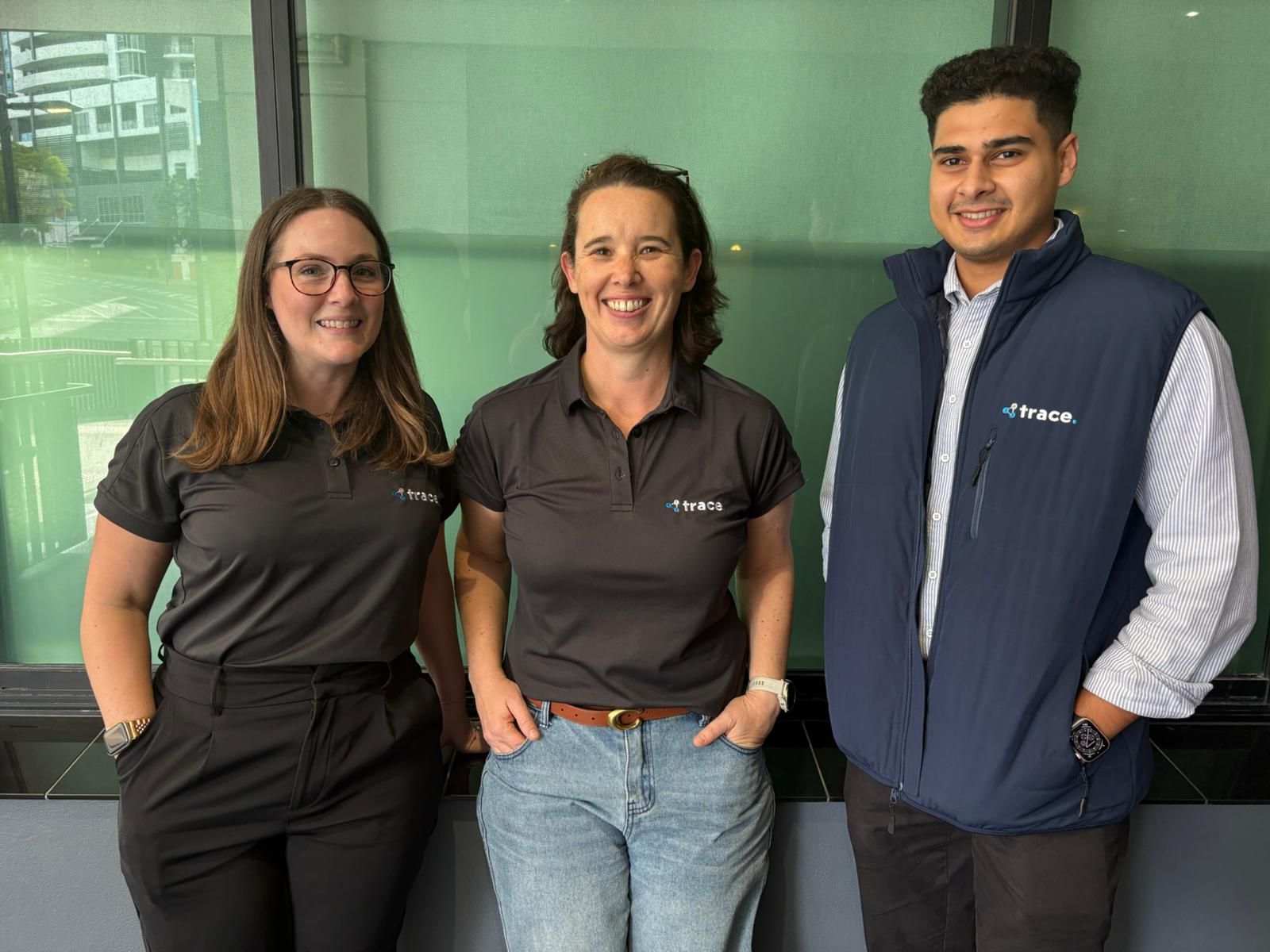
Trace is a boutique supply chain and procurement advisory firm with offices in Sydney, Melbourne, Brisbane and Canberra. Our model is deliberately senior-led: the partners and directors who design your engagement are the people delivering it, not supervising a graduate team from a distance. That distinction has a material effect on the quality of thinking that goes into the work and the pace at which we can move.
Our work spans:
- Supply chain strategy and network design. We work with Australian organisations to design supply chain networks, operating models and sourcing strategies that reflect the real constraints and opportunities of your business. Explore our strategy and network design services.
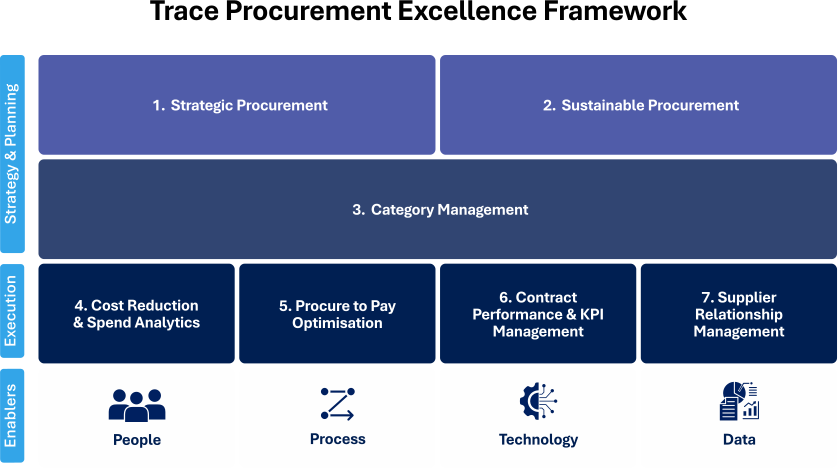
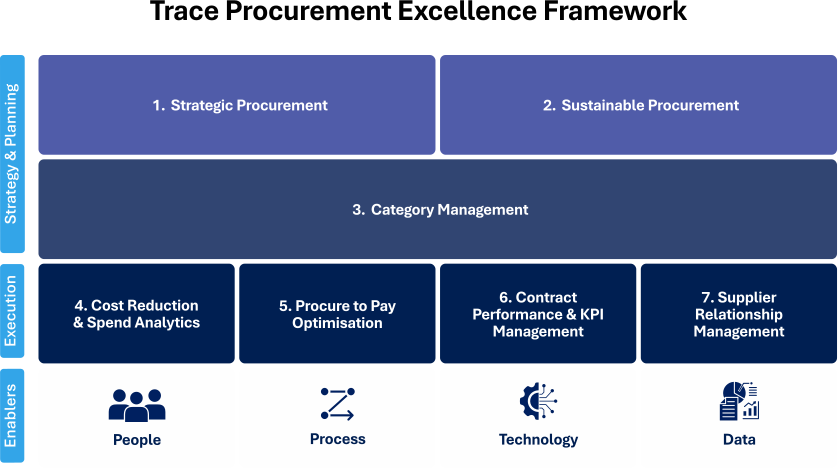
- Procurement advisory and category management. Our procurement practice covers category strategy and supplier rationalisation through to contract design, sourcing execution and procurement operating model design. We work across direct and indirect spend, and across both private sector and government procurement environments. Explore our procurement services.
- Resilience and risk management. We help organisations build resilience frameworks that are operationally grounded, not just governance documents. Explore our resilience and risk management services.
- Sector depth across the industries that matter. Our team has deep experience across property, hospitality and services, FMCG and manufacturing, retail, health and aged care, and government and defence.
Explore all our services or speak to an expert at Trace.
Frequently Asked Questions
How much does supply chain consulting cost in Australia?
Fees vary by firm type, team seniority, and engagement scope. Boutique specialists typically range from $2,000 to $3,800 per day. A focused procurement category review might cost $40,000 to $80,000 over four to six weeks. A broader supply chain strategy engagement across multiple sites might run $200,000 to $500,000 over three to six months. The more useful question is what the engagement will return. Well-executed supply chain and procurement work typically delivers benefits of five to fifteen times the consulting fee.
How is a boutique supply chain consultant different from a Big 4 firm?
The primary difference is the delivery model. Boutique firms tend to be senior-heavy and partner-led, meaning the people you meet during the pitch are largely the people who will do the work. Big 4 and large global firms offer broader capability and larger teams, but the day-to-day delivery is often carried by more junior staff supervised at a distance. Neither model is universally better. The right choice depends on the scale and nature of your engagement.
How do I know if a supply chain consultant has genuine sector experience?
Look past the client list and ask about the specific nature of prior work. Ask directly for an example of an engagement in your sector that did not go as planned, and how it was handled. The depth and honesty of that answer is more informative than any reference list.
What should a supply chain consulting engagement actually deliver?
At minimum: a clear diagnosis of root causes, practical recommendations that account for your operating constraints, an implementable roadmap with sequenced priorities, and a mechanism for tracking outcomes. A good engagement should leave your team more capable, not more dependent.
When is the right time to bring in a supply chain consultant?
The most common trigger is when a problem has grown beyond what the internal team can absorb, or when a significant decision needs independent analytical rigour. The most effective time is slightly earlier than that: before pressure builds and before the organisation has already committed to a direction.
Where to start: if you are in the early stages of deciding whether to engage a supply chain consultant, the most useful thing you can do before going to market is write a clear problem statement. Not for the market, but for yourself and your leadership team. What are you trying to fix? What would a successful outcome look like twelve months from now? What have you already tried? What constraints are genuinely non-negotiable?
That clarity will not only help you brief the market better. It will help you recognise the difference between a consultant who is responding genuinely to your situation and one who is simply responding to the commercial opportunity.