


A distribution centre is one of the most capital-intensive and operationally consequential investments a supply chain organisation makes. Get the design right and you have a facility that runs efficiently for 10–15 years, absorbs volume growth without constant disruption, and gives the operation genuine competitive advantage. Get it wrong — and wrong usually means locked-in at the briefing phase, before anyone has started drawing — and you spend the life of the lease working around structural constraints that cost you money every single day.
This article is a practical guide to the DC design process: how to define the brief, how to size the facility, how to make the layout decisions that determine operational performance, how to select the right storage and materials handling systems, and how to manage the design project to avoid the mistakes that consistently derail Australian DC projects.
It is written for supply chain leaders, operations directors, CFOs, and project teams who are facing a new DC build or fit-out decision and want to understand what good looks like — and where the traps are.
Why DC Design Gets Expensive When It Goes Wrong
The consequences of a poorly designed distribution centre are not immediately visible. They accumulate. A receiving dock that is two positions short of what the throughput requires forces operations to manage daily inbound queues. A pick face that was sized for current SKU counts and cannot expand without a racking reconfiguration becomes a constraint within three years of opening. A floor-level mezzanine installed to accommodate manual picking that is later incompatible with the goods-to-person automation the business wants to deploy creates a retrofit problem at seven figures.
None of these are technology failures. They are design failures — specifically, failures to adequately define requirements before the design work began. The brief drives everything. A weak brief produces a facility designed to the wrong parameters, and the cost of correcting that inside a 10-year lease is enormous.
The starting point for any DC design project is therefore not AutoCAD. It is a rigorous requirements definition process that establishes what the facility needs to do — not just today, but across the full lease horizon.
Stage 1: Defining the Brief — The Most Important Document You Will Produce
The design brief is the document that defines what the distribution centre must achieve. Every subsequent design decision — size, layout, storage systems, automation, dock configuration — is derived from the brief. Errors in the brief produce errors in the design that cannot be corrected without starting again.
A complete DC design brief covers the following dimensions:
Throughput requirements. What volumes does the facility need to handle — inbound receipts, outbound despatches, and the peak-to-average ratio that determines how the facility must be sized. Many Australian DCs are designed to average throughput and then struggle operationally during the peaks (promotional periods, seasonal demand, end-of-month retailer orders) that actually determine how the facility needs to function. Size for the operational peak, not the annual average.
Order profile. What does the outbound order look like — pallet orders, carton orders, unit picks, or a mix? The order profile is the single most important determinant of picking system design. A DC despatching 95% full pallet orders needs a completely different pick design from one despatching mixed-carton store replenishment or e-commerce unit picks. Getting this wrong — designing a pick operation for the wrong unit of measure — is one of the most common and costly DC design errors.
SKU profile. How many active SKUs does the facility hold? What is the velocity distribution — what proportion of SKUs are fast-moving (A-class), medium-moving (B-class), and slow-moving (C-class)? What are the physical characteristics — weight, dimensions, fragility, temperature requirements, hazardous materials classification? The SKU profile determines storage system selection, slotting strategy, and the pick face configuration.
Inventory holding requirement. How many days of stock does the facility need to hold? This determines the storage volume requirement — and therefore a significant component of the floor area calculation. Inventory holding requirements are frequently underestimated in DC briefs because the analysis is done at average inventory levels rather than at the maximum holding position the facility must accommodate.
Growth assumption. The facility will serve the business for the duration of the lease — typically 10–15 years for a purpose-built DC. The brief must include a credible view of volume growth over that period, with the design incorporating sufficient flexibility to accommodate that growth without a major reconfiguration. A facility designed for today's throughput with no expansion provision will be operationally constrained within three to five years.
Operating model. How will the facility be staffed and operated? What shift patterns? What degree of automation is being considered — now or in the future? Will the facility operate under a WMS, and if so, which one? The operating model directly affects the physical design: automation infrastructure requirements, power and data provisions, floor flatness specifications, and the spatial requirements for operational support areas.
Special requirements. Temperature-controlled storage (chilled, frozen, ambient-controlled), hazardous materials storage and handling, pharmaceutical serialisation and traceability requirements, bonded storage, returns processing areas, value-added services (pick-and-pack, kitting, labelling). Each of these has specific physical design implications that need to be captured in the brief before the design begins.
Stage 2: Sizing the Facility
With the brief defined, the facility can be sized. DC sizing is an engineering calculation, not an estimate — and the quality of the output depends entirely on the quality of the input data.
The sizing process works through three components:
Storage volume calculation. Convert the inventory holding requirement (in units or pallets) into a physical storage volume, accounting for the storage systems being used. Selective racking at 9–10 metres clear height yields a fundamentally different storage density from drive-in racking, narrow-aisle racking, or automated storage. The storage volume calculation also needs to account for the space occupied by aisles, which varies significantly by storage system — selective racking with standard forklifts requires aisle widths of 3.0–3.5 metres; very narrow aisle (VNA) racking with man-up trucks reduces this to 1.6–1.8 metres, increasing storage density by 30–40% at higher capital and operating cost.
Operational area calculation. The non-storage operational areas of the DC — inbound staging and receiving, outbound marshalling and despatch, pick faces, packing benches, value-added services, battery charging, maintenance, waste management, and staff amenities — typically represent 25–35% of total floor area in a well-designed facility. These areas are frequently undersized in initial design briefs because the focus is on storage, and the operational consequences of inadequate staging and marshalling space are only felt once the facility is running.
Dock calculation. The number of inbound and outbound dock doors required is determined by the peak hourly throughput of vehicles, the average turnaround time per dock, and the separation required between inbound and outbound operations. Dock underprovision is a structural constraint that cannot be easily remedied within an existing building — the number of dock positions should be calculated for the peak operational position over the lease horizon, not current average throughput.
The output is a total net internal area (NIA) requirement. To convert this to a gross internal area (GIA) or gross external area, add a structural factor (typically 3–8% for columns, walls, and plant rooms) and confirm against the clear internal height assumption.
In the current Australian industrial property market, where national vacancy rates edged upward through 2024 and into 2025 as new supply entered the market Trace consultants, there is more tenant negotiating leverage than has existed for several years — but lease economics still favour locking in a well-sized facility over signing a lease and then discovering the building is inadequate.
Stage 3: Layout Design — The Four Principles
With the size established, the internal layout can be designed. Four principles govern distribution centre layout, and the best DC designs achieve a well-balanced optimisation across all four simultaneously. Optimising for one at the expense of the others is a common design error.
Flow. Goods should move through the facility in a logical, unidirectional sequence — inbound, storage, pick, pack, despatch — with minimal backtracking and no cross-flow between inbound and outbound traffic streams. The three canonical layout configurations are the I-shape (receive at one end, despatch at the other — maximum separation, maximum hardstand requirement), the U-shape (receive and despatch on the same elevation — most common in Australian conditions, minimises hardstand), and the L-shape (receive and despatch on perpendicular elevations — suits irregular sites). The right choice depends on site geometry, relative volumes of inbound and outbound activity, and the separation requirements of the specific operation.
Accessibility. Every storage location needs to be accessible to the handling equipment used to service it, at the frequency required by the product's velocity. Fast-moving SKUs need pick faces that are immediately accessible, at the right height, without retrieval from depth storage. Slow-moving SKUs can be stored at height or in deep locations where access takes longer. Designing storage accessibility around velocity — putting fast movers closest to the pick despatch point, in the most accessible locations — is the slotting principle that has the greatest impact on pick productivity.
Space utilisation. The cubic volume of the building should be used as efficiently as the handling equipment and storage systems allow. Australian industrial property is expensive; unused cubic volume is wasted capital. The tension is between space utilisation and accessibility — very dense storage systems (drive-in racking, mobile racking, AS/RS) maximise cubic use but constrain access, while wide-aisle selective racking maximises accessibility at the cost of storage density. The right balance depends on the velocity profile: facilities with a high proportion of slow-moving, low-access-frequency SKUs can justify denser storage systems; facilities with high throughput and frequent access requirements need more accessible configurations.
Safety and throughput. The layout must provide clear separation between forklift and pedestrian traffic, adequate sight lines at intersections, sufficient aisle widths for the equipment in use, and compliance with Work Health and Safety legislation and the relevant Australian Standards. Safe design is not a constraint imposed on operational design — it is an integral part of it. Facilities that compromise safety in the pursuit of storage density or throughput create liability and operational disruption that far outweighs any efficiency gain.
Stage 4: Storage System Selection
Storage system selection is one of the most consequential technical decisions in DC design. The wrong system — one that is right for the product range in the brief but wrong for how the range evolves — becomes a stranded asset.
The main storage system options and their appropriate applications:
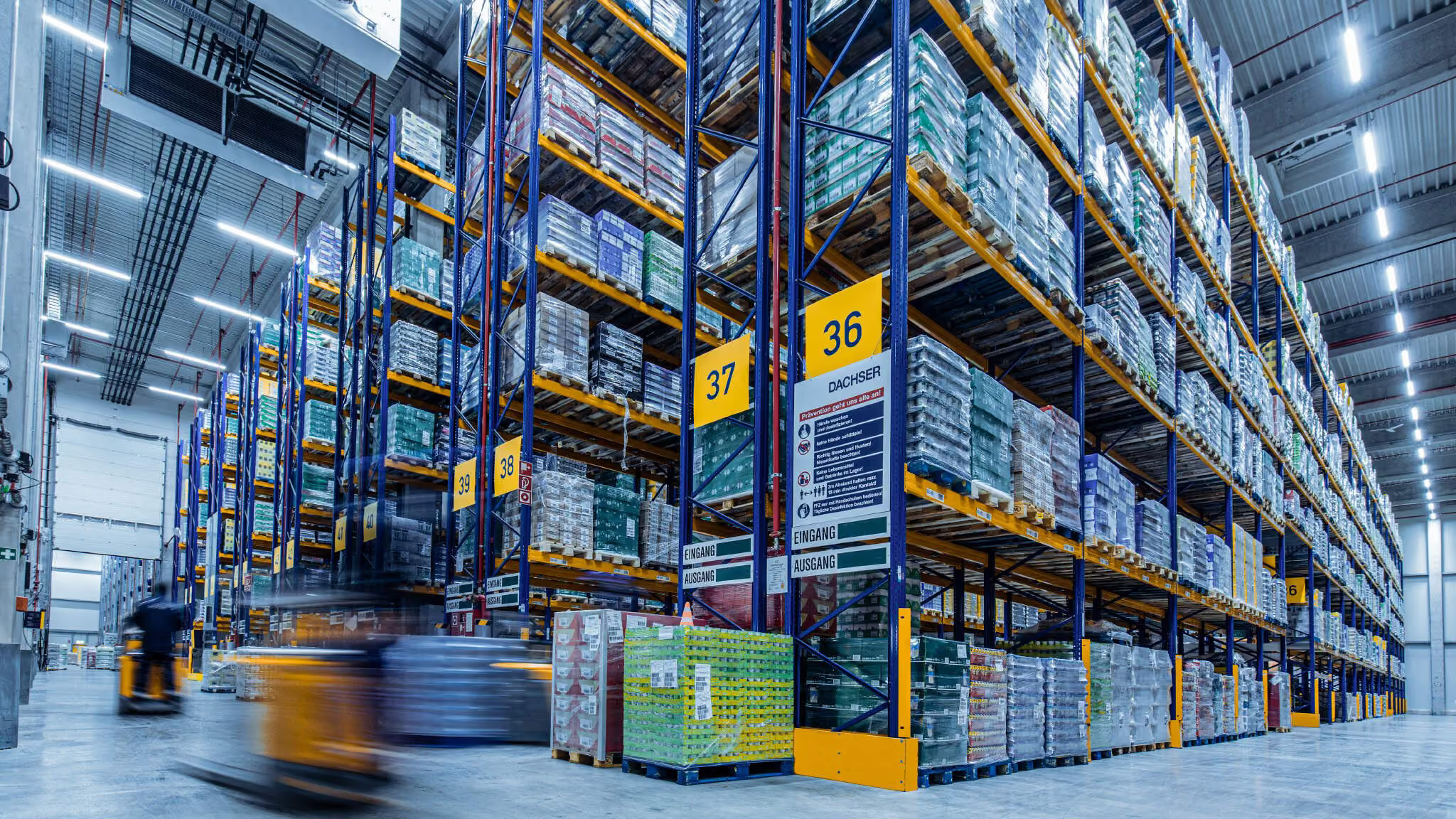
Selective pallet racking is the most common system in Australian DCs — every pallet position is directly accessible, the system is highly flexible (beam heights can be adjusted, configurations changed), and it suits wide velocity ranges. It is the right default choice for most general merchandise, FMCG, and retail distribution applications. Its limitation is space efficiency: because every pallet position requires its own aisle access, utilisation of the building footprint is lower than denser systems.
Drive-in and drive-through racking sacrifices individual pallet accessibility for density — forklifts drive into the racking structure to place and retrieve pallets in depth. It is appropriate for high-volume, low-SKU-count operations with limited product variability and where FIFO discipline is either not required or can be managed structurally (drive-through for FIFO, drive-in for LIFO). Common in cold storage (where maximising refrigerated volume is paramount) and beverage distribution.
Narrow-aisle and very narrow aisle (VNA) racking reduces aisle widths from the 3.0–3.5 metres required by counterbalance forklifts to 1.6–1.8 metres by using guided turret trucks or man-up order pickers. The density improvement is substantial — 30–40% more pallet positions on the same footprint — at the cost of specialist equipment, higher capital investment, and reduced operational flexibility. It suits operations where land cost is high and the investment in specialist equipment is justified by the density improvement.
Automated Storage and Retrieval Systems (AS/RS) — including stacker cranes, shuttle systems, and goods-to-person systems — deliver the highest storage density and can operate at heights of 30–40 metres. They are increasingly relevant for Australian operations as labour costs rise and automation technology costs fall, but they require significant capital investment, have specific building specification requirements (floor flatness, seismic considerations, sprinkler system design), and are most appropriate for operations with the throughput to justify the investment. The business case is strongest for operations with high SKU counts, significant slow-moving stock, or strong labour cost pressure.
Mezzanine and multi-level picking suits operations with high unit-pick requirements — e-commerce fulfilment, pharmaceutical distribution, and parts distribution. Mezzanines add effective floor area within the building height, supporting manual or semi-automated pick operations across multiple levels. They require careful structural design and fire engineering, and the decision to install mezzanine structure needs to be made early in the design process, as retrofitting is expensive.
Stage 5: Dock and Yard Design
The dock and yard are frequently the most undersized elements of Australian DC designs — because they are the least visible in a building floorplan but among the most operationally critical.
Dock door quantity should be sized for the peak inbound and outbound vehicle arrival rate, with separate dock zones for inbound and outbound to avoid cross-contamination of receiving and despatch operations. Dock levellers, dock seals, and vehicle restraints are standard equipment in a well-equipped Australian DC — not optional additions.
Yard design needs to accommodate the full length of B-double or road train vehicles where applicable, provide adequate turning radii, separate truck movements from staff car parking, and manage the queue of vehicles waiting for dock allocation during peak periods. Yards that are too small to accommodate the vehicle mix that actually arrives at the facility — a common problem when the brief was written assuming semi-trailers and the customer shifts to B-doubles — create serious operational bottlenecks and safety risks.
Container unloading areas, wash-down bays, waste management areas, and trailer parking for pre-loaded or pre-staged vehicles all need to be designed into the yard from the outset.
The Australian Context: Specific Design Considerations
Several factors make DC design in Australia distinct from the generic principles in international reference material.
Industrial property constraints. The Australian industrial property market is dominated by institutional landlords — GPT, Goodman, Charter Hall, Logos, CEVA — with standard speculative DC products in the 10,000–50,000 sqm range concentrated in established logistics precincts in western Sydney, the Melbourne west (Laverton, Truganina, Dandenong), Brisbane's Trade Coast and southern corridor, and Perth's Kewdale and Hazelmere precincts. Most Australian occupiers take existing buildings rather than building to suit, which means fitting the design to the building rather than designing the building from scratch. This requires a different approach: the brief must be defined first, the building found second, and the fit-out designed to the specific building's structural parameters — clear height, column grid, dock positions, yard depth, and power supply.
Clear height. Australian speculative DC buildings are now typically built to 12–14 metres clear internal height, with some premium logistics facilities at 15–17 metres. This is substantially higher than the 9–10 metre facilities that dominated the market until the mid-2010s, and it opens up storage system options — particularly high-bay racking and AS/RS — that were not practically available to most occupiers previously.
Labour market. Warehouse labour is structurally scarce and expensive in Australian gateway cities. This shifts the automation business case: the threshold throughput at which automated picking systems are financially justified is lower in Australia than in comparable international markets, because the labour cost it displaces is higher. DC designs that do not at minimum provision for future automation — power supply, floor flatness, structural clearances — are foreclosing options that may become economically necessary within the lease term.
Fire engineering and sprinkler design. Australian Standards AS 2118 and the requirements of AFSS (Automatic Fire Suppression Systems) significantly affect racking height and configuration in Australian DCs, particularly for FMCG, plastics, and high-bay applications. Early engagement with fire engineers during the design process — before racking design is finalised — avoids costly late-stage redesign.
How Trace Consultants Can Help
At Trace Consultants, DC design advisory is part of our Warehousing & Distribution practice. We help Australian organisations define their DC requirements, assess building options against those requirements, design the internal layout and storage system configuration, develop the automation business case, and manage the design and fit-out project.
Our approach bridges the gap between property and operations — we understand both the industrial property market and the operational requirements of a well-run distribution centre, and we design facilities that work as operations rather than as impressive buildings. We also integrate Supply Chain Network Design thinking into DC projects, ensuring facility-level decisions are consistent with the network strategy rather than made in isolation.
We work across FMCG and manufacturing, retail, health and aged care, and government and defence. DC design requirements differ significantly across sectors — the design brief for a pharmaceutical cold chain DC is fundamentally different from a general merchandise retail DC — and that sector knowledge shapes every stage of the process.
Explore our Warehousing & Distribution capability →
The Brief Is the Design
Every structural problem in a running distribution centre can be traced back to something that was either missing from the brief or inadequately defined in it. Peak throughput not modelled. Growth not provided for. Order profile assumed rather than analysed. Dock positions sized for today's vehicle mix, not tomorrow's.
The investment in getting the brief right — rigorous data analysis, honest operational forecasting, proper stakeholder engagement — is trivial compared to the cost of operating a constrained facility for a decade. The brief is the design. Everything else is implementation.