

Predictable Rosters in Aged Care: Get Your Rostering and Scheduling Ready Before the Change Lands
Aged care providers are being asked to give their workforce something the sector has rarely managed to deliver: hours people can plan their lives around. Fixed shift patterns, guaranteed hours, rosters that do not change the night before. It is the right answer for retention, for continuity of care and for the agency bill. It is also a transfer of risk. The moment hours are guaranteed, the provider pays for them whether or not the demand turns up, and the only thing that decides whether that is affordable is the rostering and scheduling capability underneath it.
You can change next fortnight’s roster. You cannot change your enterprise agreement for the next three or four years. Once guaranteed hours, shift patterns and roster-change rules are written into an EBA, they are the operating model. A provider that signs them before its demand model, workforce design and scheduling engine are ready will spend the life of the agreement paying for the gap.
This article is for executives and operations leaders in residential and home care who are heading into that decision, or who have already made it and are finding out what it costs to live with. It sets out what predictable rostering means, why it is arriving now, what it does to the economics of care delivery, and how to get rostering and scheduling ready in the right order.
What predictable rostering actually means
Predictable rostering is a workforce model in which most care hours are delivered by permanent employees working fixed, repeating shift patterns with guaranteed hours, published well ahead and changed only by exception. The alternative most providers run today is a template roster: built from last cycle’s roster, reworked several times before it is published, and patched at the last minute with casuals, agency staff and overtime.
The award already points in this direction. Under the Aged Care Award, a part-time employee is someone engaged to work less than full-time hours who has reasonably predictable hours of work, and rosters must be available for viewing at least two weeks before the first working period, with shorter-notice changes reserved for emergencies and unplanned absence. Predictable rostering goes further than the award. It is the deliberate choice to make the fixed pattern the core of the workforce rather than the exception, and to treat casual and agency labour as a thin layer on top rather than the thing that holds the roster together.
Why it is arriving now
Four things are pushing predictability from a nice-to-have to a condition of running the business.
The first is regulation. The new Aged Care Act started on 1 November 2025, and since 1 October 2024 residential providers have been required to deliver 215 care minutes per resident per day, including 44 minutes of registered nurse time. Support at Home replaced Home Care Packages on the same date, with 10 per cent of each care budget set aside for care management, and the Commonwealth Home Support Programme due to move into Support at Home no earlier than 1 July 2027. Care minutes cannot be met reliably with a roster that is rebuilt every fortnight, and Support at Home pricing leaves little room for the travel, cancellation and rework costs that unplanned scheduling creates.
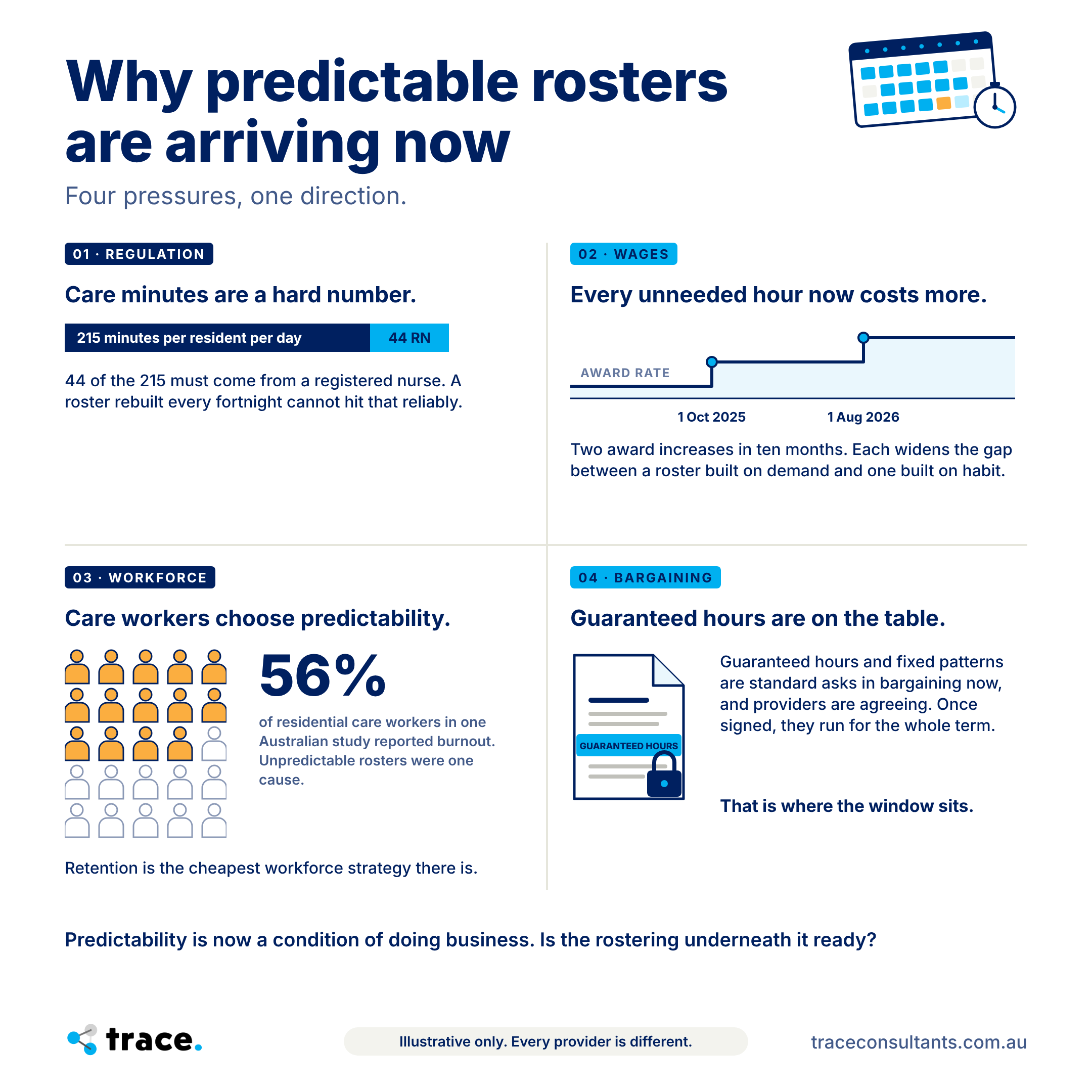
The second is wages. The Fair Work Commission’s Stage 3 award wage increases for aged care workers and a separate nurse award increase took effect on 1 October 2025, and a further work value-related increase for relevant aged care classifications applies from 1 August 2026. Every hour of unproductive or unnecessary labour now costs more, and the gap between a roster built on demand and a roster built on habit has widened with it.
The third is the workforce itself. Care workers are choosing employers on whether they can plan their lives. One Australian study of residential aged care workers reported elevated burnout among 56 per cent of those studied, with unpredictable schedules and limited recovery time among the contributing factors. Predictability has become a retention tool, and retention is the cheapest workforce strategy there is.
The fourth is bargaining. Guaranteed hours and fixed patterns are now standard asks in enterprise agreement negotiations, and many providers are agreeing to them. That is where the window sits.
The EBA is the window, and this is what it locks in
In a building, the thing you cannot change later is the loading dock. In a care workforce, it is the enterprise agreement. Once signed, it fixes the terms that decide whether a predictable roster is affordable: the guaranteed minimum hours for each part-time employee, shift lengths and patterns, the notice period and rules for changing a roster, minimum engagement periods, broken shift limits, the balance of permanent and casual labour, and the mechanisms, if any, for moving hours up or down when demand moves.
Every one of those terms should be set from a demand model and a workforce design, with the scheduling capability tested against them before anyone signs. In practice they are often set in a negotiating room, from what the other side asks for and what the provider thinks it can bear, with the operating consequences worked out afterwards. A guaranteed-hours clause that looks generous in the agreement and unworkable in the scheduling system is a cost the provider will carry for the full term.
The lesson is not to resist predictability. It is to walk into bargaining knowing exactly which patterns, hour bands and change rules the operation can run, because that knowledge only comes from doing the work first.
Predictability moves the risk onto the provider
The trade at the heart of predictable rostering is simple. Under a template roster, the provider carries the cost of chaos: agency premiums, overtime, scheduler hours, churn. Under a fixed roster, the provider carries the cost of commitment: hours paid whether or not the demand turns up. The second is cheaper than the first only when the roster is built on real demand and the scheduling engine can absorb the daily movement.
In residential care the movement comes from occupancy, acuity changes, leave and sickness. In home care it is constant. Clients cancel, go to hospital, change packages or die. Workers cancel too. Some clients cannot be sent certain workers, and some workers cannot be sent to certain clients. Travel between visits stretches a run until the last client of the morning is seen at lunchtime. A template model absorbs all of this by not committing hours until the picture is clear. A fixed model has already committed them.
That shows up in the numbers. In modelling we built for a large Australian home and residential care provider, adding the real scheduling constraints to the model (limited route optimisation, do-not-send lists, and cancellations on both the client and worker side) lifted the modelled operating cost of every fixed roster option by 10 to 20 per cent compared with a version that assumed clean demand. Treat that as a representative range rather than a rule. The point is that a business case built on tidy demand will understate the cost of predictability, and a provider that signs its agreement on that basis will find the difference in its P&L.
None of this makes predictability the wrong call. It means two things. The business case has to be built on cost avoidance, because the costs a predictable roster avoids (agency, overtime, churn, recruitment and onboarding, continuity failures, and compliance exposure on care minutes) are real and large. And the enablers have to be ready before the hours are guaranteed, not after.
What it looks like when the roster is fixed but the capability isn’t
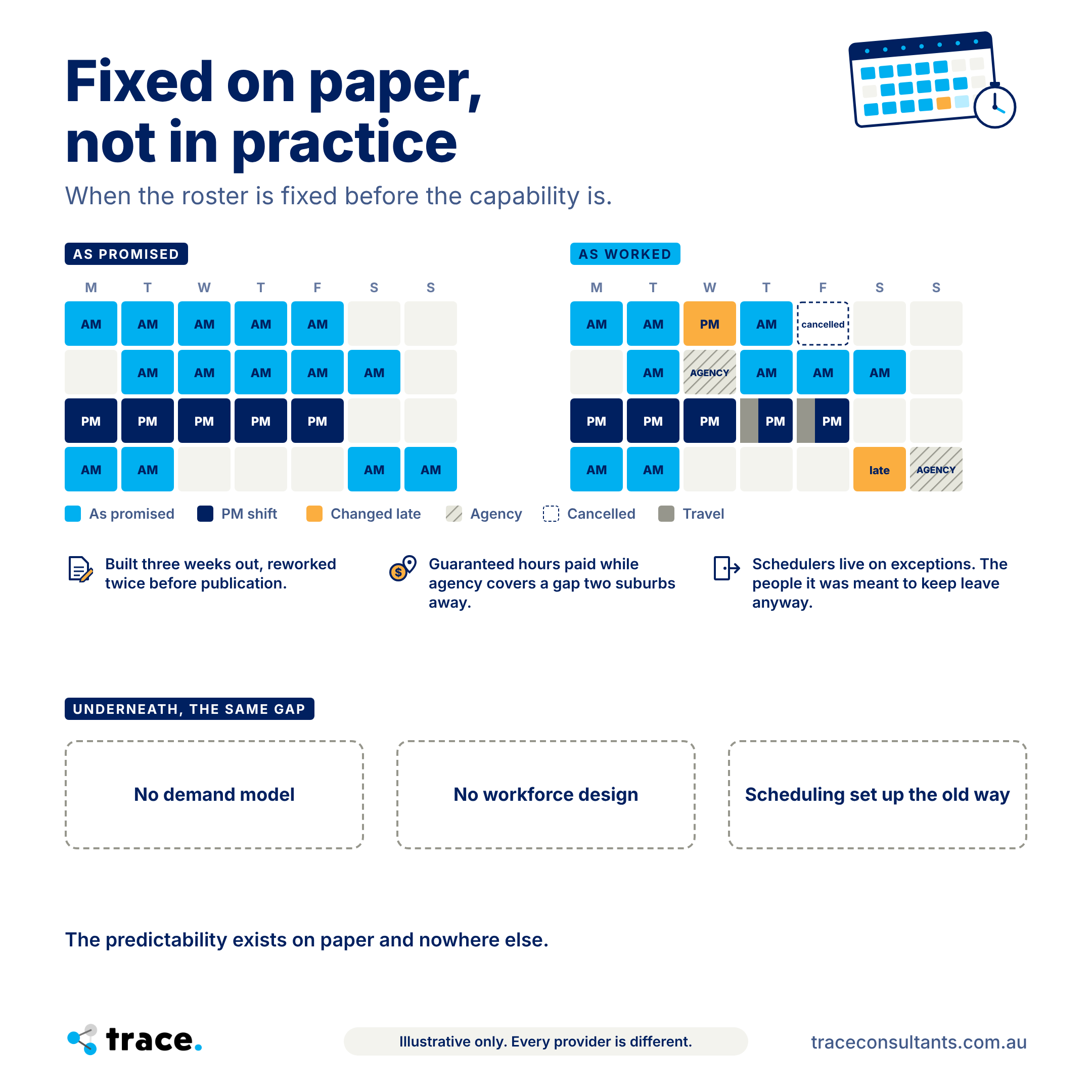
We see the same picture across providers who have moved to fixed patterns ahead of their capability. Rosters are built three weeks out and reworked twice before publication, so the predictability exists on paper and nowhere else. Guaranteed hours are paid on the same day that agency staff are brought in to cover a gap two suburbs away, because nobody can see both at once. Home care workers are sent across town because the system cannot cluster clients, and the fixed pattern that looked efficient in the agreement burns an hour a day in travel. Shift patterns are evenly spread across the day while clients want care before nine in the morning. Weekend care minutes are missed because the fixed pattern was designed around weekday demand. Schedulers spend their week on exceptions, and the people the model was meant to retain leave anyway, because the roster they were promised is not the roster they work.
Underneath all of it is the same gap: nobody built the demand model, nobody designed the workforce around it, and the scheduling system was configured for the old way of working.
Start with demand, not last year’s roster
Most rosters are built from the previous roster. A predictable roster has to be built from demand, because the demand is what the guaranteed hours are being committed against.
For residential care, that means resident numbers, acuity and funding classification, care minute obligations by shift, registered nurse coverage, the morning and mealtime peaks, and the leave and sickness profile of the team. For home care it means every client’s services by time window, location, duration and skill requirement, continuity preferences, cancellation rates by client segment, and realistic travel times between visits. The output is hours by skill, by time of day, by day of week, and in home care by neighbourhood.
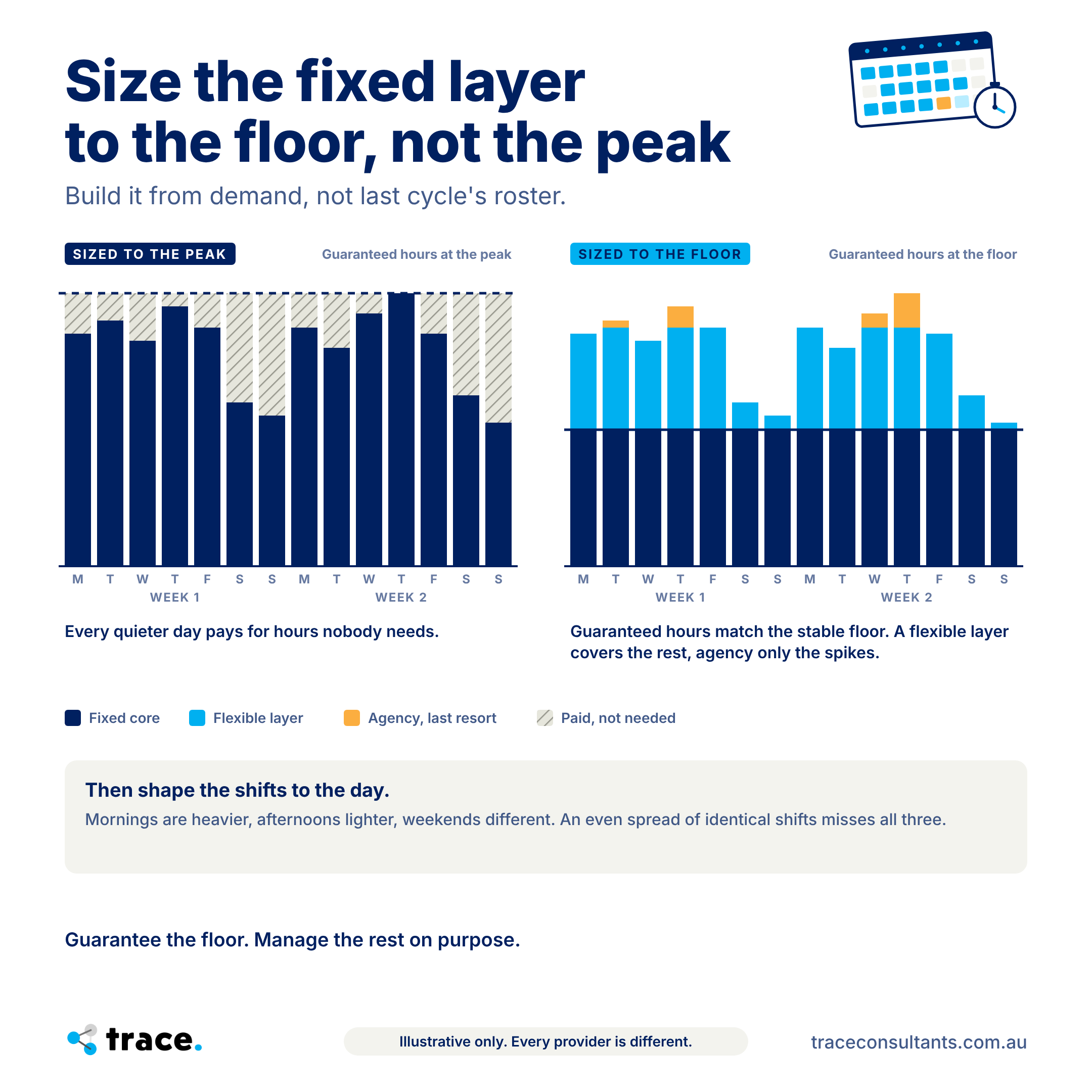
Then comes the question that decides the whole model: how much of that demand is stable enough to fix? The stable floor is what the fixed, guaranteed layer should be sized to. Everything above it is the flexible layer. Providers that size the fixed layer to the peak will pay for hours nobody needs. Providers that size it to the floor and build a disciplined flexible layer on top will get the retention benefit without carrying the risk alone.
Design the workforce model around the demand
With the demand picture in hand, the workforce model has five parts.
A fixed core of permanent staff on repeating patterns sized to the stable floor. A flexible layer of part-time employees with agreed additional hours, a casual pool managed for skill match and continuity rather than as a last-minute phone list, and agency as a genuine last resort. Shift patterns that match the shape of demand, which in care almost always means heavier mornings and lighter afternoons, not an even spread. In home care, geographic neighbourhoods or clusters, so that travel is contained and the same workers see the same clients. And defined rules for exceptions: what happens to a worker’s guaranteed hours when a client cancels (redeploy to another client, bring a visit forward, training, documentation), how do-not-send requests are handled, and how leave is covered without breaking the pattern.
Each of these has a consequence for the enterprise agreement. The size of the fixed core sets the guaranteed-hours exposure. The shift patterns need to be ones the agreement allows. The exception rules need to be ones the agreement permits. This is why the workforce design has to exist before bargaining starts.
Get the scheduling engine ready
A fixed roster model lives or dies on the scheduling capability that runs it day to day. Most rostering systems in the sector were configured for the template model, and the configuration has to change before the model does.
The system needs the fixed patterns and guaranteed-hours rules built in, award and agreement interpretation that is correct for the new terms, travel and route planning that reflects the neighbourhoods, a cancellation workflow that redeploys committed hours rather than just cancelling the visit, do-not-send and continuity rules that are applied automatically, and a mobile experience that lets workers see and confirm their patterns. It also needs a defined publish-and-lock point, after which changes go through a structured exception process rather than a text message to the scheduler.
The data matters as much as the configuration. A provider running a fixed roster needs to see planned versus actual hours, cancellation rates by cause, travel minutes per visit, fill rates for the flexible layer, agency hours by site and neighbourhood, and turnover by pattern. Without that, nobody can tell whether the model is working, and the fixed-to-flexible balance cannot be adjusted when the client mix moves.
Schedulers themselves need a different job. In a template model they build rosters. In a fixed model they manage exceptions and protect the pattern. That is a role design and training question as much as a systems one.
Build the business case on the right baseline
Predictable roster business cases fail in the same two ways as most workforce business cases. They compare the new model against today’s operation, and they lead with a headline saving nobody operational believes.
The right baseline is the committed future: the wage increases already legislated, the care minute obligations, Support at Home pricing, and the agreement terms being negotiated. Against that baseline, continuing with a template roster is not free. It carries rising agency premiums, overtime on rising base rates, churn and recruitment costs that grow with every wage step, and real compliance exposure on care minutes. A fixed roster built properly avoids those costs, and the avoided cost is usually the larger number in the case.
The benefit has to be built from the bottom up in units people can check: agency shifts per week, overtime hours, turnover by site, recruitment and onboarding cost per starter, travel minutes per visit, cancellation rates, care minute performance. And the scheduling constraints have to be in the model from the start, because a clean-demand model will overstate the benefit by the same margin it understates the cost.
Get ready in the right order, then pilot before you scale
The sequence matters more than the speed. Build the demand model first, because everything else is sized from it. Design the workforce model second, because that is what the agreement terms need to support. Get the scheduling system and the schedulers ready third, because that is what runs the model every day. Take all three into bargaining, so the terms that are signed are ones the operation can run. Then pilot in a small number of sites or neighbourhoods, measure planned against actual for at least two full roster cycles, adjust the fixed-to-flexible balance, and only then scale.
Providers who have run this sequence have usually found that the pilot changes the design. Cancellation rates are higher than assumed in some segments and lower in others. Some neighbourhoods have a stable floor and some do not. Some patterns that looked efficient create travel problems that only show up on the road. Finding that out in three neighbourhoods is cheap. Finding it out in fifty, after the agreement is signed, is not.
And name an owner. Predictable rostering crosses operations, people and culture, finance, industrial relations and technology, which in most providers means it belongs to everyone and therefore to nobody. One accountable leader, with the demand model, the workforce design and the scheduling readiness in their remit, is the difference between a fixed roster that works and one that is fixed in name only.

How Trace Consultants Can Help
Trace Consultants is a boutique Australian supply chain, procurement and operations advisory firm with a dedicated workforce planning, rostering and scheduling practice. We apply demand and supply balancing, the same discipline used to plan distribution networks, to care workforces, and we do it with small, senior teams who have designed and run these models for Australian providers.
Workforce demand modelling. We build the demand model from your resident and client picture, care minute obligations and service profile, including realistic cancellation, travel and continuity constraints, so the fixed layer is sized to the demand that actually exists. See our workforce planning and scheduling services.
Fixed and flexible workforce design. We design the fixed core, the flexible layer, the shift patterns, the neighbourhood structure and the exception rules, and we translate them into the terms your enterprise agreement needs to allow. Our work in health and aged care covers residential, home care and community settings.
Business cases built on cost avoidance. We build the baseline on the committed future and quantify the agency, overtime, churn and compliance costs a predictable roster avoids, with the scheduling constraints in the model from day one.
Scheduling system readiness. We define the configuration, workflows, data and scheduler roles the new model needs, and work with your rostering platform and vendor to get them in place before go-live. See our technology and organisational design services.
Pilot, measure and scale. We run the pilot with your operations team, measure planned against actual, adjust the model and support the rollout across sites and neighbourhoods. See our project and change management services.
Explore our workforce planning and scheduling services →
Where to Begin
- Find your bargaining date. The enterprise agreement expiry is the deadline that matters. Count back the time needed to build the demand model, design the workforce and get the scheduling system ready, and that is when the work has to start. For most providers it is now.
- Measure the current roster honestly. Agency hours, overtime, cancellation rates by cause, travel minutes per visit, how many times each roster is reworked before publication, and turnover by site. This is the baseline and the evidence for the case.
- Build the demand model with the real constraints in it. Cancellations, do-not-send lists, travel and continuity preferences from the start, not as a sensitivity.
- Size the fixed layer to the stable floor, not the peak. Then design the flexible layer and the exception rules that protect it.
- Pilot before you sign. Run the model in a handful of sites or neighbourhoods for two full roster cycles and take what you learn into the negotiating room.
Predictability is a promise, and promises cost money
Predictable rosters are the right direction for aged care. They are what the workforce is asking for, what continuity of care requires, and what the economics of agency dependence are pushing providers towards anyway. But a guaranteed hour is a promise to pay, and the only way to keep that promise affordably is to build the demand model, the workforce design and the scheduling capability before the promise is made. The enterprise agreement is the window. Providers that use it will have a workforce model that holds for the full term. Providers that sign first and build later will spend the term paying for the difference.
Explore our workforce planning and scheduling services →