

We help organisations transform ideas into measurable results with strategies that work in the real world. Let’s talk about how we can solve your most complex supply chain challenges.
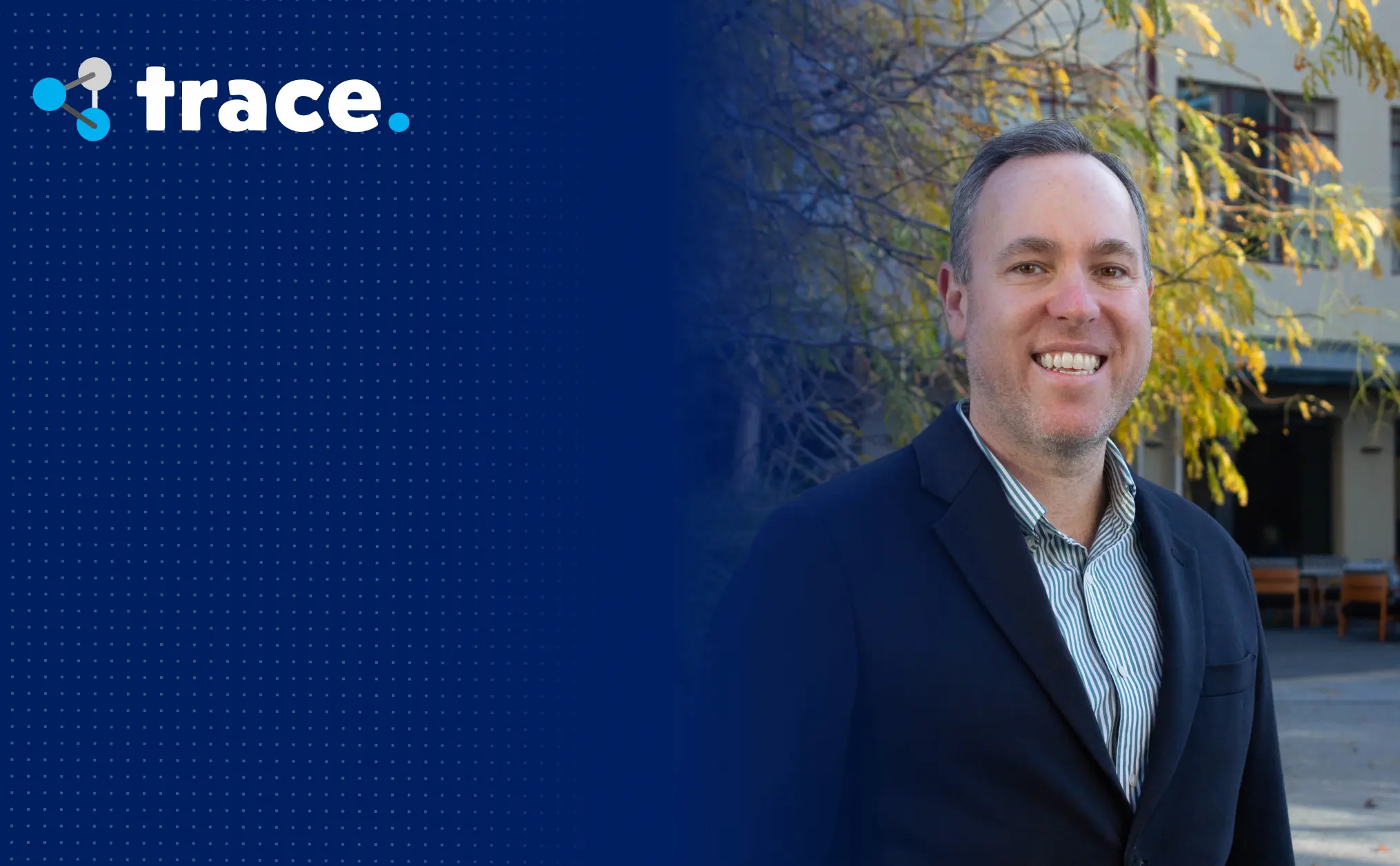
Joe joined Trace as a graduate in December 2024 and is now a Senior Consultant working across sustainability, cost optimisation, and strategic advisory. Alongside his client work, Joe developed interactive sustainability workshops with Professor George Panas at the University of Melbourne, exploring practical initiatives for reducing Scope 3 emissions. His economics background shapes how he thinks about trade-offs, incentives, and finding solutions that deliver on multiple goals.
We sat down with Joe to talk about what's driven his progression, what surprised him about supply chain work, and why competing priorities stop sustainability from moving beyond good intentions.
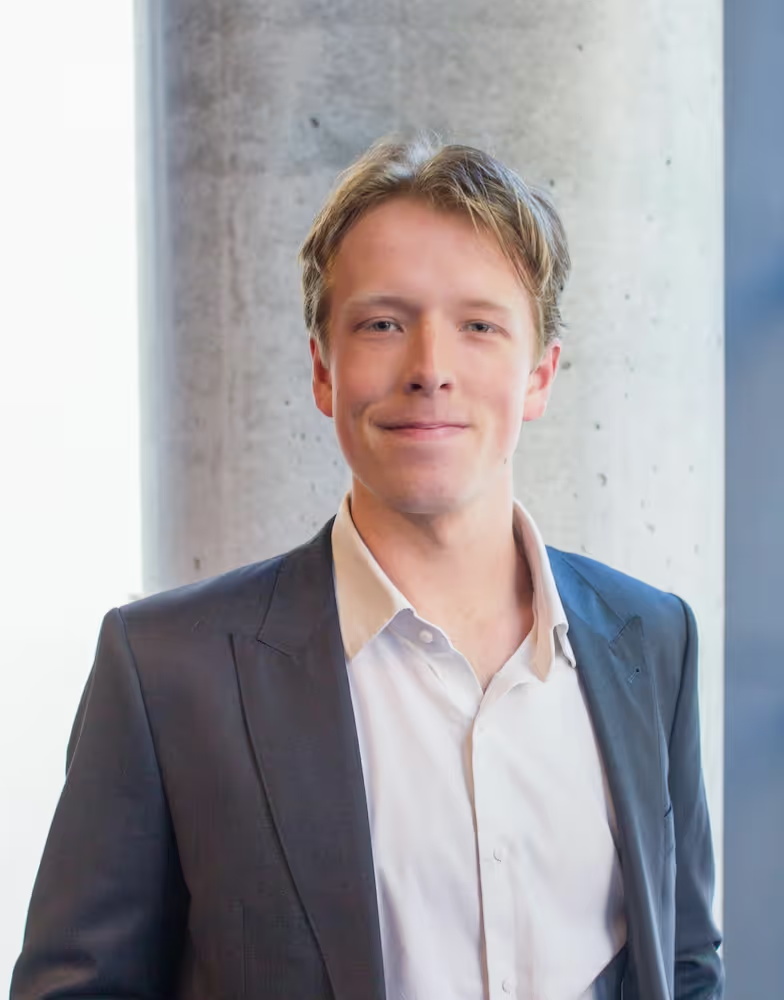
Joe Bryant, Senior Consultant
You started at Trace as a graduate in December 2024 and you've already accelerated to Senior Consultant. That's a pretty impressive trajectory! What's driven that progression, and what have been the steepest learning curves in your first year?
JB: You’re right, its been a pretty wild and fast ~18 months. When I first started, I made a commitment to myself to put my hand up and get involved in as many projects as possible. A year and a half later, that sentiment has remained, and paid off in progressing my development.
Learning, gaining experience, and being comfortable with making mistakes has been key. I consistently attempt to apply the lessons learnt, incorporate feedback, and minimise how often I’m repeating the same mistakes.
In terms of learning curves, some have been fun whilst others more tedious. Starting a new project with a new client, starting largely unfamiliar with the intricacies of how they work, and catching yourself up to speed is exciting. Put in the time, and before you know it, you find yourself understanding, debating, and challenging others on the organisation of complex systems or how to mitigate risks in really niche scenarios. Those learning curves are riveting.
In a more macro sense, in my time at Trace I’ve found myself consistently reevaluating how I work and balance my priorities. Whilst I’ve always aimed to keep a high work ethic and drive with work, learning how to efficiently harness my time and mental capacity has been challenging. It is the type of self-improvement that has no true end goal, and can be difficult to stick to, however I’m fairly confident it will pay off in the long term. I’m looking forward to how I can improve in this way.
Coming from an economics background, you're trained to think in terms of trade-offs, incentives, and systems. How does that lens influence the way you help clients make decisions?
JB: At the high-level, recognising when stakeholder incentives may clash and how that may guide biases is crucial. For the most part, everyone is doing what they believe is best for their team/project/company. When various teams come together, finding the right path that can align all relevant parties is crucial.
When it comes to the more detail-oriented projects, I’m very thankful for how an economics background trains you to challenge assumptions, look at how different processes work together, and explore creative solutions. Whilst my day-to-day work is likely fairly far from the more advanced microeconomic models and charts, understanding the application of game theory, and the principles of decision making echoes a lot closer to home.
You've worked on an array of projects spanning commercial waste management, workforce planning, and cost optimisation. What's surprised you most about the variety of problems clients bring to Trace?
JB: Prior to beginning at trace, I had a narrow understanding of what “Supply Chain” meant. My exposure was limited to operational logistics and inventory management. Meanwhile, my time so far has opened my horizons to include fields such as workforce planning, procurement, and strategic advisory. I’ve learnt how to adopt new technologies, work with varied teams, and communicate complex, new ideas. You always have to be ready to learn a lot and approach a problem from a new angle.
That being said, seeing the similarities in underlying problems was also quite surprising. People want their work to be seen and barriers to be lifted. Everyone is trying to do the best with the resources they have at their disposal. Recognising this, and doing whatever possible to equip stakeholders with the best information for decision making is crucial.
Sustainability clearly drives a lot of your work. When you're advising clients on reducing emissions or building more sustainable operations, what's the biggest obstacle that prevents good intentions from becoming real change?
JB: Competing priorities often constrain the pursuit of sustainable goals. Everyone would like to be more environmentally friendly, but when it comes at the cost of significant time, cost, or efficiency, it is often pushed down the priority list. Projects can easily face scope review, reconsideration, and before you know it the implemented solution is a fraction of the initial design.
Circuit-breaking this pattern requires a bit of creativity. It is often the out-side of the box solutions that can achieve dual goals of financial/process improvements as well as emissions reductions. My research work with Professor George Panas from Melbourne University has helped me equip that lens and find the right solution for the client.
With the right solutions, some clever framing, and clear consideration we can really help the client make lasting change.
What are some final tips for starting out a career in consulting?
JB: A few nuggets of advice pop into mind straight away.
Be curious! Doing what you can to understand new ideas, systems, and processes always pays off well. Asking smart questions is the best way to get smarter.
Take the initiative. Trying to solve an issue yourself, and then asking for confirmation or clarity is always better than simply giving up and asking for help.
Find a balance. You can't do everything, right now. Prioritising tasks and projects by urgency is an art, and consciously making time outside of work for the goals you have and people around you is a necessity.
Ready to turn insight into action?
We help organisations transform ideas into measurable results with strategies that work in the real world. Let’s talk about how we can solve your most complex supply chain challenges.
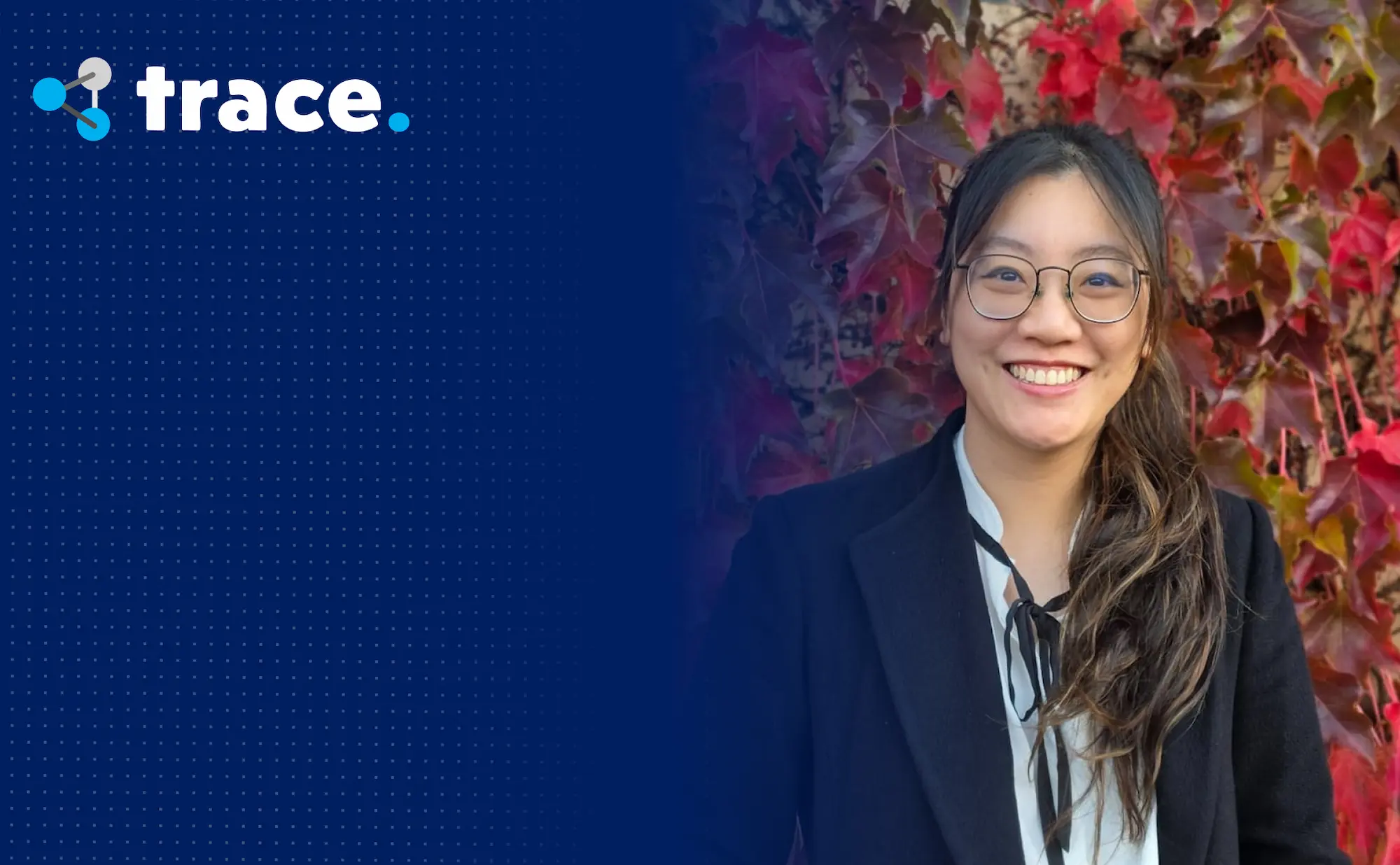
Senior Manager Emma Woodberry reflects on her career across high-stakes operations and Big Four consulting, discussing what circular supply chains actually require, and where sustainability still has ground to cover.
At Trace, Emma bridges operational expertise with sustainability transformation. She's a supply chain specialist with deep experience in circular economy design, change management in heavily regulated industries, and back-of-house logistics. Her strength is seeing patterns across vastly different environments and asking the questions that expose risk before it compounds.
We sat down with Emma to talk about what shaped her approach to problem-solving, what circular supply chains actually require in practice, and why embedding sustainability into operations is harder than most organisations want to admit.
Emma Woodberry, Senior Manager & Sustainability Lead
You've led supply chain operations in defence, advised global clients at PwC, and now lead sustainability at Trace. That's a pretty extraordinary range. Looking back, what experiences have been most formative in how you solve problems today?
EW: The defence years shaped me more than anything else. When you're managing supply chains in that environment, the stakes are critical, the wrong part missing at the wrong time isn't a KPI problem, it's a mission problem. That pressure teaches you to think in systems, to find the weak link before it finds you, and to stay calm when complexity is at its peak. I came away with a deep respect for operational discipline, but also for the people on the ground who actually make things work.
What I didn't expect was how naturally that translated into sustainability. On the surface, defence logistics and sustainability couldn't look more different but both are fundamentally about managing risk across long, interdependent chains where the consequences of getting it wrong compound over time. At Trace, I find myself drawing on that same instinct: where's the fragility? What are we not seeing? Who bears the cost if this breaks? The context has changed, but the way I approach a problem really hasn't.
Sustainability in supply chains is shifting from compliance to competitive advantage. We’re seeing organisations embed sustainability considerations into route planning, network design, and supplier selection. What's driving that shift, and how are the leaders in this space actually operationalising sustainability rather than just reporting on it?
EW: We’ve definitely seen the shift from nice to have to a regulatory compliance led must have, and now into the competitive advantage space.The organisations we’re seeing getting ahead are the ones who’ve put in the work and got the data right — not just the glossy sustainability report. Scope 3 emissions are a good example, a lot of organisations can tell us their headline number but not where it comes from or which supplier is driving it. The gap between reporting and understanding is closing, but understanding and taking action is where competitive advantage really sits.
You've worked extensively in back-of-house logistics, particularly in complex environments like stadiums and large venues. With Brisbane preparing for the 2032 Olympics, what are the critical logistics challenges that organisers need to be thinking about now?
EW: Brisbane 2032 is operating with a distributed model across multiple venues and regions, which multiplies the coordination challenge enormously. The critical decisions about network design need to happen now. How will goods flow between venues, where will there be consolidation points, how will surge volumes be handled without disrupting regular supply chains? Infrastructure lead times are a lot longer than most realise, decisions over the next two years will lock in constraints that will require operational workarounds and risk mitigations later.
Circular supply chains are gaining momentum, but implementation often lags behind intention. What does a circular supply chain actually look like in practice, and where do organisations typically struggle to close the loop?
EW: A circular supply chain isn't a recycling program or a take-back scheme bolted onto a linear process. It's when end-of-life thinking is embedded in design from the start, and material flows are tracked with the same rigour as cost and lead times. Practically, this means knowing what your products are made of at a component level, having pathways to recover those materials, and most importantly, having suppliers who are willing and capable of receiving them back or repurposing them. The organisations doing this well have essentially redesigned their supplier relationships, not just their packaging.
Where most organisations struggle is the reverse logistics part. Getting products out to customers is a system built over decades. Getting it back used to be an afterthought, and while it's gained momentum in the last few years, it’s still under-resourced, poorly tracked, and there’s a lack of clearly defined commercial models to sustain it. There's also a data problem: circularity depends on knowing what you have, where it is, and what condition it's in at recovery, and most supply chain systems aren't built for that. Additionally, there is a system-level gap. Procurement teams are still largely rewarded on unit cost, not lifecycle value, which means circular options that cost more upfront get deprioritised even when the total-cost case is sound. Closing the loop isn't only a logistics challenge, it's a governance and measurement challenge as well.
You've led transformations in highly regulated, risk-averse environments like defence and health. What makes change so difficult in these settings, and what strategies actually work when you're trying to shift entrenched systems and processes?
EW: Regulated and risk-averse environments are likely resistant to change because the cost of getting it wrong is genuinely high, and the system has been deliberately designed to protect against failure. In defence, a process failure doesn't mean a missed KPI, it can mean an aircraft doesn't fly or a person doesn't come home. In health, the stakes are equally concrete. So when you come in with a transformation agenda, you're up against a deeply rational risk equation that has been reinforced over years of operating in high-consequence environments.
Credibility can be a game changer. In these environments, trust is critical and it's earned through demonstrated competence and consistency, not just through a flashy slide deck or a business case alone. The other thing that consistently separates successful transformations from stalled ones is how you handle compliance and risk framing. Most change programs treat regulation as a constraint to work around. The smarter approach is to position the change as the risk-reduction mechanism, showing that the current process is actually the higher-risk option, whether that's a manual system creating error exposure, a legacy procurement approach creating supply vulnerability, or a siloed data environment creating compliance blind spots. When you can reframe the conversation from "change is risky" to "not changing is riskier," you're speaking the language these organisations already understand.
Looking ahead, what shifts in how organisations approach sustainability are you most excited or optimistic about, and where do you think the industry still has significant ground to cover?
EW: ’m looking forward to seeing the divide between sustainability and operations continue to reduce and eventually disappear. For a long time, and even now, sustainability is treated as a separate function, and with siloed reporting and initiatives. What we’re starting to see more of, particularly in the organisations that are leading in this space, is sustainability logic being embedded directly into operational decision-making. Procurement teams pricing in carbon alongside cost. Network design teams modelling emissions as a real constraint, not an afterthought. That integration is where the real leverage is, and it's starting to happen at scale in a way it wasn't three or four years ago.
We've all become very good at producing sustainability narratives, but not so much the harder work like supplier engagement beyond tier one, meaningful scope 3 accountability, and being honest when a target is off track rather than reframing it. The compliance frameworks coming through will force some organisations' hands to increase rigour, but regulation tends to set a floor not a ceiling. The organisations that will lead are the ones that treat the standard as a starting point rather than a destination, and are willing to have uncomfortable conversations with their suppliers, their customers, and their own leadership about what progress actually looks like. I’m optimistic for the shift in sustainability, even though there is still a lot of work to be done.
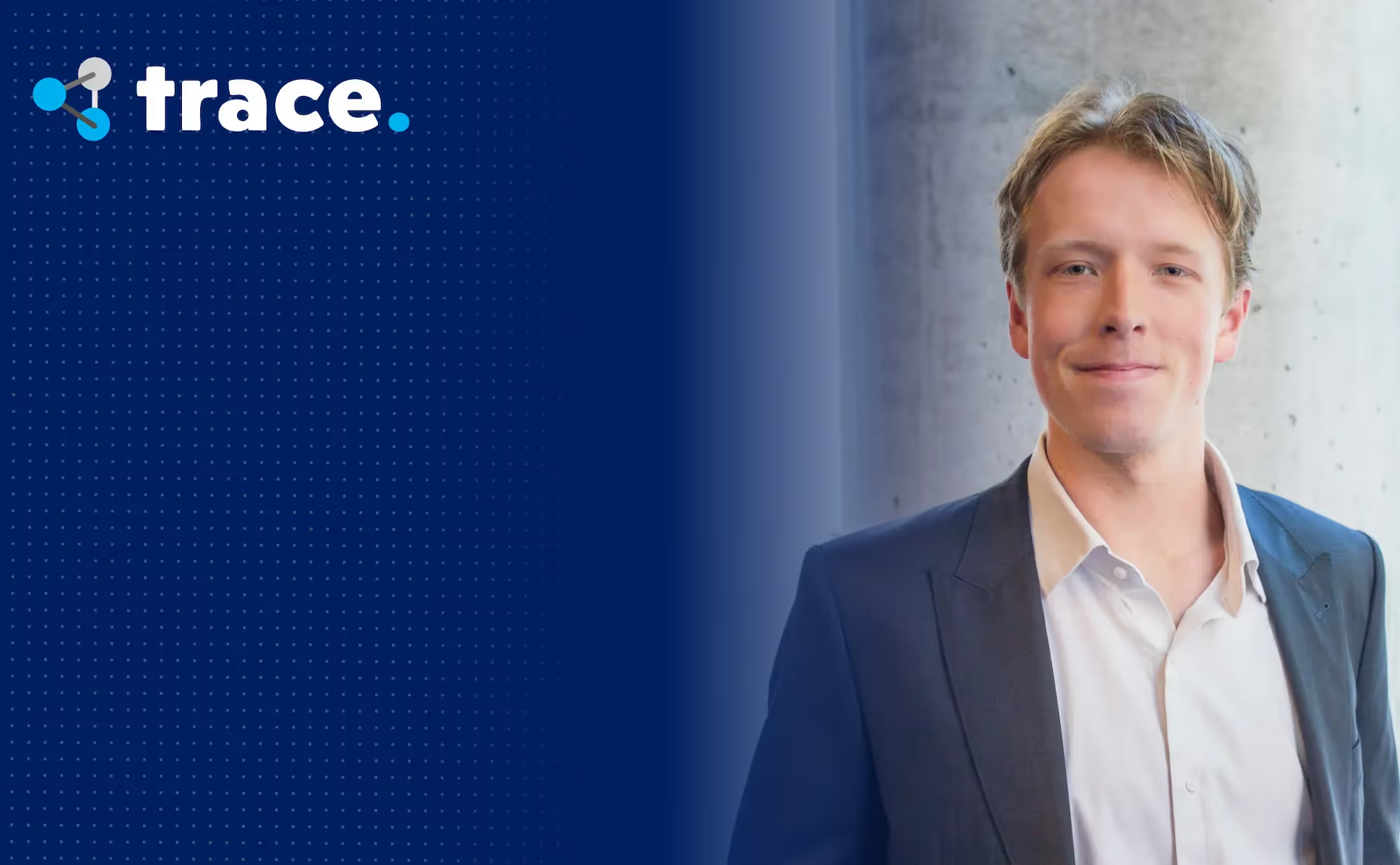
I do less travel and more thinking these days. Here is how I think Australian supply chains are being rebuilt this decade, what is actually changing in commercial operations, where the real cost-out is, and why the next ten years will be won by execution rather than strategy.
How I Think Australian Supply Chains Are Being Rebuilt This Decade
For a stretch a couple of years back, I was on the Melbourne to Perth flight every week. Some of my clearest thinking about supply chains happened at thirty thousand feet over the Nullarbor on a Thursday evening. That pattern compressed when our third arrived in November. The travel is lighter now, the house is busier, and the thinking happens at the eleven o'clock dream feed and on the cab ride into Sydney. The setting changes. The thinking continues.
The conversation, lately, is some version of this. The supply chain we built for the last decade is not going to work for the next one, and we need to fix it without spending more, in fact probably while taking cost out, while also adding new layers of regulation and resilience and reporting that did not exist five years ago, and finding the people to do the work, and putting some kind of artificial intelligence into the mix because the board has asked.
I have had a version of that conversation in retail, FMCG, hospitality, property, industrial manufacturing, health and aged care, financial services, and construction in the last six months. The products are different. The margins are different. The customers are different. The conversation is identical.
This is what I think has shifted, what I think comes next, and what I think the leaders I respect should be doing about it. It is not a list of trends. It is what I actually think, including the parts that are unpopular with my own profession.
The end of single-source efficiency
Australian supply chain practice for the last thirty years was built on a single big idea. Find the lowest landed cost. Source it from a single, scaled supplier. Build the network around the inventory. Optimise the working capital. Hold a small safety buffer. Repeat.
It worked, for a long time. The economics were genuine. China matured into the world's manufacturer at a pace that flattered every cost-out program it touched. Container freight got cheaper in real terms, year after year. Trade liberalised, mostly. A generation of supply chain leaders built careers on landed-cost models that assumed all of this would continue. A generation of boards backed them.
Then 2020 happened, and 2021, and 2022, and we are all still standing in the rubble pretending we have moved on.
The events themselves have been written about exhaustively. What I think gets written about less honestly is the cumulative effect on Australian boards. The pandemic stockouts. The Suez Canal blockage. The Chinese trade sanctions on barley, beef, wine, and lobster. The 2022 fertiliser crisis. The 2023 AdBlue scare, when the diesel additive that keeps every modern truck running nearly ran out across the country. The collapse of the global liquid urea supply when one country decided to keep its production at home. The Hormuz fuel exposure that we modelled across a dozen sectors earlier this year. None of these were defence stories. They were commercial stories. They hit retailers, manufacturers, transport operators, mining companies, hospitality groups, and farmers. They did not feel like supply chain shocks at the time. They felt like operational ambushes.
What happened in the boardroom over those four years, in my view, is that concentration risk got repriced. Not in a dramatic, revolutionary way. In a quiet, steady, line-item way. Risk committees started asking different questions. Internal audit started flagging single-source dependencies that used to be invisible. CFOs who had spent a decade praising lean inventory started asking whether maybe a bit more buffer was prudent, just in case. Procurement teams who had been measured purely on landed cost started getting questions about supplier geography that they did not have ready answers for.
The shift I now see, almost universally, is that single-source-is-cheapest has stopped being a defensible position with most boards. It is not that boards have abandoned cost. They have not. Cost discipline is, if anything, more demanding than it was. The shift is that "cheapest" no longer wins an argument by itself. It has to be defended against a residual risk position, an alternative-supplier scenario, and a question about what happens if the country of origin has a bad year.
For most commercial operators, the answer is not full reshoring. The maths does not work, and frankly most of the people writing those articles have not had to defend the unit economics in a board pack. The answer is some form of deliberate redundancy. A second source, often regional, sometimes domestic. A modest inventory buffer in critical categories. A tighter relationship with the primary supplier so you find out about problems earlier. Maybe a small investment in onshore finishing, packaging, or assembly that lets you respond to demand changes faster.
This sounds simple. It is not. Building a credible second source for a category that has been single-sourced for a decade takes eighteen to thirty months. It costs working capital. It requires a procurement team capable of managing a portfolio rather than running a tender. And it has to be funded, paradoxically, while the same procurement team is being asked to deliver year-on-year cost savings on the existing book.
The companies I see making genuine progress on this are the ones who have stopped framing resilience and cost-out as competing priorities. They have figured out that, done well, deliberate redundancy is a cost-management strategy, not a cost burden. A second source disciplines the primary supplier on price. A small onshore capability prevents the catastrophic stockout that dwarfs the line-item premium. A sensible buffer reduces expediting costs, air freight, and customer-service compensation. The framing is "redundancy as insurance with a positive return profile," not "redundancy as a tax on resilience."
The companies still struggling are the ones who treat resilience as something the risk function does and cost-out as something the procurement function does and never reconcile the two.
Sovereign capability is now a commercial question
A specific version of the resilience argument has been getting most of the political airtime, which is sovereign capability. The framing tends to come dressed in defence language because the most visible Australian programs in this space are defence programs, and politicians enjoy speaking about submarines and frigates more than they enjoy speaking about urea.
This is a mistake of audience. Sovereign capability has become a commercial question, and the operators figuring it out fastest are not in defence.
Walk into a major Australian retailer right now and you will find someone, usually quite junior, building a list. The list is the SKUs whose primary source of supply is a single country, in many cases a single facility, where a ninety-day disruption would create a material problem. The list is shorter than people expect, but the items on it are more concentrated than people expect. Once you have the list, the conversation changes. It is no longer "how do we cut three percent from the cost of goods." It is "what would it cost to make sure we could replace these in ninety days, and is that less or more than the disruption cost of not being able to."
I have done versions of this work for retailers, FMCG manufacturers, health groups, hospitality operators, and infrastructure clients in the last twelve months. The patterns repeat. The number of genuinely critical, single-source, single-country SKUs is usually between ten and thirty. The cost of building credible alternative supply for those SKUs, properly scoped, is usually between one and three percent of the total category spend. The avoided cost of a single realistic disruption event, properly modelled, is usually a multiple of that. The economics work. They almost always work.
What stops the work from getting done is not the economics. It is the absence of someone to own it. Procurement is set up to run tenders, not to build supply optionality. Risk is set up to monitor exposures, not to fund mitigations. Operations is set up to keep the lines running, not to invest in things that are not on a critical path today. Finance is set up to ask whether this quarter's number is on track. Sovereign capability work, in commercial organisations, falls in the gap between all of these functions. The companies making progress are the ones who have figured out where to put the accountability, usually within a strengthened procurement or strategy and network design function, and who have given that role enough air cover to make decisions that look, at first glance, like cost increases.
The deeper point is that sovereignty in the commercial world is not about national pride or government policy. It is about which fifteen things you cannot afford to be without. The framing on a recent diligence I worked on was: if our top customer asked us tomorrow whether we could guarantee continuity of supply across our material categories, in writing, what would we say. The honest answer in most cases is "we could not." The next question is "what would it take to be able to."
That is a commercial question. It is also one of the cleanest cost-and-risk problems I have worked on in years, because the answer is bounded, the work is concrete, and the value, if you do it well, shows up in two places. It shows up in the avoided-loss line, where you can model the disruption cost. And it shows up in the procurement line, because the existence of a credible second source disciplines pricing on the first.
The defence programs in the public eye are the most visible expression of this shift, and they will be the case studies that get written about for the rest of the decade. I would rather you spent your time on the version of the question that lives inside your own organisation. It is more valuable, more tractable, and more urgent. The people building the lists right now are not waiting for the policy environment to settle.
The trade architecture has permanently changed
The third thing I think has shifted, and the one most clients still mentally treat as temporary, is the global trade architecture.
The decade from roughly 2008 to 2018 was the high-water mark of trade liberalisation as a default. Free trade agreements proliferated. Tariffs trended down. Cross-border supply chains grew more complex because the friction was getting less, not more. Most of the planning assumptions baked into Australian commercial supply chains were laid down in this period. You could plan a five-year sourcing strategy on the assumption that the trade environment in year five would be roughly the trade environment in year one, with some adjustments at the margin.
That assumption is gone. It is not coming back.
The recent shifts in US trade policy, the periodic Chinese sanctions episodes, the new European tax on imports based on their carbon footprint, the various export controls that have been brought in on critical minerals and advanced computer chips for national security reasons, the steady maturing of trade policy as a routine instrument of geopolitical pressure, all of these point in the same direction. Tariffs, sanctions, and export controls are now policy tools that any government will use, predictably, in response to events that have nothing to do with your supply chain. You should plan for that, the way you plan for currency volatility or interest rate changes. It is now part of the operating environment.
What this means in practical terms, for an Australian importer or exporter, is that the question of where you source from is no longer adequately answered by "wherever is cheapest." You need a coherent geographic portfolio. The companies I see doing this well have stopped trying to find a single best country to source from and have started thinking in portfolios. Keep a strong position in China for the categories where the cost advantage is genuinely structural and the geopolitical risk is manageable. Build a meaningful second position somewhere in Southeast Asia, usually some combination of Vietnam, Indonesia, Thailand, Malaysia, occasionally the Philippines. Add an Indian or domestic capability for specific categories where the strategic case is strongest. Manage that portfolio actively, the way you would manage a portfolio of customers or financial assets, rather than passively.
This is harder than it sounds. Running a sourcing strategy across three or four geographies, instead of one, is materially more demanding. Lead times are longer in most of the alternative geographies. Quality systems are different. Logistics infrastructure is uneven. The supplier base is less mature. The trade agreements are different. The freight forwarding network is fragmented. Most procurement teams in Australia are not built for this. They were optimised for a single-geography world and the muscle for genuine portfolio management has atrophied.
There is also a quieter cost that does not get talked about much. Diversifying out of China at scale, in most categories, makes your overall cost go up. Not enormously. Three to seven percent in most cases I have worked on. Sometimes more in highly automated categories where Chinese productivity is genuinely structural. The boards that are doing this well have accepted the cost increase and committed to make it back through working capital release, network optimisation, automation, and tighter supplier management. The boards that are not are doing one of two things. They are either pretending the cost increase will not happen, in which case the procurement team will eventually disappoint them. Or they are using the trade environment as an excuse to avoid the diversification, in which case they will eventually be ambushed by the next round of policy changes.
I do not think this is a crisis. I think it is a permanent recalibration, and the operators who treat it as a temporary disruption to be waited out will be the ones who get caught when the next round comes.
Cost-out has not gone anywhere. It has compounded.
If there is a single sentence that best describes what has actually changed in commercial supply chains over the last three years, it is probably this. The list of things the supply chain function is expected to deliver has roughly doubled, and the budget has not.
Three years ago, a reasonably senior supply chain leader in an Australian commercial business was expected to manage cost-of-goods, optimise working capital, run a credible procurement function, keep the network operating, and report on a few performance metrics. The agenda was wide enough.
Today, that same person is expected to do all of the above, and manage emissions reporting across their entire supplier base under the new climate disclosure rules, and respond to regulator-driven supply chain mapping requirements where they apply, and assess and mitigate concentration risk across their critical categories, and evaluate and pilot artificial intelligence applications across planning and procurement, and navigate the people and skills shortage that is hitting most of their function, and keep delivering year-on-year cost reduction because the CFO has not changed her view about the size of the procurement savings target.
The budget has not doubled. The team has not doubled. In many cases the team has shrunk because the previous round of cost-out included the supply chain function itself. The expectation that all of this gets done in parallel, with the same or fewer resources, is the thing that makes the current operating environment genuinely difficult, in a way that boards and CEOs do not always appreciate.
This is the texture I think most commentary about supply chains misses. Resilience, sustainability, technology, talent, sovereignty, and compliance are not replacing cost-out. They are stacking on top of it.
What has shifted, sharper than the volume of work, is the defensibility of the cost-out itself. Boards have been burned, repeatedly, by transformation programs that promised double-digit savings and delivered fragments. They have grown sceptical. The CFO who used to accept a procurement savings claim at face value now wants to see the baseline, the methodology, the assumptions, the run-rate, and the verifiable benefit. The savings number is not enough. The argument supporting the savings number is what gets scrutinised.
The way through this is not to hide from it. It is to invest in the analytical infrastructure that makes the defence of the saving easy. Historical headcount data going back four or five years. Org charts at multiple points in time. Activity-based costing, where it is feasible. A clear methodology written down before the conversation gets political. Reframing where it makes the message easier without compromising the substance. "Cost avoidance" rather than "cost reduction" lands better in some forums; the dollars are the same.
The deeper point I would make to any commercial leader running a cost-out program right now is that the operators who win this decade will not be the ones who promise the biggest savings. They will be the ones who promise defensible savings, and then deliver them. The premium on credibility is rising sharply. Boards are tired of being disappointed. Procurement leaders, supply chain leaders, and the consultants advising them, would do well to take that seriously.
I have come to think of cost-out, sovereignty, sustainability, technology, and resilience as a single integrated problem rather than five competing ones. The companies making the most progress are the ones who understand that resilience well done releases cost, sustainability well done finds waste, and technology well done takes labour out of the right places. The framing is not "how do I deliver cost-out and all this other stuff." It is "how do I deliver cost-out through all this other stuff." That is a more useful posture.
Australia has a productivity problem, and supply chains are part of the answer
There is a force operating underneath every conversation I described above that is bigger than any single company's supply chain agenda. Australia has a productivity problem.
The Productivity Commission has been documenting it for years. Treasury has flagged it in successive intergenerational reports. The numbers are stark by historical standards. Australia's productivity growth over the last decade has been at multi-decade lows. Output per hour worked has barely moved. Real wages cannot grow, sustainably, faster than productivity does, which means the productivity slowdown is also the wages slowdown, and the cost-of-living problem, and the housing affordability problem, and the budget problem, all of which connect back to the same root.
I am not an economist and I will not pretend to know all the levers that contribute to it. Migration patterns, capital investment intensity, energy costs, regulatory complexity, the mix of industries we have built. All of those matter. What I am qualified to say is that supply chains, operations, procurement, and workforce planning sit closer to the productivity question than most public commentary acknowledges.
Roughly half of every dollar of operating cost in most Australian commercial businesses goes through the supply chain or the labour roster in some way. Inventory carrying cost. Logistics. Procurement. Production planning. Workforce scheduling. Distribution. The processes that determine what a business sources, where it sources from, how it gets it to the customer, who does the work, and how the work is organised. If you make those processes ten percent more productive, you have moved a bigger lever than almost any other change a business can make.
The problem is that most Australian commercial operations are not anywhere near the productivity frontier. The forecasts are still run in spreadsheets. The networks are designed around facilities that were chosen for reasons that no longer apply. The procurement processes are run on systems that were modern in 2008. The rosters are built by hand. The decisions are made on data that arrives a week too late. The operating model is the operating model the business inherited, and nobody has been given the air cover to rebuild it.
This is the gap that the rebuild I have been describing through this piece is supposed to close. Smarter network design takes cost out and reduces lead times, which is productivity. Better technology takes routine work out of the day and lets people focus on the decisions that matter, which is productivity. Targeted AI in planning and procurement compresses analytical time and improves decision quality, which is productivity. Workforce planning that matches labour to demand more accurately reduces wasted hours, which is productivity. Resilience-driven dual sourcing, done well, improves supplier performance and reduces emergency expediting, which is productivity. Each of the themes in this article, taken seriously, is also a productivity story.
I do not think Australia's productivity problem gets solved by a single national policy. It gets solved by ten thousand commercial decisions to invest in better operations, better systems, better processes, and better people. Most of those decisions sit with the same operators I have been writing about all along. The leaders who treat their supply chain rebuild as a productivity investment, not just a cost-out exercise, are doing some of the most useful work in the country right now, in my view. They will not get the credit for it the way a politician gets credit for a press release. But the cumulative effect on Australia's economic performance over the next decade is, I suspect, larger than most policy packages will manage.
That, I think, is part of why this work matters. It is not only commercial. It is national.
Targeted benefits, faster, beats big platform transformation
Let me say this directly because I think it is the most important practical shift in supply chain technology in the last three years and most boards have not yet understood it.
The era of multi-year, multi millian dollar dollar transformation programs that promised everything and delivered fragments is over. It is over because boards will not fund it any more, and it is over because they should not have to. The capability stack now available to a moderately well-organised supply chain or procurement function makes the old transformation logic obsolete.
The new logic, the one I think the operators ahead of the curve are running, is roughly this. Identify a specific, measurable benefit pool. A category where forecast accuracy is poor and inventory is inflated. A function where invoice processing is taking up disproportionate time. A spend area where you do not really know where the money is going. A planning cycle where the analytical work consumes more time than the decisions it informs. Stand up a focused capability against that benefit pool. A new planning system selected, deployed, and operationalised. A pilot using smarter forecasting tools that pick up shifts in customer behaviour earlier than traditional models do. Better analytics on your spend data, feeding the next sourcing wave. An automated invoice processing tool. AI assistants handling routine procurement tasks end-to-end in a single category. Deliver the benefit inside six to twelve months. Measure it. Then go again, with the next benefit pool.
This is not a less ambitious model than the old transformation programs. It is more ambitious, because it is real. The old model promised forty million in benefits over three years and routinely delivered eight to twelve. The new model targets two to four million in a single category in nine months and routinely delivers it. Stack four or five of those over three years and the cumulative benefit is larger than the old transformation, the cash payback is materially faster, the organisational learning is deeper, and the risk profile is much lower because each phase stands on its own.
What I have seen change in the buying pattern, over the last twelve to eighteen months, is interesting and worth noting. Clients are increasingly asking for selection and implementation as a single piece of work, rather than separating them. The old model had a strategy firm pick the technology, then a system integrator implement it, then maybe an operations consultancy come in to operationalise it. Three vendors, three contracts, three sets of incentives, and a value leakage at every handoff. The new model wants one team to pick the right tool, embed it in the operation, and stay around long enough to make the value real. That is a different commercial offer, and it is the one most clients I speak to now genuinely want.
There is a frame I have used in a number of recent conversations that seems to land. The work in any consulting engagement breaks roughly into three zones. The early zone, where the strategic direction is set, the problem is framed, and the conviction is built. The middle zone, where the analysis happens, the models get built, the options get evaluated, the slides come together. The late zone, where the change actually has to happen on the floor, in the system, with the people doing the work.
Artificial intelligence does the middle zone genuinely well, and it is going to do it far better, and far cheaper, every twelve months. It does not do the early zone well, because conviction is a human act and an AI cannot have a coffee with a CEO who is wrestling with the trade-off between capital investment and short-term earnings. It does not do the late zone well either, because change management is fundamentally a relationship business and an AI cannot sit with a supervisor who is afraid the new system is going to make their team redundant.
This is going to reshape what supply chain technology is worth, and what supply chain people are worth, faster than most leadership teams have priced in. The planners and category managers who survive the next decade will be the ones who can do the strategic edge of their work and the execution edge of their work, with AI doing the analytical middle for them. The ones who built their careers on being faster and more accurate than the next person at building a model in Excel will struggle, because they were running a race that no human is going to win.
The honest counter-point, and it is a serious one, is that most Australian commercial businesses do not yet have the data foundations to run any of this well. The forecast accuracy uplift you can achieve from the smarter, machine-learning-based forecasting tools is real, sometimes very large, but it depends on having clean, detailed sales history at a product level, going back several years. The value of any tool that analyses where your money goes depends on consistent, well-coded supplier data. The AI assistants that promise to handle routine procurement tasks end-to-end depend on processes that are documented well enough to automate. The first investment for most clients I work with is not the AI tool. It is the unsexy, frustrating, slow work of fixing the master data, integrating the systems, and cleaning up the processes that the technology is supposed to sit on top of. Boards do not love this conversation, because there is no glamorous press release at the end of it. But the businesses that do this work are the ones who get to be in the AI conversation in three years' time. The ones that skip it will buy expensive software that fails to perform, blame the vendor, and conclude that AI is hype.
I think the next decade is going to separate Australian businesses, fairly cleanly, into two groups. The ones who built the data foundation and used AI to genuinely change their operating model, and the ones who put a chatbot on the front of an unchanged process and called it transformation. The cost gap between those two groups will be large enough to determine winners and losers in most commercial categories.
Procurement has quietly become a regulated function
There is a separate force at work in commercial supply chains that I think is underappreciated, even by people inside procurement.
The function used to be a commercial discipline. You ran tenders, negotiated contracts, managed suppliers, reported savings. The skills were commercial, analytical, and relational. Compliance existed, in modern slavery, in anti-bribery, in sanctions screening, but it was a side activity. The main game was commercial.
In the last three years, the compliance side has exploded, and it is no longer a side activity. It is the main game in several large commercial categories.
Australia's new mandatory climate reporting regime is the most obvious driver. The largest companies, those above $500 million in revenue, started reporting their direct emissions and electricity emissions from the start of 2025, with their full supply chain emissions becoming mandatory from their second reporting year. Mid-sized companies, above $200 million, follow from July 2026. Smaller companies above $50 million from July 2027. Within eighteen months, virtually every large and mid-sized Australian commercial business will be reporting on emissions across its full supply chain, which by definition sits across the supplier base, which means it sits on the procurement function's desk.
Then there is the new operational risk standard the banking regulator has brought in for the financial services industry. It now requires banks, insurers and super funds to map their critical service providers, work out where they have dangerous concentration, and prove they could keep operating if a major supplier went down. The work I have seen this generate inside major Australian banks is significant. It is not a one-off mapping exercise. It is an ongoing operational discipline that cuts through procurement, vendor management, technology, and risk. Procurement teams in financial services are now responsible for evidencing supplier resilience to a regulator, not just managing supplier cost. The shift in skill profile required is genuine.
Add modern slavery reporting, which is now reaching its second wave of maturity with stronger expectations on supplier engagement and remediation. Add the regulations covering critical infrastructure, which have expanded the perimeter of what gets treated as critical and brought new sectors into supply chain reporting obligations. Add the various environmental, social and governance reporting frameworks that have been brought in across different industries and states, all of which map onto the same supplier base. The cumulative effect is that procurement, which used to be a commercial function with a compliance overlay, is becoming a compliance-and-commercial function. The compliance is not optional, the data trail has to withstand external assurance, and the work has to happen at scale.
Most procurement teams in Australia are not built for this and do not yet know it. The capability profile that won in 2018, strong commercial negotiators with category depth, is still necessary but no longer sufficient. The new profile needs that, plus the ability to design data collection from suppliers, plus the ability to integrate emissions and operational risk data into category strategies, plus the ability to evidence the work to internal and external assurance providers, plus the ability to maintain all of this as the regulatory perimeter keeps expanding.
This shows up commercially in two ways. It shows up in the supplier conversation, where the top fifty suppliers in any large business are now being asked, in some combination, for their emissions data, modern slavery disclosures, evidence of business continuity planning, evidence of their cyber security, and proof that they could keep delivering if something went wrong. The good suppliers are starting to charge for this work, or to penalise customers who ask for it inconsistently. The poor suppliers are giving evasive answers, which is its own form of risk. It also shows up in the procurement contract itself, which is becoming a compliance instrument, with clauses on emissions reduction, supplier audit rights, data sharing, and resilience obligations. The negotiation is now harder, slower, and more multi-dimensional than it used to be.
The leaders who are getting this right are doing two things. They are investing in the data and process infrastructure that makes regulated procurement sustainable, rather than trying to spreadsheet their way through it. And they are being clear, internally, that this work is not a tax. It is a competitive advantage when done well. Knowing more about your supplier base than your competitors do is genuine value, and the regulators have just done procurement leaders the favour of mandating that they do the work.
The workforce squeeze, and the service line it has created
I have written before about the supply chain talent shortage in Australia, and most of what I said then I still believe. The mid-level capability is structurally short. The pipeline from universities is thin. The skill profile required has shifted faster than the supply of people has updated. The sectors competing for the same analytical and commercial talent, finance, technology, consulting, private equity, are all paying more than supply chain has historically paid. The geographic concentration in Sydney and Melbourne makes it harder still for clients in Perth, Brisbane, Adelaide, and the regions.
I do not think we are solving this fast enough as a profession or as a country. I am happy to be wrong, but the data and the conversations I am in keep saying the same thing. The mid-level, eight-to-fifteen years experience, capable of running a category, leading a planning cycle, owning a transformation, comfortable with technology and commercial work and a bit of regulation on top, is the scarcest profile in the market. Salaries are climbing for genuinely good people. Transformation programs are stalling because the people to lead them are not available. Internal promotions are happening earlier than they used to, which is good for individuals but creates fresh capability gaps below.
What I want to add to that conversation, because it is visible in our pipeline in a way that I had not fully appreciated until this year, is that workforce planning, rostering optimisation, and operating model design for labour-intensive operations have become one of the most actively bought services in the commercial market. Not as a constraint on supply chain transformation. As a service line in their own right.
Aged care providers are buying rostering optimisation, hard, because the regulatory environment has lifted the floor on care minutes (the minimum direct care time each resident must receive each day) and the labour cost base has gone up faster than the funding model. Health groups are buying it because nursing labour is the single largest controllable cost in a hospital and the workforce shortage means every roster is now a constraint problem. Hospitality groups are buying it because casual labour is the dominant variable cost in their P&L and the regulatory environment has tightened materially. Financial services are buying workforce planning for complaints handling, scams response, and compliance functions where caseload is volatile and the consequences of under-staffing are direct customer harm. Industrial operators are buying it for shift optimisation in plants where the mix of permanent, casual, and contract labour is structurally complicated.
The common thread is that labour, in labour-intensive commercial operations, is the cost-out frontier most operators have not yet worked over. Procurement has been worked over for a decade. Inventory has been worked over for five years. Network design has had its turn. The labour cost stack, in most labour-intensive commercial businesses, has not been touched at the same level of sophistication. The savings available are typically four to twelve percent of the relevant cost base, sometimes more in operations where the legacy roster has accumulated drift over several years. That is a large number. It is also defensible, because the methodology is concrete, the data is auditable, and the change is observable in week-on-week roster cost.
The reason this is not better understood, I think, is that workforce planning has historically lived in HR rather than in supply chain or operations. The discipline has been seen as a compliance and people-cost function, not as an operating-model lever. The leaders who are unlocking value from this work right now are the ones who have moved it into operations, given it analytical horsepower, treated it as a planning problem with hard constraints, and put a senior person in charge of it. It is, frankly, very similar to running a good demand and supply planning cycle (what supply chain people call S&OP). The grammar of demand, supply, capacity, and constraint maps almost directly. The teams who have made that connection are the ones doing the most interesting work.
This connects back to the broader talent shortage. The same scarcity that makes the work hard, also makes the work valuable. If labour is structurally hard to find and structurally expensive, then optimising how you use the labour you have is structurally valuable. The two things are related, and the leaders thinking about them as a single integrated problem are pulling away from the ones who treat them separately. And every hour that gets used better, instead of wasted, is a small but real contribution to the productivity number Australia desperately needs to lift.
How supply chain consulting is being reshaped, and what the market actually rewards now
This is the section I have been thinking about the longest, because the easiest thing for a consultant to do is write a self-serving piece about how the market needs more of what their firm does. I will try to avoid that. What I want to describe here is what I think is actually happening to the supply chain consulting market, including the parts that I find uncomfortable.
The same force I described earlier, about artificial intelligence compressing the analytical middle, is reshaping consulting at least as fast as it is reshaping operations. The work in any engagement breaks into three zones. The early zone, where the problem is framed, the conviction is built, the strategic direction is set. The middle zone, where the analysis happens, the models get built, the slides come together. The late zone, where the change has to happen on the floor.
The middle zone is what most large consulting firms have been selling, profitably, for the last twenty years. Big teams of analysts and managers, building decks and models, with a partner showing up for the steering committee. That work is being commoditised, fast. A capable senior consultant with the right tools can now produce, in a week, the analytical output that used to take a team of four most of a month. The economics of pyramid-shaped consulting firms depend on selling the middle at high enough rates and high enough volumes to fund the partner overhead. Those economics are quietly cracking, and the firms that depend on them are starting to feel it.
What is not being commoditised, in fact what is becoming more valuable, is the early zone and the late zone.
The early zone, the work of framing the right problem, building the conviction to act, and helping a CEO or COO see something they could not see before, is fundamentally a senior judgement business. It does not scale through analyst leverage, and it does not get faster with AI. It depends on the cumulative pattern recognition of a person who has seen forty versions of the situation and can tell, within the first conversation, which version this one is. That capability is rare, expensive, and increasing in value.
The late zone, the work of making the change actually happen, is fundamentally a relationship and execution business. It also does not scale through analyst leverage. It depends on consultants who can sit in a steering committee and read the politics, who can spot the supervisor on the floor whose buy-in will determine whether the new process sticks, who can find the right phrase to land the change with a sceptical board chair. That capability is also rare and increasingly valuable, partly because the AI tools that are making the analytical middle cheaper are also making the operational complexity higher, which means more change management, not less.
If I am right about this, then the supply chain consulting market is being repriced in a way that most firms have not yet acknowledged. The day rate for a senior consultant doing real strategic or execution work should be going up. The day rate for a junior or mid-level analyst doing work that AI can now do better should be going down. The shape of a sustainable consulting firm in this market is therefore senior-heavy, deliberately. Not because seniors look better in front of a client, although they do. Because the work the market actually rewards now is the work that seniors do.
I think about the return on fees a lot, probably more than is healthy. The number I keep coming back to, across the engagements I am proudest of, is around twelve to one. For every dollar a client spends with us, roughly twelve come back to them in benefit. Cost out, working capital release, service uplift, risk avoided, value protected. That number is not a marketing line and I will not put it on the website without underlining it five times. It is the lens I use, internally, to decide whether work is worth doing. If we cannot see a credible path to ten to one, I think we should not be in the room. The reason this matters more in the next decade than it did in the last is that boards no longer have patience for fees-to-value ratios of two or three to one, which is what most large transformation programs actually deliver when you measure them honestly.
There is a phrase one of my partners uses that I have come to think of as the most important sentence we have written down about how we work. He says our job is to be the most helpful person in the room, not the smartest. I think about that a lot. It is a deceptively important distinction.
The smartest person in the room writes the cleverest deck. The smartest person in the room can quote the latest McKinsey research. The smartest person in the room is on the slide with the diagonal arrows. That work is being eaten alive by artificial intelligence. The model can write that deck for you in twenty minutes, and the model is getting cheaper every quarter.
The most helpful person in the room is different. The most helpful person is the one the operator actually calls when something goes wrong on a Sunday night. The one who flagged the risk three months ago and was right. The one who knows the difference between what the slide says and what the supervisor is actually going to do on Monday morning. The one who will tell the truth about whether the program is going to work, even when it is not the easy truth to tell. The market for clever decks is collapsing. The market for the person you call on a Sunday night is, if anything, growing.
I would much rather build a firm that does the second thing well than the first thing brilliantly. That has consequences. It means we hire more slowly than firms our size usually do, and we hire seniors more aggressively than juniors. It means we say no to engagements where we cannot see the multiple, even when the work is interesting. It means we invest in our people in ways that look uneconomic if you only look at this quarter. It means we charge more than some of our peers for the senior end of the work, and noticeably less than others for the mid-level work, because we are deliberately trying to buy our seniors back from the analytical middle that AI is going to take over anyway. It also means we lean hard on the idea that the decision a senior consultant brings into a CEO conversation is the genuinely valuable bit, not the deck that supports it.
For what it is worth, the questions I would ask any consulting firm right now if I were hiring one are these. Who actually does the work, the senior people or the analysts. Whether the pricing model depends on a pyramid that AI is going to compress. Whether they will commit to a credible return on fees, or whether the conversation only ever lives in day rates. Whether the senior people in the room have actually run operations themselves, or whether they have only consulted on them. None of these are silver bullets. I do think they tell you something useful about which firms have done the work to figure out what their job actually is in this new market, and which have not.
The next decade gets won by execution
I want to land the piece on the thing I am most certain about, which is that the next decade in Australian supply chains will be won by execution rather than strategy.
I do not say this dismissively about strategy. The strategic shifts I have been describing through this piece are real and matter. They will determine the shape of the playing field. But when I look across the operators I respect, the ones genuinely pulling ahead, the consistent characteristic is not strategic brilliance. It is operational obsession. They show up. They follow up. They check the data. They change what is not working. They do the unglamorous, painstaking, sustained work of making a thing actually function.
Australian commercial history is full of cautionary tales of programs that made sense on paper and fell over in delivery. Major retail systems that were going to revolutionise inventory management and ended up costing more than they saved. Procurement transformations that delivered the savings on paper and lost them in the second year because the operating model never caught up. Network redesigns that won the modelling exercise and never made it to operational stability. AI pilots that produced beautiful business cases and quietly stalled when the data turned out to be worse than the slide assumed. Workforce planning programs that built the model and never made the rosters change. The pattern is so consistent, across so many companies and sectors, that I have come to think of it as the default outcome rather than the exception.
The leaders who pull ahead, against this default, share a few characteristics. They are unreasonably specific about what they are trying to deliver. They measure it. They expose the measurement to scrutiny. They keep the senior team uncomfortable about the work even when it is going well, because they have learned that complacency is what kills programs. They invest in the unglamorous middle of the work, the data, the processes, the capability building, the change management, more than they invest in the launch event. They are willing to slow down at the right moments. They understand that the program ends not when the technology goes live but when the operating model has truly absorbed it.
In a world where AI can produce a strategy paper in twenty minutes and a board deck in forty, the constraint on value creation is no longer the quality of the analysis. It is the quality of the execution. That has been true for a long time. It is more true now than it has ever been, because the analytical edge is collapsing toward zero and the execution edge is becoming the entire competitive moat.
A note from home
I am writing this on a Sunday afternoon, with a six-month-old asleep in the next room. The firm is busier than it has ever been. We are almost four years into building Trace, and the senior team is more behind the steering wheel than they were even a year ago, which has changed the shape of my week in ways I did not predict. There is a clarity that comes with that, which I had not expected.
I think about the work I want to do for the next decade in a way I did not think about it five years ago. I am less interested in being busy, and more interested in being useful. Less interested in being clever, and more interested in being honest. Less interested in winning the deck, and more interested in moving the needle for an operator who actually has to make a hard call on Monday morning.
That is what I am betting on, professionally. That is what the firm I helped build is for. We are senior-heavy because the work that matters is senior work. We are deliberately small because we believe in the multiple, not the headcount. We say openly that being the most helpful person in the room is more valuable than being the smartest, because we have seen the evidence in our own engagements. And we think the next decade in Australian supply chains will reward exactly that posture, more than the previous decade did.
There is one more reason, less commercial than the others. Australia's productivity problem is not going to be solved by a single policy. It will be solved by ten thousand operators making their operations better, slowly and seriously. Helping with that is, in our view, some of the most useful work an Australian supply chain consulting firm can do right now.
If you have read this far, the most likely reason is that you are wrestling with some version of the problems I have been describing. The cost-out program that has gone political. The technology investment that needs to land in nine months. The supplier base that no longer feels safe. The workforce model that is straining under regulation and shortage. The board that wants resilience and Scope 3 and AI and savings, all of them, all at once.
I would be happy to talk about any of it. Not because we are the only ones who can help, we are not, but because most of these problems get easier when you can talk them through with someone who has seen a number of versions of them. That conversation, more often than not, is what gets the work moving.
Ownership of supply chain outcomes is being diluted by AI, fractional roles, duplicated systems, and permanent science projects. Even compliance is not safe. Here is what to do about it.
The Age of Diluted Accountability in Supply Chains
Ask a simple question in most large Australian supply chain functions today. Who owns this? Watch what happens.
You will get a list. You will get an org chart. You will get a RACI that somehow makes three different people accountable for the same outcome. What you will not get is a name.
This is not an accident. It is the accumulated result of several trends landing at the same time: AI absorbing the analytical middle of every decision, the rapid rise of fractional and advisory roles, the duplication of systems and data sets across functions, and a culture of permanent pilots that never quite arrive at a conclusion. The net effect is what we are calling the age of diluted accountability.
It is showing up in every sector we work in. Retail, FMCG, hospitality, government, defence, infrastructure, health, and aged care. And most worryingly, it is showing up in the compliance-driven corners of organisations where accountability is supposed to be clearest of all.
This is an argument for doing something about it.
What diluted accountability actually means
Diluted accountability is not the absence of process. Most organisations have more process than they did five years ago, not less. It is the condition where ownership of an outcome is so distributed across roles, systems, advisors, and algorithms that nobody is genuinely answerable when things go wrong, and nobody has the authority to act decisively when things go right.
You see it in the way decisions get described. "We've aligned with stakeholders." "The model recommended this." "The policy says." "Procurement is working with the business." These are not decisions. They are descriptions of decision-making processes in which no individual has put their name on the outcome.
The shorthand test is simple. When a result is bad, can you point to the person who owns fixing it? When a result is good, can you point to the person whose judgement produced it? If the answer to either question is a committee, a workstream, a system, or an advisor, accountability is diluted.
AI has absorbed the analytical middle. Nobody replaced what it moved
The biggest structural change in supply chain decision-making over the past three years is the quiet industrialisation of AI across the analytical layer. Demand forecasting, inventory optimisation, supplier risk scoring, contract review, freight optimisation, store replenishment, workforce rostering. Tasks that used to sit with analysts and planners are increasingly performed by tools, often with no human in the loop until the decision is ready to be made.
This is not the problem. In our own AI philosophy at Trace, we have argued consistently that AI should own the analytical middle of most engagements. It is faster, more consistent, and better at handling the combinatorial complexity of modern supply chains than any human team. The value is real, and the direction of travel is right.
The problem is what happens at either end.
At the front end, someone still has to frame the question. What are we solving for? What constraints actually matter? Whose interests are we weighing? These are judgement calls that require commercial, operational, and ethical context. Too often, they have become a checkbox in a software configuration rather than a considered act of leadership. The model inherits the framing, and the framing inherits the blind spots of whoever set up the tool last.
At the back end, someone still has to make the call. The model produces a recommendation. A human is meant to review it, apply judgement, and act. But when an analyst receives fifty AI-generated recommendations a week, review collapses into rubber-stamping. When a senior leader receives a summary of the summary of the summary, the accountability for the outcome has been laundered through so many layers that nobody can honestly claim to have made the decision.
This is the accountability grey zone of AI-assisted decision-making. The algorithm did not decide. The analyst did not decide. The manager who approved the batch did not decide. The system that executed the order did not decide. And yet the decision was made.
When it goes wrong, the conversation that follows is revealing. Nobody can explain why the decision was made. Nobody is willing to say they owned it. The post-mortem produces better guardrails for the next time, but no named accountability for this time. The cycle repeats.
Fractional roles and the erosion of end-to-end ownership
The second trend compounding the problem is the rise of fractional, interim, and advisory roles across the senior layers of Australian organisations.
Fractional CFOs. Fractional heads of supply chain. Interim procurement leaders. Part-time chief data officers. Strategic advisors who sit somewhere between the board and the executive. Consulting partners who are functionally embedded for six months at a time.
Many of these arrangements are rational. Not every organisation can justify a full-time senior executive in every discipline. Fractional talent brings experience that smaller and mid-market businesses could never afford on a permanent basis. Interim executives stabilise functions during transition periods. Advisors inject outside perspective that insiders cannot provide.
The issue is not any one of these roles. The issue is the cumulative effect.
In a growing number of organisations, the senior supply chain function is now a patchwork of fractional and advisory contributors. The fractional head of supply chain is two days a week. The data strategy advisor is there for the transformation programme. The procurement consulting partner runs the tender process. The operations interim fills the gap until a permanent hire is made. The AI lead is a vendor-supplied specialist on secondment. Each person is capable. Each person is well-intentioned.
But nobody is carrying the full weight of the function across a multi-year horizon. Nobody is present for the full arc of a decision, from framing through execution through consequence. Nobody accumulates the scar tissue that real accountability produces.
Fractional leaders arrive with their own frameworks, make recommendations, and leave before the consequences land. Successors inherit a set of decisions they did not make and often do not fully understand. Knowledge walks out the door on a quarterly cycle. What remains is a function that looks well-resourced on paper and is quietly leaking accountability in practice.
This is not a criticism of fractional talent. Many of the best people we work with operate in fractional capacities, often because it is the only way to secure them. It is a criticism of the governance gap that surrounds them. Without a named permanent owner in each functional area, fractional contributions compound rather than resolve the accountability problem.
Duplicated systems and data sets: three versions of the truth
If you want to see diluted accountability in its most tangible form, look at the data landscape of any large Australian organisation.
Walk through the supply chain function of a typical mid-to-large enterprise and you will find an ERP that holds the master inventory record, a warehouse management system with its own view of stock, a bolt-on planning tool that pulls from both but reconciles to neither, a transport management system with yet another data structure, a demand forecasting tool that runs off a subset of the planning data, a supplier risk platform with its own view of supplier status, a sustainability reporting tool drawing from procurement extracts that are themselves drawn from the ERP, a data lake, a data warehouse, and a handful of department-level SharePoint libraries holding what people quietly refer to as the real numbers.
Every one of these systems was purchased to solve a problem. Every data set was created to answer a question nobody could answer before. Individually, these were rational investments. In aggregate, the result is a decision-making environment in which different parts of the organisation are literally looking at different realities.
When nobody trusts the same numbers, nobody can be held accountable for them. An executive who is asked to own the inventory position can reasonably point out that three different systems disagree on what the inventory position is. The accountability question becomes a data question, which becomes an integration question, which becomes a multi-year transformation programme. The original question of who owns the outcome is lost in the scaffolding.
The problem is made worse by shadow systems. When the official systems are not trusted, teams build their own. The planner's Excel model. The procurement team's Power BI dashboard. The category manager's working file. These shadow systems are often more accurate than the official ones, which is precisely why they exist. But they are invisible to governance, immune to audit, and dependent on the continued presence of the individual who built them. When that person leaves, the real view of the function leaves with them.
Good data architecture is not a technology problem. It is an accountability problem. A single source of truth for each operational metric forces the organisation to decide who owns that metric. Without it, ownership is negotiable, and accountability becomes a matter of whose spreadsheet gets to the boardroom first.
Science projects that never end
The fourth driver of diluted accountability is the proliferation of what we call permanent science projects. Pilots, POCs, trials, and initiatives that were meant to run for a defined period and produce a decision, but instead become part of the organisational furniture.
Every organisation we work with has them. The AI forecasting pilot that was scoped for six weeks and is now in month eighteen. The digital twin initiative that has generated three steering committee papers and zero operational changes. The procurement analytics platform that has been live for two years and is still described as being in proof-of-concept. The traceability trial that keeps getting its scope revised rather than concluded.
Science projects are not the problem. Unmanaged science projects are. A pilot without a decision deadline is not a pilot. A POC without a kill criterion is not a proof of concept. A trial that outlives its sponsor, its business case, and its original technology stack is not a trial. It is a liability dressed up as innovation.
The accountability cost of permanent science projects is specific and severe. Operational decisions get deferred because the pilot might change the answer. Investment in core capability is starved because the science project is expected to render it obsolete. Teams develop expertise in running pilots rather than in running operations. And the original sponsors who could have made the call to scale or kill have moved on, taking the decision authority with them.
Good governance of science projects is not complicated. Every pilot should have a named executive sponsor with the authority to scale or kill. Every pilot should have a decision deadline, not just a review date. Every pilot should have a kill criterion agreed in advance. And every pilot should produce a written decision at the deadline, with a named person on the paper.
Organisations that do this end up with fewer pilots and more operational improvement. Organisations that do not end up with science projects as a permanent substitute for decisions.
Even compliance is not safe
The most unsettling part of this pattern is that it is now showing up in compliance-driven areas, where accountability is supposed to be the clearest.
Modern slavery. Product safety. Food safety. Biosecurity. Critical infrastructure security. Cyber supply chain. Quality assurance. These are areas where regulators, boards, and the public expect a single named owner who can answer questions, explain decisions, and bear consequences. And yet, in engagement after engagement, we find that accountability in these areas has been quietly diluted by the same forces described above.
Ask who owns the modern slavery statement in a large retailer. The answer is typically "the ESG team, working with procurement, with input from legal, and endorsed by the supplier risk committee." Press on who actually owns the statement, who would be called into a regulator's office if that statement turned out to be materially misleading, and the answer gets vaguer.
Ask who owns supplier security assessment in a critical infrastructure operator. "Cyber reviews the technical controls. Procurement manages the onboarding. The business owner signs off the contract. Risk aggregates the findings." Ask who is accountable for the decision to onboard a supplier with residual cyber risk, and the answer becomes a committee.
Ask who owns product traceability in a food manufacturer. "Quality owns the system. Supply chain owns the data. IT maintains the platform. Operations runs the daily checks." Ask who would personally be called to account if a contaminated product reached consumers, and the answer is often a legal construct rather than a person.
This is dangerous. Regulators and courts do not accept committee-based answers when something goes wrong. They look for individuals. When they cannot find one, they create one, usually by default and usually someone who did not expect to be holding the liability.
Boards are beginning to notice. Directors of Australian companies are increasingly asking their executives a version of the same question: who is the named, single point of accountability for this compliance outcome? Where the honest answer is "nobody", directors are insisting on change. This is a welcome trend, and organisations that get ahead of it will find themselves in a better position than those who wait for a regulatory event to force the issue.
What good looks like
Reversing diluted accountability does not mean reverting to rigid hierarchies or abandoning AI, fractional talent, or innovation pilots. All of those are here to stay and, when properly governed, all of them are net positive. What it does mean is applying a small set of disciplines consistently.
A named owner for every outcome, not just every process. Processes have owners already. Outcomes often do not. The distinction matters. An outcome owner is the person who is personally answerable for the result, regardless of how many systems, functions, and advisors contributed to it. For every material operational outcome (service level, inventory accuracy, procurement savings, compliance posture, cost-to-serve), a named executive should be on the record as the owner.
AI positioned as decision support, not decision maker. The framing matters. AI that is positioned as the decision maker creates accountability ambiguity by default. AI that is positioned as decision support, with a named human decision maker on every material output, preserves accountability by design. This is particularly important for compliance-adjacent decisions.
Science projects with explicit decision deadlines and kill criteria. Every pilot should have a sponsor, a deadline, a success threshold, and a kill criterion agreed in advance. No pilot should outlive the executive who sponsored it without an explicit decision to continue.
A single source of truth for each operational metric. This is a technology problem, a data governance problem, and an accountability problem, in that order. Organisations that invest in data architecture that enforces single sources of truth find that accountability follows the data, not the other way around.
Compliance accountability vested in a named executive. Compliance-driven outcomes should be owned by a named person at the executive level, not by a committee. The committee can advise. The executive is on the hook.
None of this is revolutionary. What is remarkable is how rare it has become.
How Trace Consultants can help
Trace works with Australian organisations across retail, FMCG, hospitality, government, defence, infrastructure, and health and aged care to restore accountability across supply chain, procurement, and operations functions. Our approach deliberately combines senior practitioner leadership with AI-enabled analytical depth, reflecting our view that AI should own the analytical middle while humans own problem framing, judgement, and implementation.
Operating model and organisational design. We help organisations redesign supply chain and procurement operating models so that accountability is named, clear, and supported by the right structure, roles, and decision rights. See Organisational Design for how we approach this.
Planning, operations, and decision governance. We work with planning and operations leaders to restore clean lines of accountability across S&OP, inventory, forecasting, and service level decisions, including the governance layer around AI-enabled planning tools. See Planning and Operations.
Procurement accountability and category ownership. We redesign procurement functions so that category managers own outcomes, not just processes, and so that compliance obligations (modern slavery, supplier risk, ESG) sit with named owners rather than committees. See Procurement.
Technology and data architecture. We help organisations rationalise duplicated systems and data sets, establish single sources of truth for operational metrics, and right-size their supply chain technology stack. See Technology.
Resilience and risk governance. We work with boards and executive teams to name ownership for supply chain risk, compliance, and resilience outcomes, and to put the governance layer in place that supports it. See Resilience and Risk Management.
Project and change management. We take pilots, POCs, and transformation programmes and bring them to a decision. When a programme is stuck, the fix is rarely more analysis. It is clear governance, named accountability, and a deadline. See Project and Change Management.
Restoring accountability is less about transformation than it is about clarity. Most of the work is in the first four weeks.
Start by mapping the ten most material operational and compliance outcomes in the function. For each, ask a single question. Who is the named, permanent, accountable owner? Where the answer is a committee, a fractional role, a system, or a vendor, that is where the work is.
Then look at the science project portfolio. List every pilot, POC, and trial currently running. For each, ask two questions. When is the decision deadline? What is the kill criterion? Anything without clear answers to both questions should be paused until it has them.
Finally, look at the data landscape. Pick the three or four metrics that matter most to the function (service level, inventory accuracy, supplier performance, procurement savings, a compliance indicator). For each, identify the authoritative system and the authoritative owner. Where there is disagreement, resolve it at the executive level and write it down.
This is not a multi-year programme. It is a set of decisions that can be made in weeks. The organisations that make them recover something that gets harder to recover the longer it is left. The organisations that do not will continue to accumulate the costs of diluted accountability, in service failures, compliance events, and the quiet erosion of decisiveness that makes operational functions great.
The age of accountability is worth reclaiming
AI is not going away. Fractional talent is not going away. Systems will continue to proliferate. Pilots will continue to get funded. None of that is the enemy. The enemy is the quiet slide into a world where nobody owns anything, where every decision is a collective product of systems and advisors, and where the answer to "who is accountable" is a list.
Australian organisations that notice this early and reverse it will build a durable advantage. They will move faster. They will be more trusted by their regulators, their boards, and their customers. They will attract the kind of senior talent that wants to own outcomes, not manage committees. And they will find that many of the problems they thought were technology problems or transformation problems were accountability problems all along.
Diluted accountability is a choice, not an inevitability. It is worth the effort to make a different one.