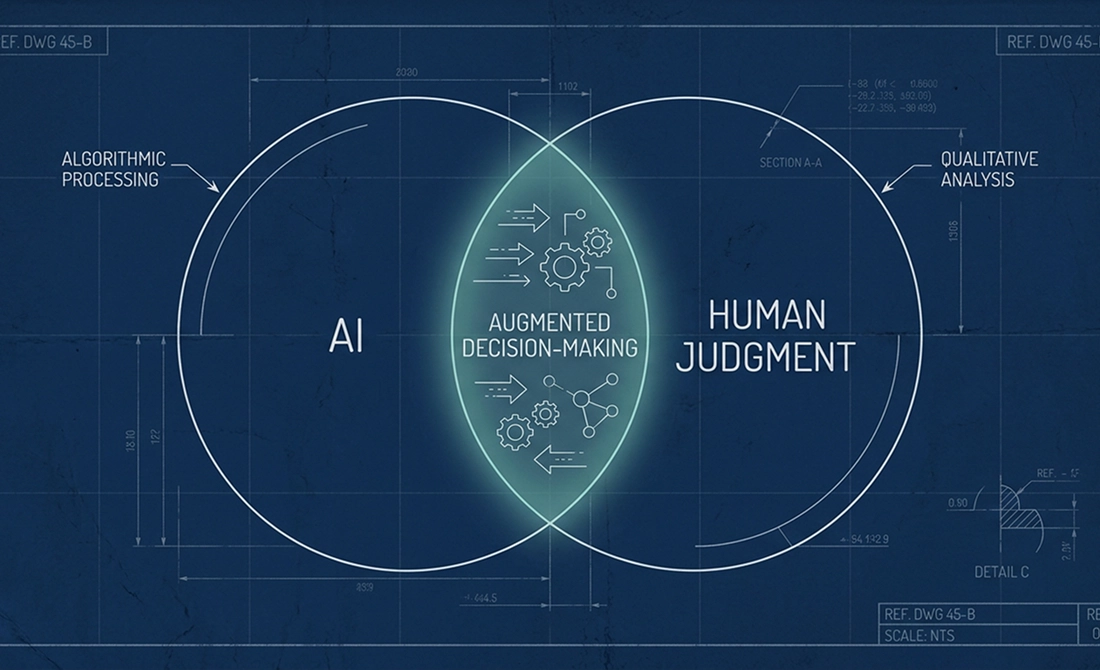



There's a widening gap in Australian supply chains right now, and it's not the one you'd expect. It's not between organisations that have AI and those that don't. It's between organisations that have deployed AI and are getting genuine operational value from it, and organisations that have deployed AI and are quietly wondering why the results don't match the business case.
The Australian Government's National AI Centre tracks AI adoption across the economy, and its Q1 2025 data tells an instructive story. When asked whether AI had helped with supply chain and supplier management, only 14% of surveyed businesses said "definitely." Another 46% said "possibly" — the kind of answer you give when something is technically in place but the results aren't clear enough to point to. The remaining 40% said "unlikely." Meanwhile, industry data from the Supply Chain and Logistics Association of Australia suggests nearly 40% of supply chain leaders report measurable improvements from AI implementation — which means 60% haven't captured those benefits yet.
These numbers don't reflect a technology failure. The AI tools available today — for demand forecasting, inventory optimisation, logistics routing, predictive maintenance, warehouse automation and supply risk management — are genuinely capable. The algorithms work. The platforms are maturing. The cloud infrastructure to run them is accessible and affordable.
What these numbers reflect is an execution failure. Organisations are adopting AI without adequate preparation in the areas that actually determine whether it works: understanding their own readiness, selecting the right use cases, redesigning processes to consume AI outputs, choosing the right technology for their context, running pilots that test the full operating model, building the data foundations that AI depends on, and developing the human capability to work alongside AI tools effectively.
These seven disciplines aren't optional extras that you bolt on after the technology is deployed. They're the work that determines whether your AI investment delivers a 15% improvement in forecast accuracy and a $30 million reduction in inventory — or becomes a line item that finance questions at every budget review.
This article covers all seven, in the order they need to happen, with practical guidance for Australian supply chain and operations leaders who want to get this right.
1. Supply Chain AI Readiness Assessment
Every AI journey should start with an honest answer to a question most organisations skip: are we actually ready for this?
Readiness isn't about whether you can buy an AI tool. Of course you can — the market is flooded with options. Readiness is about whether your organisation has the foundations in place to deploy AI in a way that produces reliable outputs, integrates into operational decision-making, and sustains value over time.
A genuine AI readiness assessment evaluates five dimensions.
Data maturity. AI is only as good as the data it learns from and operates on. For demand forecasting, that means clean, granular historical transaction data at the right level of detail — typically SKU-location-week — with promotional activity, pricing changes, new product introductions and other demand-shaping events accurately captured. For inventory optimisation, it means reliable lead time data, supplier performance history and demand variability metrics. For logistics optimisation, it means accurate delivery windows, vehicle constraints, cost structures and geographic data.
Most Australian organisations have this data somewhere in their systems. The question is whether it's accessible, consistent, integrated and trustworthy. Data quality issues, system fragmentation, inconsistent master data and manual workarounds are the norm. A readiness assessment quantifies where you actually stand — not where you think you stand — against the data requirements of specific AI use cases.
Process maturity. AI tools produce recommendations, forecasts, optimisation outputs and alerts. Those outputs only create value if there's a business process that consumes them. If your S&OP process is dysfunctional, a better demand forecast won't fix it. If your warehouse has no standard operating procedures for pick path management, an AI-optimised slotting recommendation won't translate to throughput improvement. If your procurement team doesn't have a structured approach to supplier risk management, an AI early warning system will generate alerts that nobody acts on.
Process maturity assessment looks at the planning and operations processes that would need to consume AI outputs: demand planning, supply planning, inventory management, S&OP, logistics planning, warehouse management, procurement execution. For each, it evaluates whether the process is defined, followed, measured and governed — because these are the prerequisites for AI integration.
Technology landscape. What systems are currently in place? What's the ERP platform? Is there a warehouse management system? A transport management system? An existing planning tool? What are the integration points and constraints? What's the cloud posture? These questions determine what's technically feasible, what integration work is required, and whether AI tools can plug into the existing architecture or need a parallel infrastructure.
Organisational capability. Do your planners, analysts and operations managers have the skills to work with AI tools? Not to build models — that's a different skill set — but to interpret AI outputs, manage exceptions, configure parameters, and know when to trust the model versus override it. The readiness assessment should evaluate current capability levels across the roles that will interact with AI, identify gaps, and flag the training and development investment required.
Governance and culture. Does the organisation have a framework for managing AI responsibly? This includes data governance (who owns data quality, who authorises data use), model governance (who monitors performance, who recalibrates, who decides when a model should be retired), decision governance (who is accountable when AI-informed decisions go wrong), and cultural readiness (is the organisation open to changing established ways of working based on AI-generated insights, or will there be resistance?).
The Australian Government's 2025 Guidance for AI Adoption sets out six essential practices for responsible AI governance, reflecting a maturing regulatory environment that organisations need to align with. The readiness assessment should evaluate current governance maturity against these expectations.
What the output looks like. A well-executed readiness assessment produces a clear picture of where the organisation stands across all five dimensions, with specific gaps identified and prioritised. It should include a heat map of readiness by AI use case — showing which applications are ready to pursue now, which need foundation work first, and which should be deferred until earlier initiatives have matured. This becomes the basis for a sequenced AI roadmap that's grounded in reality rather than aspiration.
The organisations that skip this step — that jump straight to technology selection or pilot execution — almost always find themselves circling back to readiness issues 6-12 months later, having spent budget and credibility on initiatives that underperformed because the foundations weren't in place.
2. AI Use Case Identification and Business Case Development
With a clear readiness picture in hand, the next step is identifying which AI applications to pursue and building the business cases to justify the investment.
This sounds straightforward. It rarely is. The challenge isn't a shortage of potential use cases — it's an overabundance. Every AI vendor, every conference presentation, every industry report suggests dozens of ways AI could be applied across the supply chain. The risk is either trying to do too many things at once (spreading resources thin and delivering nothing well) or picking the wrong things to start with (choosing technically interesting applications that don't address the organisation's most material operational problems).
Starting with the operational problem, not the technology. The most reliable approach to use case identification starts with a simple question: which operational decisions are currently made most poorly, and which have the largest financial impact?
In supply chain and operations, the decisions that typically offer the highest leverage for AI-assisted improvement include demand forecasting (where machine learning can materially improve accuracy for products with complex demand patterns driven by promotions, seasonality, weather or external signals), inventory optimisation (where AI-driven parameter setting can improve service levels while reducing working capital — particularly valuable in the current interest rate environment), logistics and route optimisation (where AI can reduce transport costs by 5-15% through better vehicle allocation and delivery sequencing — particularly impactful given Australian distances), supply risk and disruption management (where AI can monitor external data sources to provide early warning of disruptions), warehouse operations (from predictive slotting through to demand-driven labour scheduling), and predictive maintenance (where AI can reduce unplanned downtime by identifying equipment failure patterns).
Each of these is a broad category. The use case identification process should drill into the specific version of each that's relevant to the organisation: which product segments have the worst forecast accuracy? Which inventory positions are structurally wrong? Which logistics lanes have the most inefficiency? Where are the biggest maintenance cost drivers?
Quantifying the opportunity. For each candidate use case, the business case needs to quantify the current cost of the problem (excess inventory, lost sales from stockouts, transport cost premium, unplanned downtime cost), the realistic improvement AI can deliver (based on benchmarks, published research and the organisation's specific data characteristics — not vendor claims), the investment required (technology, implementation, data preparation, process redesign, training, ongoing support), and the payback period and return profile.
This is analytical work that requires deep understanding of supply chain economics — understanding total cost of ownership for inventory, the service-level-to-stock-level trade-off, the relationship between forecast accuracy and safety stock requirements, the cost structure of logistics operations. It's strategy work as much as technology work.
Prioritisation. With quantified business cases for multiple use cases, prioritisation should consider both financial attractiveness and readiness. The best starting point is a use case that has high financial impact and where the organisation's data, process and capability foundations are strong enough to support successful deployment. Starting with a lower-impact but higher-readiness use case can also make sense if it builds confidence and capability that enables more ambitious applications later.
The output should be a prioritised portfolio of 3-5 use cases with detailed business cases, clear sequencing, identified dependencies, and a realistic timeline. This becomes the investment case for the AI program — and the accountability framework against which results are measured.
3. AI-Enabled Planning and Operations Process Design
This is where most AI initiatives fall down, and it's the area that gets the least attention. Organisations invest heavily in selecting and implementing AI technology, then try to insert it into planning and operations processes that were designed for a pre-AI world. The result is predictable: the AI tool produces outputs that don't fit the existing workflow, planners don't know what to do with them, and the system either gets ignored or creates more work rather than less.
AI-enabled process design means redesigning the planning and operations processes — not just adding AI as an input — so that the entire workflow takes advantage of what AI makes possible.
What changes when AI enters the planning process. Consider demand planning as an example. In a traditional process, planners spend the majority of their time generating the statistical baseline forecast, then adjusting it based on market intelligence, promotional plans, sales team input and other qualitative factors. The S&OP cycle revolves around reviewing and reaching consensus on the forecast.
When AI handles the statistical forecasting — and does it better, faster and more granularly than manual methods — the planner's role fundamentally changes. They shift from forecast generation to forecast management: reviewing AI outputs, focusing attention on the exceptions and outliers where human judgement adds value, incorporating market intelligence that the model can't access, and making the cross-functional trade-off decisions that require business context.
This is a better use of skilled planners' time. But it requires a redesigned process that defines how AI forecasts are generated and reviewed, what exception thresholds trigger human intervention, how the planner's adjusted forecast feeds into the S&OP cycle, what governance ensures the AI model stays calibrated, and how forecast accuracy is measured and reported.
The same principle applies across other domains. AI-optimised inventory parameters need a process for planner review and override. AI-generated route plans need a process for driver exceptions and real-time adjustment. AI supply risk alerts need an escalation and response framework.
Designing the target operating model. For each AI use case, the process design work should define the end-to-end workflow (how does the AI-enabled process work, step by step, from data input through to operational decision?), the role of the planner or operator (what does the human do that the AI doesn't, and how do they interact with the system?), the exception management framework (what triggers human intervention, and what's the process for handling exceptions?), the governance rhythm (how often are AI outputs reviewed, who is accountable for model performance, what are the escalation paths?), and the performance measurement framework (how do we know the AI-enabled process is delivering better outcomes than the previous approach?).
This is organisational design work applied to AI-enabled operations. It requires understanding both the technical capabilities of the AI tool and the operational realities of the planning or operations environment — how planners actually work, what information they need, where they add value, and what frustrates them about current processes.
The S&OP connection. For organisations with a formal S&OP or integrated business planning process, AI-enabled planning has significant implications. AI can accelerate the demand planning phase, improve the quality of scenario modelling, provide more granular inventory trade-off analysis, and enable faster response to demand or supply changes between formal planning cycles. But these benefits only materialise if the S&OP process is redesigned to take advantage of them — if the meeting cadence, the information packs, the decision frameworks and the accountability structures all reflect the new AI-enabled capability.
Trace has written extensively about S&OP and planning process design — organisations looking at this intersection should also review our thinking on planning and operations process maturity and our guide to Advanced Planning Systems which covers how APS capabilities integrate with planning processes.
4. AI Technology Selection and Vendor Advisory
With clear use cases, quantified business cases and a target process design, the organisation is ready to evaluate technology options. Not before.
The sequence matters because technology selection should be driven by defined requirements — not the other way around. Too many organisations start with a technology shortlist and then try to find use cases that justify the purchase. This leads to solutions looking for problems, features that don't map to actual decision-making needs, and implementations that are technically impressive but operationally irrelevant.
The AI technology landscape for supply chain and operations. The options fall into four broad categories.
Embedded AI within existing platforms. Your ERP vendor's demand planning module may now include ML-based forecasting. Your WMS might offer AI-powered slotting optimisation. Your TMS may have added AI routing capabilities. These embedded capabilities are typically the easiest to deploy (no new integration required) but may be less sophisticated than specialist tools.
Best-of-breed AI point solutions. Standalone platforms focused on specific use cases — demand sensing, inventory optimisation, logistics route optimisation, predictive maintenance, supply risk monitoring. These typically offer deeper functionality for their specific domain but create integration requirements and add another vendor relationship to manage.
Advanced Planning Systems with native AI. The dedicated supply chain planning platforms — Kinaxis, Blue Yonder, o9 Solutions, SAP IBP, RELEX, Logility and others — increasingly embed AI and ML capabilities across their planning modules. For organisations considering a broader planning transformation, these platforms offer comprehensive capability but require significant implementation investment.
General-purpose AI and analytics platforms. Cloud ML platforms (AWS SageMaker, Google Cloud AI, Azure ML) and business intelligence tools with predictive capabilities can be configured for supply chain use cases. These offer maximum flexibility but require more internal technical capability to deploy and maintain.
How to evaluate. The evaluation approach should mirror the structured RFx process we recommend for any significant technology selection, but with specific adaptations for AI.
First, evaluate against defined use cases, not feature lists. The question isn't "does this platform support demand forecasting?" (they all do). It's "does this platform's forecasting capability handle our specific demand patterns — high promotional variability, long-tail SKUs, new product introductions with no history — better than alternatives?"
Second, insist on demonstrations with representative data. Canned demos tell you nothing about how the system will perform in your environment. Provide shortlisted vendors with a sample dataset that reflects your real data characteristics and ask them to demonstrate their system's outputs against defined scenarios.
Third, evaluate the implementation approach and partner ecosystem as heavily as the software. For AI tools specifically, the quality of model configuration, data engineering and calibration during implementation determines the majority of the outcome. A superior algorithm badly implemented will underperform an adequate algorithm well implemented.
Fourth, assess total cost of ownership, not just licensing. Implementation services, data engineering, integration development, training, change management and ongoing model monitoring and recalibration typically represent 60-70% of the total investment.
Fifth, evaluate local capability. For Australian organisations, the vendor's or partner's presence and experience in the ANZ market matters. Long inbound supply chains, Australian seasonal patterns, concentrated retail customers and specific regulatory requirements create a context that global vendors may not have deep experience with.
The procurement disciplines of structured evaluation, commercial benchmarking and negotiation are just as important for AI technology selection as for any other significant purchase — perhaps more so, given the complexity and the risk of vendor lock-in.
5. AI Pilot Design and Execution Support
Before committing to full-scale deployment, most organisations benefit from a structured pilot that tests whether the AI tool, configured for their data and integrated into their process, actually produces better operational outcomes than the current approach.
The key word is "structured." An AI pilot isn't a sandbox experiment where data scientists play with models to see what's possible. It's a controlled operational test with defined scope, clear success metrics, baseline measurement, and a rigorous evaluation framework that determines whether to scale, adjust, or stop.
Designing the pilot. A well-designed AI pilot defines several critical elements.
Scope. Which products, which locations, which planning horizon, which operational process? The scope should be large enough to be representative but small enough to be manageable. For a demand forecasting pilot, this might mean a specific product category across a defined set of locations over a 12-16 week period. For an inventory optimisation pilot, it might mean a subset of SKUs in a defined part of the distribution network.
Baseline. What does "current performance" look like, measured rigorously? If you're testing AI-driven demand forecasting, you need a clean baseline of current forecast accuracy by SKU, by location, by time horizon — measured consistently over a period long enough to account for normal variability. Without a solid baseline, you can't measure improvement.
Success metrics. What does "better" look like, quantified? A 10% improvement in forecast accuracy at SKU-week level? A 15% reduction in safety stock without service degradation? A 7% reduction in transport cost per delivery? The metrics should be defined before the pilot starts, agreed with stakeholders, and directly traceable to the business case.
Operating model for the pilot period. How will planners or operators interact with the AI tool during the pilot? Will they use AI outputs as their primary input (replacing the current approach) or run in parallel (comparing AI outputs against current methods)? Parallel running is safer but less realistic — planners who know they have a fallback behave differently than planners who are depending on the new tool. The pilot design should specify the operating model clearly.
Duration. The pilot needs to run long enough to test performance across different demand conditions — not just steady-state weeks but promotional periods, seasonal transitions, supply disruptions and other real-world variability. For most supply chain use cases, 12-16 weeks is a reasonable minimum.
Evaluation framework. How will the pilot be evaluated? Who reviews the results? What threshold of improvement justifies scaling? What happens if results are mixed — some metrics improve, others don't? The evaluation framework should be defined upfront, not designed retrospectively to fit the results.
Testing the full operating model. The most important — and most frequently missed — aspect of pilot design is testing the full operating model, not just the technology. This means evaluating whether planners are actually using the AI outputs in their decision-making, whether the process changes are working as designed, whether exceptions are being managed appropriately, and whether the results are genuinely better than the current approach across the full range of real-world conditions.
A pilot that demonstrates impressive algorithmic accuracy in a test environment but doesn't test whether planners trust and use the outputs is answering the wrong question. The question isn't "can this model forecast well?" It's "does this model, used by our planners, in our process, with our data, produce better operational decisions than what we do today?"
The scale decision. At the end of the pilot, the organisation faces a clear decision: scale, adjust, or stop. If the pilot demonstrates clear, measurable improvement against the defined success metrics — and the operating model is working — the case for scaling is strong. If results are mixed, the pilot data should inform what needs to change before scaling (data quality issues? process gaps? model configuration? planner training?). If results are poor despite good execution, that's also valuable information — it means this particular use case, with this particular tool, in this particular context, doesn't deliver the expected value.
Honest evaluation at this stage — rather than confirmation bias that justifies the investment already made — is what separates organisations that deploy AI effectively from those that scale failures.
6. Data Readiness and Foundation Work
If there's one section of this article that deserves to be read twice, it's this one. Data readiness is the single largest determinant of AI success in supply chain and operations, and it's the area where organisations most consistently underinvest.
Every AI model — whether it's forecasting demand, optimising inventory, routing deliveries or predicting equipment failures — depends on data. The quality, completeness, granularity and accessibility of that data determines the ceiling of what AI can achieve. No algorithm, however sophisticated, can overcome fundamentally poor data.
What "data ready" actually means. For supply chain AI applications, data readiness typically requires several things.
Clean historical transaction data. For demand forecasting, this means order or shipment history at the right level of granularity (SKU-location-day or week), with anomalies identified and addressed (one-off bulk orders, data entry errors, system migration artefacts), and sufficient history to train models effectively (typically 2-3 years minimum, more for seasonal products).
Accurate demand-shaping event data. Promotions, pricing changes, new product introductions, range deletions, competitor activity — the events that cause demand to deviate from underlying patterns. AI models can learn from these events, but only if they're captured accurately in the data. Most organisations have promotional calendars, but the linkage between promotions and transaction data is often incomplete or inaccurate.
Reliable master data. Product hierarchies, location hierarchies, supplier data, customer segmentation, lead times, minimum order quantities, shelf life constraints — the reference data that AI models use to structure their analysis. Master data quality is a pervasive challenge in Australian organisations, and it directly impacts AI model performance.
Integration and accessibility. Data often sits in multiple systems — ERP, WMS, TMS, point of sale, CRM, external data sources — and needs to be brought together in a form that AI tools can consume. This requires data integration pipelines, potentially a data warehouse or data lake, and APIs or connectors to the AI platform.
Timeliness. Some AI applications require near-real-time data (logistics optimisation, warehouse operations), while others work on daily or weekly data cycles (demand planning, inventory optimisation). The data infrastructure needs to support the refresh frequency that each use case requires.
The foundation work. Getting data ready is unglamorous, time-consuming work. It includes data profiling and quality assessment (understanding what you have, where the gaps are, and how severe the quality issues are), data cleansing and enrichment (fixing historical anomalies, filling gaps, enriching transaction data with event data), master data governance (establishing ownership, standards, processes and tools for maintaining data quality on an ongoing basis — because data quality degrades continuously without active management), integration development (building the pipelines that bring data together from multiple sources into a form AI tools can consume), and data architecture design (determining where data lives, how it flows, and what infrastructure supports it).
This work should begin early — ideally during the readiness assessment phase — and continue in parallel with use case development and technology selection. It's the longest-lead-time activity in most AI programs, and it's the one most commonly underestimated.
The ongoing challenge. Data readiness isn't a one-time project. It's a continuous discipline. Data quality degrades as products change, systems are updated, processes evolve and people make mistakes. AI models trained on historical data gradually lose accuracy as the underlying patterns shift. Master data requires ongoing maintenance as the business changes.
This is why data governance — the ongoing organisational capability to maintain data quality — matters as much as the initial data cleansing effort. Without it, the AI investment delivers diminishing returns over time as the data foundations erode.
For organisations across FMCG and manufacturing, retail and consumer, resources and energy and government and defence, data readiness challenges take different forms — but the fundamental principle is the same: invest in the data foundation before investing in the AI tool, and establish the governance to sustain it.
7. AI-Focused Capability Building and Training
The final discipline — and the one that determines whether AI delivers value in year one only or compounds value over time — is building the human capability to work effectively alongside AI tools.
This isn't about turning planners into data scientists. It's about developing a set of practical skills that enable supply chain and operations professionals to get the most from AI-enabled tools and processes.
What AI-literate supply chain professionals need to know. The capability requirements fall into several layers.
Interpreting AI outputs. Understanding what a demand forecast from an ML model represents — including its confidence intervals, its assumptions, and its known limitations. Understanding what an inventory optimisation recommendation means — why the model is suggesting a particular safety stock level, what inputs are driving it, and what would change if assumptions shifted. This isn't deep technical knowledge; it's practical literacy that allows professionals to use AI outputs intelligently rather than either blindly following them or reflexively ignoring them.
Managing exceptions. Knowing when and how to override AI recommendations. AI models work well for the majority of routine decisions but struggle with genuine exceptions — unprecedented events, data quality issues, business context the model can't see. Building the judgement to recognise these situations — and the confidence to intervene — is a critical skill that comes from training, practice and organisational support.
Configuring and monitoring. Understanding how to adjust parameters that the AI tool exposes — service level targets, demand segmentation rules, exception thresholds, scenario assumptions. Knowing how to monitor whether the model is performing as expected and recognising the signs of degradation (declining accuracy, increasing exceptions, outputs that don't align with business reality).
Asking better questions. Perhaps the most valuable capability shift is moving from "generating the answer" (which AI now handles) to "asking better questions." What scenarios should we test? What assumptions should we challenge? What trade-offs should we explore? What risks aren't reflected in the data? This is where experienced supply chain professionals add the most value in an AI-enabled world — and it's a capability that needs to be actively developed, not assumed.
How to build it. Capability building for AI-enabled operations typically involves several components.
Assessment. Understanding the current capability baseline across the roles that will interact with AI tools — planners, analysts, operations managers, supply chain leaders. What's the current level of data literacy? Analytical skill? Comfort with technology? Openness to changing established ways of working?
Training programs. Structured learning that covers the practical skills outlined above — tailored to specific roles and specific AI tools. This isn't generic "AI awareness" training; it's hands-on instruction using the actual systems and processes the team will work with. It should include real data, real scenarios and real decision-making practice.
Playbooks and reference material. Documentation that supports ongoing performance — standard operating procedures for AI-enabled processes, exception management guides, parameter configuration guides, troubleshooting resources. These should be living documents that evolve as the organisation's AI capability matures.
Coaching and support. Particularly in the early stages of AI adoption, planners and operators benefit from accessible support — someone who can help when the model produces an output they don't understand, when they're unsure whether to override a recommendation, or when they encounter a situation the training didn't cover.
Communities of practice. As AI adoption scales across the organisation, connecting practitioners — planners in different sites, analysts in different categories, operators in different facilities — creates a peer learning network that accelerates capability development and shares best practice.
The leadership dimension. Capability building isn't just about frontline users. Supply chain leaders need their own capability development — not in how to use AI tools, but in how to lead AI-enabled organisations. This includes understanding what AI can and can't do (to set realistic expectations), how to interpret AI-related performance metrics (to make informed governance decisions), how to allocate resources between AI investment and other priorities (to make sound trade-offs), and how to create a culture that embraces AI-enabled ways of working while maintaining appropriate scepticism and human oversight.
Strategic workforce planning for AI-enabled supply chains should address this leadership dimension alongside the frontline capability requirements — because leadership buy-in and capability is what sustains AI adoption beyond the initial implementation.
The partnership model: where to build and where to partner
One of the most important strategic decisions for organisations adopting AI in supply chain and operations is what to build internally versus what to source from external partners.
In our view, the answer is clear for most Australian organisations. The capabilities that should be built internally — because they're core to operational performance and need to be sustained over time — are AI literacy across the planning and operations team, process design and governance for AI-enabled operations, data governance and quality management, and performance monitoring and continuous improvement.
The capabilities that are typically better sourced from external partners — because they require specialist skills that aren't needed on a full-time basis — are AI model development and engineering (the deep technical work of building, training and deploying models), technology platform implementation and integration, advanced data engineering for initial setup and migration, and strategic advisory on AI roadmap, technology selection and organisational readiness.
This is where the distinction between AI engineering firms and supply chain advisory firms matters. AI engineering firms bring deep technical capability in building and deploying AI systems — custom model development, agentic AI frameworks, large language model integration, deployment infrastructure. They're the right partner for the model development, platform engineering and technical deployment work. Supply chain advisory firms bring the domain expertise to ensure AI is applied to the right problems, embedded in the right processes, and supported by the right organisational capability.
The most effective AI programs use both: domain experts who understand the operational context and define what needs to happen, partnered with technical experts who know how to make it happen. Neither alone is sufficient. An AI engineering firm without supply chain domain expertise will build technically impressive solutions that don't address the most valuable operational problems. A supply chain advisory firm without AI engineering capability can design the right solution but can't build the models. The partnership model brings both together.
For Australian organisations specifically, this model has a practical advantage. The local talent market for deep AI engineering skills is tight and expensive. Building a permanent internal team of ML engineers, data scientists and AI architects is feasible for the largest organisations but impractical for most. A partnership model lets organisations access world-class AI engineering capability on a project basis while building the internal domain expertise and operational capability that sustains value over time.
How Trace Consultants can help
At Trace Consultants, we sit firmly on the domain expertise side of this partnership model. We don't build AI models. We make sure the AI investments you make actually work in your operations.
Our role in AI adoption spans all seven of the disciplines covered in this article:
AI readiness assessment. We assess your data maturity, process maturity, technology landscape, organisational capability and governance readiness — producing a clear, honest picture of where you stand and what needs to happen before AI can deliver value. This is strategy work grounded in practical supply chain experience.
Use case identification and business case development. We identify the highest-value AI applications for your specific operation, quantify the opportunity with rigour, and build business cases that stand up to scrutiny. Our deep understanding of supply chain economics — from inventory optimisation to logistics cost structures to procurement spend analysis — ensures use cases are anchored in real operational value.
AI-enabled process design. We redesign planning and operations processes to take advantage of what AI makes possible — defining workflows, roles, exception management, governance and performance measurement for AI-enabled operations. This is organisational design work that bridges the gap between technology capability and operational reality.
Technology selection and vendor advisory. We help you navigate the AI technology landscape with an independent, informed perspective — evaluating embedded capabilities, best-of-breed tools and APS platforms against your specific requirements through structured procurement processes. Our technology advisory ensures you select the right tool for your context, not the most impressive demo.
Pilot design and execution support. We design structured AI pilots with clear scope, success metrics, baseline measurement and evaluation frameworks — ensuring you test the full operating model, not just the technology. Our project and change management capability ensures pilots run smoothly and produce the information needed for sound scaling decisions.
Data readiness and foundation work. We support the data quality, master data governance, integration planning and data architecture work that determines whether AI tools produce reliable outputs. This isn't glamorous work — but it's the work that protects your AI investment.
Capability building and training. We develop and deliver practical training programs that build AI literacy across supply chain and operations teams — from frontline planners to senior leaders. Our strategic workforce planning expertise ensures capability development is structured, role-specific and sustainable.
Our independence matters. We don't sell AI software. We don't build AI models. We don't have partnership arrangements with AI vendors that influence our recommendations. Our advice is based entirely on what will deliver the best operational outcome for your organisation — which technology, which use cases, which sequencing, which partnerships.
We work across FMCG and manufacturing, retail and consumer, resources and energy, health and human services, and government and defence — bringing cross-sector perspective on what works in practice, not just in theory.
Getting started
AI in supply chain and operations isn't a future state. It's happening now, in Australian organisations across every sector. But the organisations capturing value aren't the ones with the most ambitious AI strategies or the largest technology budgets. They're the ones that got the foundations right: honest readiness assessment, disciplined use case selection, thoughtful process design, structured technology evaluation, rigorous pilots, serious data work, and genuine investment in human capability.
Every one of those seven disciplines is within reach of any Australian organisation with the commitment to do them properly. The technology will follow — and when it does, it will land on foundations that actually support it.
If your organisation is ready to move beyond AI aspiration and start building the operational capability that makes AI work, we'd welcome the conversation.