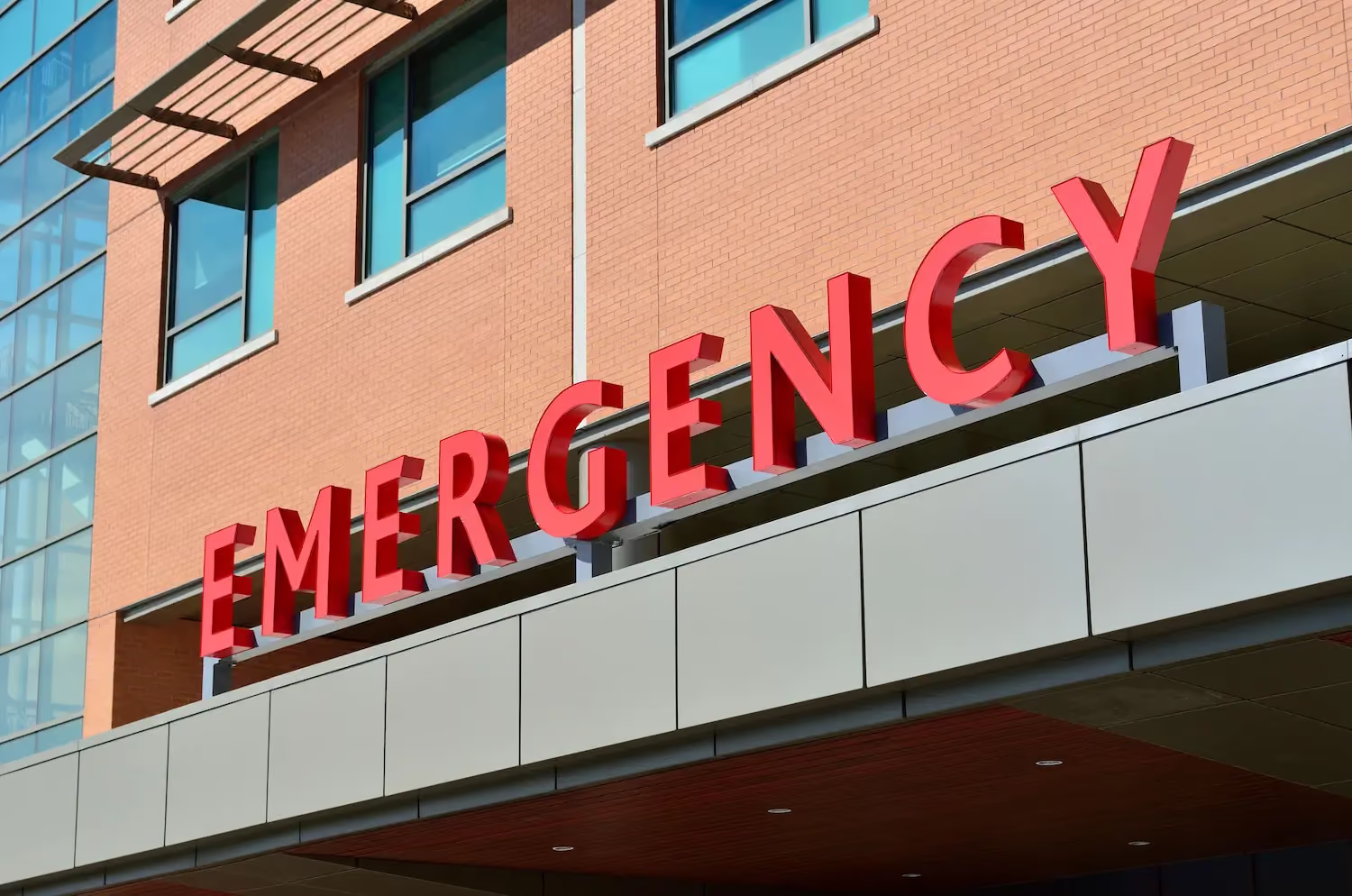


The passenger in Gate 42 waiting for a flight, and the fan in Row J waiting for kick-off, share something in common: neither sees the logistics operation that makes their experience possible. Every coffee served at a terminal café, every beer poured at a stadium concourse, every piece of merchandise stocked in a retail outlet, and every bin emptied before it overflows has a supply chain behind it — one that operates in environments of extraordinary complexity, under extreme time pressure, and with very little margin for failure.
Airports and stadiums are among the most demanding logistics environments in Australia. They concentrate enormous volumes of goods and waste into tight physical spaces, operate on non-negotiable schedules, manage multiple competing stakeholders with conflicting access needs, and face regulatory constraints — biosecurity, aviation security, food safety, work health and safety — that have no equivalent in conventional distribution operations. When the logistics works, it is invisible. When it fails, the consequences cascade immediately into the front-of-house experience.
This article explains what world-class goods and waste logistics looks like in airport and stadium environments: the design principles, the operating model, the technology, the waste strategy, and where most Australian venues are currently underperforming.
The Unique Logistics Challenge of Complex Venues
Airports and stadiums share a structural characteristic that defines everything about their logistics challenge: they are multi-tenant, multi-operator environments serving a public whose experience depends on all of those operators performing simultaneously.
A major Australian airport terminal — Melbourne's T2, Sydney's T1, Brisbane's domestic terminal — hosts dozens of retail concessionaires, multiple food and beverage operators, airline lounges, contracted maintenance and cleaning providers, and a security and safety infrastructure, all operating from a single physical plant with shared loading infrastructure and shared waste streams. No single operator controls the full system. The airport authority sets the rules, allocates the infrastructure, and bears the reputational consequence of operational failure, but each operator manages their own supply chain to the dock, their own inventory within their concession, and their own compliance with the standards the airport sets.
A major stadium — MCG, SCG, Optus Stadium, Accor Stadium, Adelaide Oval — presents a variant of the same challenge, compressed into an even tighter operational window. Match-day logistics involves dozens of food and beverage operators, merchandise outlets, and operational contractors, all taking delivery in a multi-hour window before the event, operating through the event at peak demand, and generating concentrated waste streams immediately after it. The operational peak is extreme: at a sold-out event at the MCG, a single concourse outlet may sell thousands of beverages in a two-hour period, generating equivalent volumes of packaging waste that must be removed without disrupting the fan experience or creating safety hazards.
The complexity that makes these environments distinctive — multiple stakeholders, shared infrastructure, extreme peaks, regulatory constraints, public visibility — is also what makes logistics improvement so high-value. Incremental operational improvement in a complex venue has an outsized impact on both cost and experience.
The Goods-In Framework: From Kerb to Concession
In airport logistics, the goods flow is typically described as Goods In, Waste Away (GIWA) — the bidirectional flow that sustains terminal operations. Understanding that framework, and where the constraints within it typically sit, is the starting point for improvement.
The Landside Constraint: Service Yards and Loading Docks
For most Australian airports and stadiums, the binding constraint on goods-in operations is the service yard and loading dock infrastructure — the physical bottleneck through which all inbound goods must pass before reaching the concession or outlet they are destined for.
Service yard capacity is typically designed to the projected average daily delivery volume at the time the facility was built — which, for older terminals and many stadiums, was a fraction of current volume. As the number of concessionaires grows, as delivery frequencies increase, and as operator-specific delivery windows narrow, the service yard becomes chronically congested. The visible symptoms are queuing delivery vehicles, delays to time-sensitive chilled deliveries, conflict between inbound goods and outbound waste streams, and the security risk created by unvetted vehicles waiting unsupervised in service areas.
The three levers for addressing the landside constraint are:
Delivery scheduling and slot management. Implementing a time-slot booking system — in which every supplier books a specific delivery window rather than arriving at will — transforms the service yard from a first-come-first-served queue into a managed flow. Delivery scheduling reduces peak congestion, improves dock utilisation across the day, and creates the visibility needed to plan staffing and equipment allocation. For airports and stadiums with high delivery volumes, a purpose-built dock management platform — tracking vehicle arrival, bay allocation, unload time, and departure — produces significant operational improvement at relatively modest cost.
Consolidation centres. For airports with high concessionaire density and complex security screening requirements, a consolidation centre — a purpose-built or repurposed facility on or adjacent to the airport precinct, operated by a logistics provider, into which all supplier deliveries are consolidated before final distribution to terminal concessions in a smaller number of trips — is increasingly recognised as best practice. Consolidation centres compress supply chains, reduce vehicle movements, and centralise security screening before airside transfer. GetTransport London Luton Airport's recently commissioned consolidation centre, designed to process inbound goods for more than forty shops and restaurants, illustrates the model: fewer vehicles accessing the terminal, tighter security controls, and more predictable on-shelf availability for concessionaires.
In Australia, Western Sydney International Airport — due to open in 2026 as Australia's first freight-first airport — has an opportunity to embed consolidated goods-in logistics in its design from the outset, rather than retrofitting it to an existing terminal. Melbourne Airport's ADP T2 project and other major terminal upgrades offer similar opportunities, and the logistics design decisions made at the master planning stage will shape operational performance for decades.
Physical infrastructure upgrades. Where the service yard or loading dock configuration is the primary constraint, physical upgrades — additional dock doors, improved hardstand, dock levellers, separation of inbound and outbound flows, undercover unload areas for chilled goods, improved lighting and safety infrastructure — are the prerequisite for operational improvement. Technology and scheduling cannot fully compensate for fundamental physical capacity constraints.
The Vertical and Horizontal Flow Problem
In multi-level terminals and stadiums, goods reaching the service yard still need to travel to their point of consumption — which may be multiple levels above the dock, through corridors shared with staff, contractors, and in some cases passengers. The vertical and horizontal flow of goods through the building is a logistics problem that is frequently underestimated in facility design and chronically under-managed in operations.
The constraints are predictable: lifts sized for the original delivery volumes that are now undersized for current throughput, service corridors that have been progressively narrowed by other uses, congestion points at lift lobbies and staging areas, and inadequate cold-chain infrastructure for the journey from dock to concession storage. In venues operating cold chain products — chilled beverages, fresh food, dairy — every minute of unchained cold exposure between the delivery vehicle and the concession storage is a food safety risk and a quality issue.
Designing the internal goods flow properly — with routes that separate goods movement from staff movement, lift capacity sized for peak delivery volume, appropriately placed staging areas, and cold-chain handoff points — is as important as designing the service yard, and in most Australian venues is addressed less rigorously.
Waste: The Overlooked Half of the System
Waste management in complex venues is the operational challenge that receives the least strategic attention and consistently creates the most visible operational failures. Full bins in public areas, overflow at collection points, waste contaminating recycling streams, and post-event waste removal blocking ingress and egress are all symptoms of waste infrastructure that has not been designed or resourced to match the demand placed on it.
Volume and Stream Complexity
The waste volumes generated by a major airport or stadium are large and operationally complex. At a sold-out stadium event, the volume of packaging waste, food waste, and hazardous waste (oils, chemicals, clinical) generated in a three-to-four-hour operating window can exceed the daily waste output of a medium-sized commercial building. At a major airport terminal, the continuous 24-hour operation generates a sustained waste stream across multiple concurrent sources: concession food waste, retail packaging waste, aircraft waste (subject to specific biosecurity requirements), cleaning waste, and construction and maintenance waste from the ongoing works that are a permanent feature of operating airport environments.
Managing these volumes requires a waste infrastructure that matches the throughput — sufficient collection points, appropriate compaction equipment, waste streams segregated at the point of generation to enable recycling compliance, and a collection schedule that clears primary collection points before they reach capacity.
The waste stream complexity in these environments is also significant. International aircraft waste requires incineration or controlled landfill disposal under biosecurity regulations — it cannot enter the standard waste stream regardless of its apparent composition. Food waste from kitchens and concessions needs to be separated from general waste to comply with increasingly stringent Australian organic waste diversion targets — the National Waste Policy Action Plan targets halving the volume of organic waste sent to landfill by 2030. Hazardous waste requires separate handling. Cardboard, glass, plastics, and metals each require their own collection infrastructure if recycling targets are to be achieved.
Circular Economy and Sustainability Obligations
Australian airports and stadiums are under increasing pressure — from operators, from tenants, from regulators, and from the public — to improve their waste diversion rates and reduce landfill dependency. The ASX-listed property groups and institutional investors that own many of Australia's major airports and stadiums have published sustainability commitments that include waste diversion targets, and those commitments flow down to the operating models of the venues they own.
Achieving credible waste diversion rates in a complex venue requires more than adding recycling bins. It requires: source segregation infrastructure designed into the venue (bins configured and labelled for specific waste streams at every collection point), operational protocols that ensure segregation is maintained through the collection and compaction process, supplier packaging standards that minimise non-recyclable materials entering the venue, tenant engagement programmes that ensure all operators are compliant with venue waste policies, and reporting infrastructure that tracks diversion rates by stream and by operator.
Venues that treat waste management as a cleaning contract rather than a logistics system consistently underperform against their sustainability commitments and generate operational problems — full bins, contaminated recycling, complaints from operators and patrons — that are ultimately more expensive to manage than a well-designed waste system would have been.
The Multi-Stakeholder Governance Problem
The most difficult aspect of goods and waste logistics in airports and stadiums is not the physical or technological challenge — it is the governance challenge of managing a logistics system across multiple operators with different commercial interests, different supply chains, and different views about who is responsible for what.
An airport authority or stadium operator that owns the venue and the infrastructure but does not directly operate the concessions has a structural governance challenge: it bears the reputational and operational consequence of logistics failures, but does not directly control the supply chains that create them. Concessionaires have no inherent incentive to comply with delivery scheduling if non-compliance does not cost them anything. Suppliers have no inherent incentive to use consolidation infrastructure if direct delivery is more convenient for them.
Effective governance requires: clearly articulated standards for delivery scheduling, vehicle type, goods presentation, and waste management, embedded in concessionaire leases with enforceable compliance mechanisms; a venue logistics manager or logistics coordinator role with the authority and the tools to manage the system across all operators; performance visibility — dock throughput, delivery compliance, waste diversion rates — that creates accountability across the operator base; and supplier engagement that extends the governance framework to the transport and logistics providers whose vehicles are actually arriving at the dock.
Venues that invest in this governance infrastructure consistently outperform those that rely on goodwill and best efforts across their tenant base. The difference is visible in dock congestion, in waste diversion rates, and ultimately in the front-of-house experience for passengers and fans.
Technology: From Spreadsheets to Smart Venues
The technology gap in Australian airport and stadium logistics is significant. Many venues are still managing delivery scheduling via phone and email, tracking waste collection via paper-based checklists, and managing dock congestion reactively rather than predictively. The technology exists to do substantially better, and the cost of deploying it has fallen to the point where the business case is achievable for venues of meaningful scale.
Dock management and delivery scheduling platforms — including purpose-built solutions and configurations of standard appointment scheduling software — provide real-time visibility of dock occupancy, vehicle queue, and unload status. They enable delivery window booking by suppliers, automated reminders and compliance tracking, and the operational data needed to optimise dock staffing and equipment allocation.
Real-time waste monitoring — bin sensors that track fill levels and trigger collection alerts — reduces the frequency of overflow incidents, optimises collection routes, and provides the usage data needed to calibrate bin placement and collection frequency against actual demand patterns. For venues with large concourse areas across multiple levels, real-time waste monitoring is the difference between reactive bin management (responding after overflow) and proactive management (collecting before the problem occurs).
Venue-wide visibility dashboards — integrating dock management, waste monitoring, cold-chain compliance tracking, and CCTV — give operations teams the situational awareness to manage the full logistics system in real time, rather than responding to individual incidents as they arise.
How Trace Consultants Can Help
At Trace Consultants, goods and waste logistics for complex venues is one of our most distinctive practice areas. We have designed, assessed, and improved BOH logistics operations for integrated resorts, airport terminals, stadiums, and other complex venue environments — combining the supply chain methodology, the operational design expertise, and the sector knowledge that this work requires.
Our engagement model in this space covers the full spectrum: rapid diagnostics and time-and-motion studies to quantify the current state and identify the highest-value interventions; infrastructure design advisory for new builds and major refurbishments; operating model design covering delivery scheduling, consolidation, waste management, and governance; technology selection and implementation; and ongoing performance management frameworks.
We bring BOH Logistics expertise alongside Procurement capability — ensuring that the commercial structures with logistics providers, waste contractors, and equipment suppliers support the operating model rather than undermining it. And we bring Supply Chain Sustainability thinking to waste strategy, ensuring that circular economy and diversion commitments are operationally grounded rather than aspirational.
Our clients in this space include major Australian integrated resorts, airport operators, and stadium managers. The work typically starts with a focused diagnostic — a two to three week assessment of the current goods-in and waste-away operation that quantifies the gap against best practice and identifies the priority interventions. From there, the improvement programme can be scoped and sequenced.
Explore our BOH Logistics capability →
The Opportunity in Plain Sight
The goods and waste logistics of airports and stadiums is genuinely difficult. But the difficulty is well understood — the design principles, the governance frameworks, the technology, and the operating models that work are known. The gap between current Australian practice and world-class performance in this space is not a knowledge gap. It is an investment and prioritisation gap.
Venues that treat their BOH logistics as a strategic operational capability — designing it properly, governing it rigorously, and continuously improving it with good data — achieve lower operating costs, fewer service failures, better sustainability outcomes, and a front-of-house experience that reflects the standard the venue aspires to. Venues that treat it as a facilities management overhead consistently underperform on all of those dimensions.
The logistics operation that the passenger and the fan never see is the one that determines whether they come back.
Explore our BOH Logistics capability →