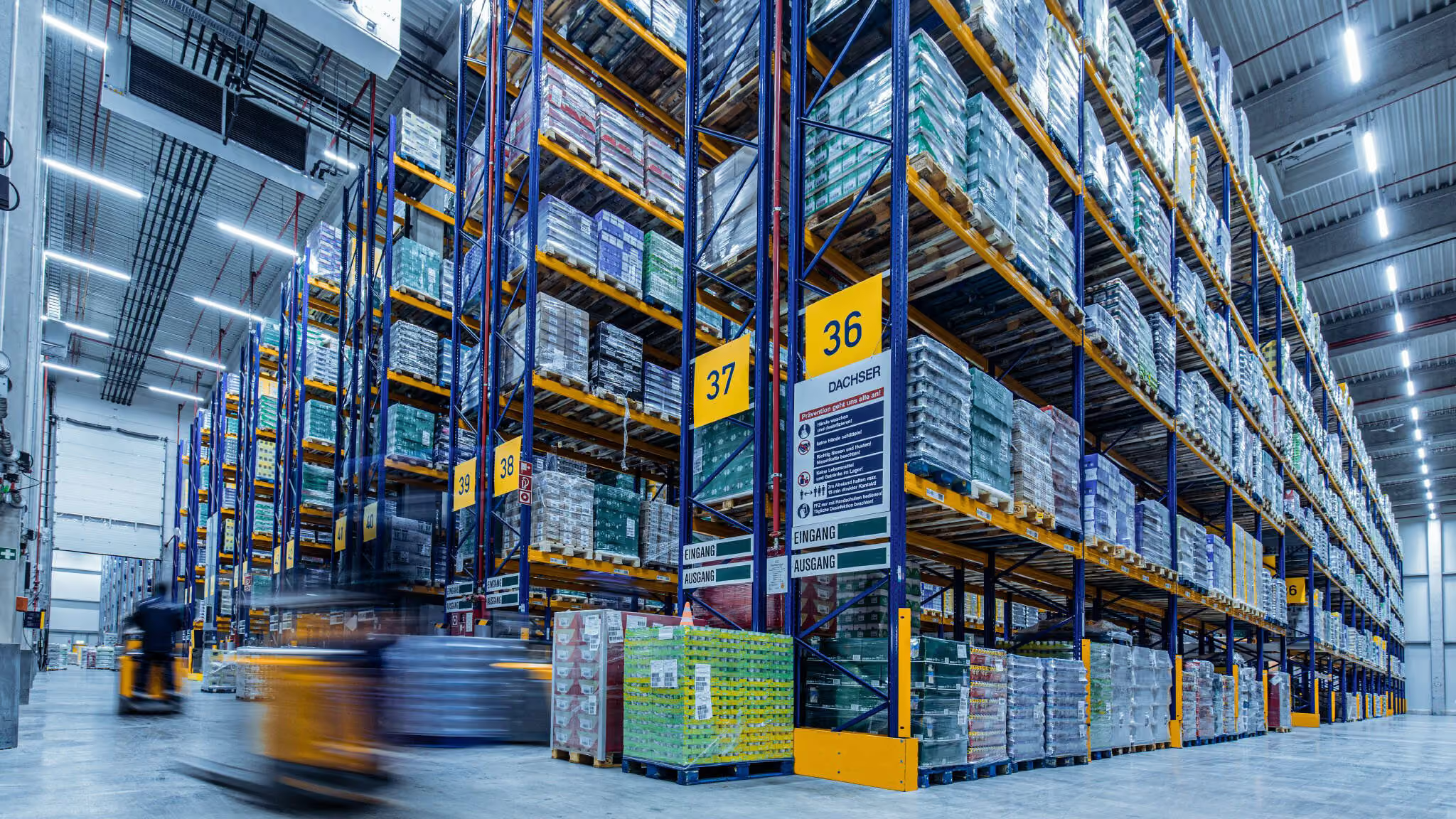
The 2026 decision framework for Australian businesses choosing between an ERP warehouse module and a dedicated Warehouse Management System.
WMS vs ERP Warehouse Module: Which Does Your Business Actually Need?
The most common decision facing Australian operations leaders considering warehouse technology is also the most poorly answered: do we use the warehouse module inside our ERP, or do we buy a dedicated Warehouse Management System? The ERP vendor will tell you their module is enough. The WMS vendor will tell you it absolutely is not. Both have a commercial interest in the answer. Neither is wrong in every case, but neither is right in every case either.
This guide is the decision framework that should sit between those two conversations. It covers the genuine capability difference between an ERP warehouse module and a dedicated WMS, the thresholds at which each becomes the right answer, the vendor pairings that work well in Australian operations, indicative cost ranges, and the SAP-specific situation that has made this decision unavoidable for many businesses through 2026.
The fundamental difference
An ERP warehouse module is software designed to integrate warehouse activity into the broader ERP data model. It sits inside the ERP, shares the ERP data model, and treats the warehouse as one function among many: finance, sales, procurement, manufacturing, warehouse. Its design centre is consistency with the rest of the ERP.
A dedicated Warehouse Management System is software designed from the ground up to direct, optimise, and record physical warehouse activity. It treats the warehouse as the entire problem. Its design centre is operational performance: pick rates, accuracy, throughput, slotting, labour productivity, and automation orchestration.
That difference in design centre shows up in three places that matter. The first is depth of warehouse-specific functionality (slotting algorithms, wave logic, task interleaving, labour standards, voice and vision picking, automation orchestration). The second is the user experience for warehouse operators (purpose-built mobile RF interfaces with task-directed workflows versus general-purpose ERP screens adapted for scanning). The third is the ability to handle the operational complexity of high-volume, multi-channel, or automated warehouses.
For simple warehouses, the difference does not matter much. For complex warehouses, it matters enormously.
When the ERP warehouse module is the right answer
The ERP warehouse module is typically the right answer when several of the following are true. Single-site or low-complexity multi-site operations. Under approximately 2,000 active SKUs. Order volumes that are predictable and not seasonally peaked. Limited or no warehouse automation. Standard pick-pack-ship flows without complex value-add or kitting. No 3PL or multi-client requirements. The warehouse is one function inside a broader business rather than the core operating engine.
In these conditions, the integration benefit of an ERP-embedded module (one data model, no integration build, native finance and inventory consistency, lower total cost) typically outweighs the capability gap. The warehouse is simple enough that you do not need the extra capability a dedicated WMS provides, and you would be paying for headroom you will not use.
The leading ERP-embedded warehouse modules considered in the Australian market include SAP EWM (embedded in SAP S/4HANA), Oracle NetSuite WMS, Microsoft Dynamics 365 Warehouse Management, and Oracle Fusion Warehouse Management. Each has its own strengths and limitations, which are covered later.
When a dedicated WMS becomes the right answer
A dedicated WMS becomes the right answer once any of the following thresholds are crossed. Active SKU count beyond approximately 2,000. Multi-site distribution where network-level inventory visibility, transfer optimisation, and consistent process management matter. Warehouse automation (conveyors, sortation, AS/RS, AMRs, goods-to-person systems, putwalls) that needs orchestration. Omnichannel fulfilment where the same DC handles bricks-and-mortar replenishment, ecommerce, and wholesale. 3PL operations with multi-client architecture, billing, and EDI requirements. Regulated environments (health, aged care, defence, food) requiring strict lot, batch, serial, and chain-of-custody control. High-throughput operations where pick rate, accuracy, and dock-to-stock time are commercially critical.
The compounding rule matters here. Crossing one threshold marginally does not necessarily require a dedicated WMS. Crossing two or three at once usually does. A single-site mid-market FMCG distributor with 3,000 SKUs but no automation, simple wholesale flows, and predictable volumes might be perfectly served by an ERP module. A single-site retailer with 1,500 SKUs but heavy omnichannel ecommerce volume, automation, and intense peaks will almost certainly outgrow an ERP module quickly.
The 2025 Gartner Magic Quadrant for Warehouse Management Systems identified six Leaders in the dedicated WMS space: Manhattan Associates, Blue Yonder, SAP, Oracle, Infor, and Infios (the new brand for what was Körber Supply Chain Software, rebranded in March 2025). These are the platforms most often considered when the ERP module is no longer enough.
The SAP situation: a forced decision through 2026
For Australian businesses running SAP, the WMS-versus-ERP-module question has become unavoidable. Mainstream maintenance for SAP Warehouse Management (LE-WM) ended on 31 December 2025, with SAP providing a final transition window to 31 May 2026 for specific on-premise customers per published SAP guidance. Beyond that, SAP WM customers must move to one of three options: SAP S/4HANA Stock Room Management (a basic warehousing continuation built on the LE-WM data model, with limited future investment per SAP's published position), SAP Extended Warehouse Management (SAP's strategic warehouse management product, embedded in S/4HANA or deployed as a decentralised solution), or a third-party WMS replacing the SAP warehouse functionality entirely.
This is one of the cleanest forced decisions on this question in the Australian market. SAP WM customers face a real choice in 2026: invest in Stock Room Management for basic continuation, step up to SAP EWM for SAP's strategic option, or use the migration as the trigger to evaluate whether a best-of-breed WMS is the right long-term answer. The right answer depends on warehouse complexity, automation roadmap, integration architecture, and whether the broader S/4HANA transformation is a forcing function or a constraint.
For Australian organisations facing this decision now, the worst answer is delay. The migration window is not large, the SAP EWM consulting market is finite, and the cost of running unsupported software past the deadline scales quickly.
What the major ERP warehouse modules actually do
The capability gap between ERP warehouse modules and dedicated WMS platforms has narrowed over the past decade. ERP modules are more capable than they were five years ago. Dedicated WMS platforms have also moved on, so the gap remains, but the location of the gap has shifted.
SAP Extended Warehouse Management (EWM) is SAP's strategic warehouse management product and is positioned by SAP as the long-term replacement for SAP WM. EWM is genuinely capable and is recognised in the Gartner Magic Quadrant as a Leader. It is particularly strong in process manufacturing, life sciences, chemicals, and industries with strict regulatory and traceability requirements. The trap with EWM is assuming it is the "free" option because it sits inside SAP. Implementation effort and configuration complexity are comparable to standalone WMS platforms, and the Australian SAP EWM consulting market is thinner than the broader S/4HANA market.
SAP S/4HANA Stock Room Management is SAP's continuation option for organisations on SAP WM that need basic warehouse functionality going forward. It reuses major parts of the LE-WM data model and covers basic warehouse processes. Per SAP's published roadmap, there is no further investment planned in Stock Room Management as EWM is the strategic solution. For organisations with very simple warehouses and no growth in complexity, Stock Room Management can be the pragmatic choice. For most others, it is a stop-gap.
Oracle NetSuite WMS is a warehouse management module within the NetSuite ERP platform that supports core processes including receiving, putaway, RF-scanned picking and packing, wave management, cycle counting, and shipping integration. For businesses already running NetSuite as their ERP, it provides a tightly integrated option with no separate integration to build. The publicly documented limitations cluster around 3PL multi-client operations, deep automation and robotics integration, advanced customisation, and very high-volume multi-location networks. For standardised single-site or low-complexity multi-site operations on NetSuite, it is a credible answer. For complex operations, the limitations show up quickly.
Microsoft Dynamics 365 Warehouse Management is the warehouse management capability within Dynamics 365 Supply Chain Management. It has matured significantly and is increasingly considered for mid-market warehouses where the broader organisation is standardised on the Microsoft stack. Its capability is credible for standard distribution operations and has improved automation integration in recent releases.
Oracle Fusion Warehouse Management is Oracle's cloud-native warehouse management capability, separable from but well-integrated with Oracle Cloud ERP. It is a credible enterprise option, particularly for organisations already standardised on Oracle Cloud applications.
The pattern across all four is the same: the modules handle standard warehouse operations well and integrate natively with the ERP. They struggle, to varying degrees, with deep automation orchestration, 3PL multi-client complexity, high-throughput omnichannel operations, and the most specialised industry-specific use cases. Whether those struggles matter depends on the warehouse.
The decision framework: six tests
When advising Australian operations leaders on this decision, six tests typically separate "ERP module is enough" from "dedicated WMS required".
The SKU and throughput test. Under approximately 2,000 active SKUs and stable order volumes is typically ERP-module territory. Beyond that, the decision becomes more nuanced. Beyond approximately 10,000 active SKUs or high-volume daily order counts, a dedicated WMS is usually required.
The network test. Single-site or two-site low-complexity networks are typically ERP-module territory. Multi-site networks with significant inter-site transfer, network-level inventory optimisation, or differentiated DC roles usually need a dedicated WMS.
The automation test. Manual or lightly mechanised warehouses can run on ERP modules. Anything orchestrating conveyors, sortation, AS/RS, AMRs, or goods-to-person systems is typically a dedicated WMS decision. Some ERP modules can integrate to automation, but dedicated WMS platforms are usually purpose-built for it.
The channel complexity test. Single-channel wholesale or B2B distribution can typically be handled by an ERP module. Omnichannel fulfilment combining store replenishment, ecommerce, and wholesale from the same DC almost always benefits from a dedicated WMS, particularly for waveless or order-streaming fulfilment patterns.
The 3PL test. If you are a Third-Party Logistics provider, the answer is almost always a dedicated WMS with multi-client architecture. ERP warehouse modules are not designed for multi-client billing, EDI breadth, and per-client workflow configuration. For more on the 3PL-specific WMS decision, our Warehousing and Distribution practice covers the operational lens that informs this choice.
The regulatory test. Industries with strict lot, batch, serial, expiry, recall, chain-of-custody, or audit-trail requirements (health, aged care, food, defence, life sciences) often benefit from a dedicated WMS or from one of the more capable ERP modules (notably SAP EWM and Oracle Fusion Warehouse Management) configured to the regulatory requirement.
The right approach is to walk all six tests honestly. If five or six come back "simple", the ERP module is usually right. If three or more come back "complex", a dedicated WMS is usually right. If the answer is borderline, the deciding factor is typically the five-year roadmap. Buying for today's complexity is cheaper. Buying for the complexity coming in 24 to 36 months is wiser.
Vendor pairings: which dedicated WMS pairs well with which ERP
If the decision goes to a dedicated WMS, integration architecture becomes the next consideration. Some pairings are smoother than others.
SAP S/4HANA ERP paired with SAP EWM is the natural pairing where SAP is the strategic ERP standard. Where the warehouse complexity warrants more than EWM offers, or where the local EWM partner ecosystem is a constraint, organisations on S/4HANA also consider Manhattan Active Warehouse Management, Blue Yonder Warehouse Management, or Infios. All three have established integration patterns with S/4HANA.
Oracle Cloud ERP pairs naturally with Oracle Fusion Warehouse Management. Where complexity exceeds Oracle Fusion's capability, Manhattan and Blue Yonder are the dominant alternatives, with proven Oracle integration.
Oracle NetSuite pairs naturally with NetSuite WMS for simple operations. For more complex operations or 3PL use cases, NetSuite is most commonly paired with Microlistics, CartonCloud (for SME 3PLs and transport operators), Made4net, or Softeon.
Microsoft Dynamics 365 pairs naturally with Dynamics 365 Warehouse Management. For greater capability, Dynamics 365 is increasingly paired with Manhattan Active WM, Blue Yonder, or Infios at the enterprise end, and Microlistics at the mid-market.
Smaller ERPs (MYOB, Xero, Cin7, Unleashed, Pronto, Greentree, Attaché, and similar) typically lack credible embedded warehouse modules for anything beyond very simple operations. CartonCloud is a common pairing for SME 3PLs and transport operators. .Store, the Trace WMS platform, is designed specifically for mid-sized Australian businesses needing structured warehouse management with any ERP, on a low-code, ERP-agnostic architecture.
The integration architecture is rarely the deciding factor on its own, but it is rarely irrelevant. Smooth integration patterns reduce implementation risk, lower ongoing support cost, and improve the speed of future changes. Worth weighing in the selection.
Indicative cost comparison
Cost comparisons between ERP modules and dedicated WMS platforms are easy to do badly. The five-year total cost picture rarely matches the headline.
For an ERP warehouse module activated as part of an existing ERP environment, the incremental cost is typically the user licensing for warehouse operators, an implementation effort to configure the module and connect to RF devices, and potentially additional licensing for advanced capabilities. Indicative ranges sit at hundreds of thousands rather than millions for most mid-market deployments. For organisations going through an ERP transformation, the warehouse module configuration is often folded into the broader programme.
For a dedicated WMS implementation, the cost ranges previously published in our Australian WMS Buyer's Guide typically run $400,000 to $1.2 million for a mid-market single-site implementation, $1.5 million to $4 million for multi-site mid-market rollouts, and $5 million to $20 million-plus for enterprise-scale national programmes. Add 15 to 25 per cent of the total for integration to the ERP, the TMS, the ecommerce platform, and any automation kit.
On a five-year total cost of ownership basis, the gap between an ERP module and a dedicated WMS narrows considerably once integration, ongoing licensing, internal support, and the operational cost of complexity-driven workarounds are all in scope. The ERP module is rarely as cheap as it first appears. The dedicated WMS is rarely as expensive as it first appears. Both should be modelled properly before the decision is made.
Common failure modes in this decision
In our experience advising Australian operations leaders, three failure modes recur in this decision.
Choosing the ERP module by default because it is "already paid for". It is not. The implementation effort, the user licensing, the operational compromises required to fit the warehouse to the module, and the cost of later having to replace it are all real. The ERP module should win on fit, not on assumed inclusion.
Choosing a dedicated WMS for an operation that does not need it. A small single-site distributor with 1,500 SKUs, stable B2B volumes, and no automation buying a Tier 1 enterprise WMS will absorb capital and leadership attention they did not need to spend. The ERP module would have served them well.
Underestimating integration when going dedicated. A dedicated WMS that does not talk cleanly to the ERP, the TMS, and the ecommerce platform is worse than no WMS at all. Integration is not a checkbox. It is a designed, tested, performance-validated workstream that typically accounts for 15 to 25 per cent of programme cost.
Avoiding all three requires honest assessment of the operation today, the operation in five years, and the architecture that supports both.
How Trace Consultants can help
Trace Consultants advises Australian organisations across the full warehouse technology journey, including the WMS-versus-ERP-module decision. Our positioning is deliberate: vendor-agnostic, partner-led, and senior on every engagement.
Operating model and warehouse strategy. Before any technology decision, we work with the leadership team to define the future-state warehouse operating model: network footprint, role of each DC, target service levels, automation roadmap, and the role technology plays in supporting the commercial strategy. This sits inside our Strategy and Network Design practice.
Technology selection. We run vendor-agnostic selections across ERP warehouse modules and dedicated WMS platforms. Our role is to test the operation against the capability of both, identify the right answer for the next five years, and run a structured selection that includes scripted demonstrations, partner evaluation, and a defensible commercial outcome. This is delivered through our Technology practice.
Implementation oversight and programme assurance. The buyer-side role through implementation is as important as the selection itself. We sit on the client side of the table through detailed design, build, testing, and go-live, providing assurance on the partner, the technology, the data, the integration, and the change. This is delivered through our Project and Change Management practice.
Warehouse operations and labour productivity. Our Warehousing and Distribution practice covers the operational layer underneath the technology: DC design, slotting, pick path optimisation, labour productivity, and automation strategy.
.Store: Trace's WMS for mid-sized Australian businesses. Where the right answer is a structured, fast-to-deploy, ERP-agnostic platform sitting outside the ERP module, we offer .Store. Sitting alongside our broader operational technology suite, .Store is part of our Technology offering.
Explore our Warehousing and Distribution services →
Speak to an expert at Trace →
Where to begin
If you are early in this decision, the first step is not a vendor demo. The first step is the six-test honest assessment: SKU and throughput, network, automation, channel complexity, 3PL, regulatory. Followed by the five-year roadmap question: where does the operation need to be in 24 to 36 months, and what does that demand of the technology?
If both point to the ERP module, configure and go. If both point to a dedicated WMS, run a structured selection. If the answer is borderline, the deciding factor is usually the trajectory of complexity, not today's state.
Frequently asked questions
Do I need a WMS or can I extend my ERP? ERP warehouse modules are typically credible for simple, low-volume, single-site operations with limited automation and under approximately 2,000 active SKUs. Once you cross multiple complexity thresholds (multi-site, automation, omnichannel, high SKU count, 3PL, regulatory complexity), a dedicated WMS becomes the right answer.
Is SAP EWM the right choice if we run SAP S/4HANA? Often, but not automatically. SAP EWM is genuinely capable and is recognised as a Gartner Magic Quadrant Leader. The trap is assuming it is the cheap or low-risk option because it sits inside SAP. Implementation effort, configuration complexity, and partner capability are the deciding factors. Manhattan, Blue Yonder, and Infios are credible alternatives for S/4HANA customers where the warehouse complexity warrants more than EWM offers.
What is the difference between SAP WM and SAP EWM? SAP WM (LE-WM) was SAP's classic warehouse management module, integrated into ECC and supported in S/4HANA compatibility mode. SAP EWM is SAP's strategic warehouse management product, with significantly broader functional capability covering complex slotting, labour management, automation integration, and advanced fulfilment patterns. Per SAP's published roadmap, EWM is the long-term strategic solution.
What happens to SAP WM after 2025? Mainstream maintenance for SAP LE-WM in S/4HANA compatibility mode ended on 31 December 2025, with a final transition window to 31 May 2026 for specific on-premise customers per published SAP guidance. After that, customers must move to SAP S/4HANA Stock Room Management, SAP EWM, or a third-party WMS.
Does NetSuite WMS work for a 3PL? It is generally not the recommended answer for serious 3PL operations. NetSuite WMS is documented as having limitations around multi-customer billing, contract-specific workflows, value-added services, and high-volume multi-location 3PL scenarios. Most NetSuite-based 3PLs pair NetSuite with a dedicated 3PL WMS like CartonCloud, Microlistics, or one of the enterprise platforms.
When does an ERP warehouse module stop being enough? Typically when several complexity thresholds compound. Active SKUs beyond approximately 2,000, multi-site networks requiring optimisation, warehouse automation that needs orchestration, omnichannel fulfilment, 3PL operations, or regulatory environments requiring deep traceability. Crossing one threshold marginally rarely forces the decision. Crossing two or three usually does.
Is Microsoft Dynamics 365 Warehouse Management capable enough for a mid-market business? It can be, for standardised warehouse operations on the Microsoft stack. Its capability has matured significantly. For complex automation, omnichannel, or 3PL use cases, organisations typically pair Dynamics 365 with a dedicated WMS like Manhattan Active WM, Blue Yonder, Infios, or Microlistics rather than relying on the embedded module.
Will a dedicated WMS deliver more value than the cost difference? It depends on warehouse complexity. For simple operations, no. For complex operations, often yes. The value drivers are pick accuracy, throughput, labour productivity, inventory accuracy, and the operational data needed to manage the warehouse as a precision operation. Modelling the value case requires honest assessment of current performance versus achievable performance, not vendor claims.
Can I start with the ERP module and move to a dedicated WMS later? Yes, and many organisations do. The risk is that the operational data, master data hygiene, and process discipline built on the ERP module may not transfer cleanly to the dedicated WMS. The implementation effort can be larger than a greenfield WMS deployment because legacy assumptions and workarounds need to be unwound. Worth weighing in the decision.
The WMS-versus-ERP-module decision is rarely binary, and the wrong framing of the question creates the wrong answer. The right framing starts with the operation, walks the complexity tests honestly, and works forward to the five-year position. Then, and only then, does the platform conversation start.
If you are facing this decision now, particularly under the SAP WM transition pressure, the rigour of the assessment matters more than the choice between two credible options.
Explore our Warehousing and Distribution services →
Speak to an expert at Trace →
Related reading: Warehousing and Distribution · Technology · Strategy and Network Design · Project and Change Management