Stay informed with expert perspectives, industry trends, and practical strategies from the Trace Consultants team. Our insights explore the challenges and opportunities shaping supply chains today, helping you make confident, informed decisions.
Sustainability Reporting in Australia: Are You Ready for What's Coming?
Sustainability reporting is now mandatory for many Australian organisations. Under AASB S2, organisations must disclose climate-related risks and opportunities, including Scope 3 emissions. This guide covers what the requirements mean in practice and how to turn compliance into a genuine competitive advantage.
Sustainability reporting in Australia is now mandatory for many organisations. Under AASB S2 Climate-Related Disclosures, Australian organisations are required to report on climate-related risks and opportunities, including mandatory reporting of Scope 3 emissions. Driven by consumer demand and regulatory pressure, sustainability is no longer voluntary target-setting. The question for most organisations right now is not whether these requirements apply to them. It is whether they are ready.
Assess how ready you are
Before responding to new sustainability reporting obligations, it is worth being honest about where your organisation currently stands. Six questions worth asking:
Do you know your reporting group, deadlines, and which mandatory obligations apply to you?
Do you have the right internal capability to meet AASB S2 requirements?
Have you identified the climate-related risks and opportunities that could impact your strategy, operations, or financial performance?
Which categories of suppliers contribute most significantly to your climate-related risks or opportunities?
Do you have reliable Scope 1, 2, and (material) Scope 3 emissions data?
Do you have the systems needed to collect, verify, store, and report emissions information consistently?
If the answers to several of these are unclear, you are not alone. Many Australian organisations are still working through these foundations.
Benefits of strategic sustainability reporting
Sustainability reporting is often framed purely as a compliance burden. Organisations that treat these requirements as a foundation for broader improvement tend to unlock four tangible benefits:
Cost reductions
Identifying inefficiencies and reducing costs through sustainability frameworks.
Operational improvements
Streamlining operations with data-driven sustainability processes.
Stakeholder trust
Strengthening stakeholder confidence through transparent ESG disclosures.
Innovation
Uncovering new opportunities by embedding sustainability into strategy.
The organisations that move confidently from disclosure and reporting to long-term value creation are the ones that treat these requirements as a starting point, not a finish line.
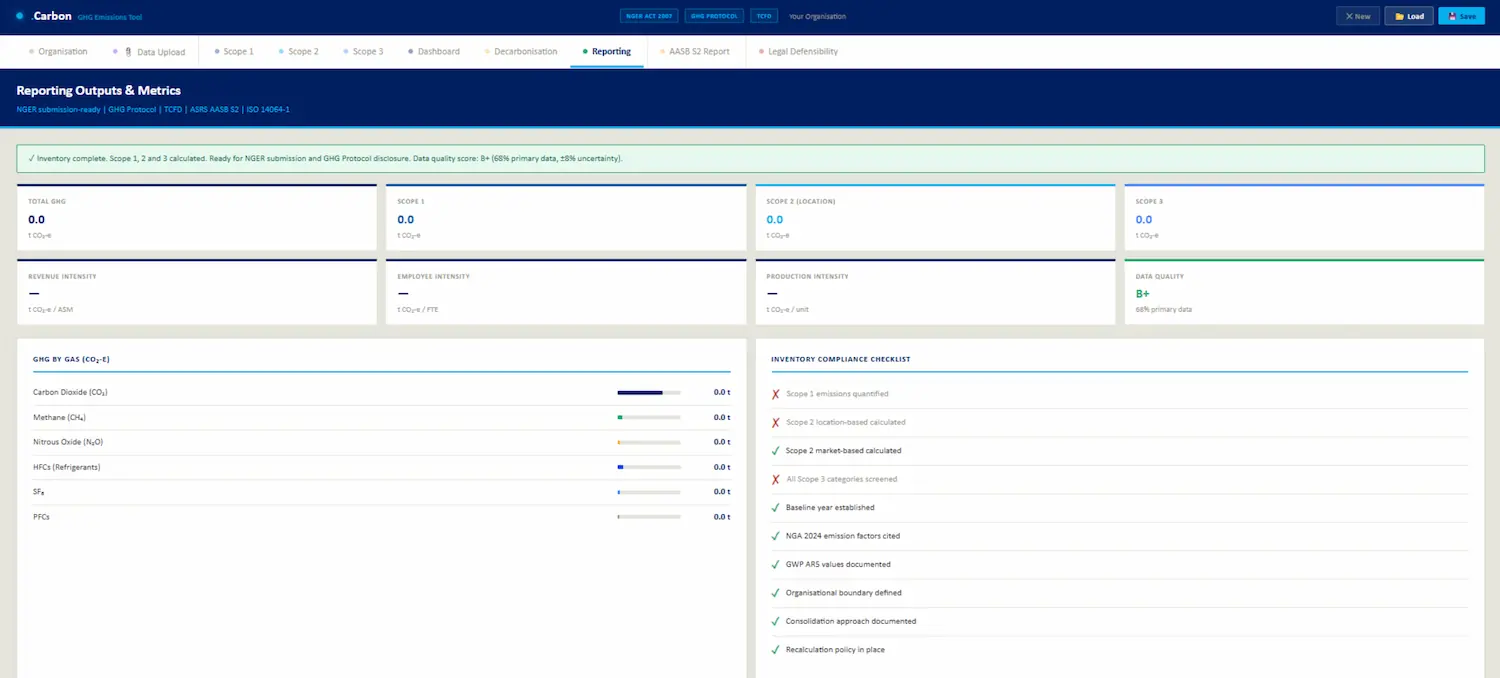
To help organisations navigate this complexity, Trace has developed .Carbon, an integrated GHG emissions calculator and sustainability disclosure tool designed to help organisations better understand their emissions profile in a simplified manner.
Screenshot of the .Carbon dashboard
.Carbon enables organisations to:
Quantify Scope 1, 2, and 3 greenhouse gas emissions
Model decarbonisation scenarios and maintain an abatement register
Scaffold an AASB S2-aligned four-pillar disclosure report
Track progress against targets
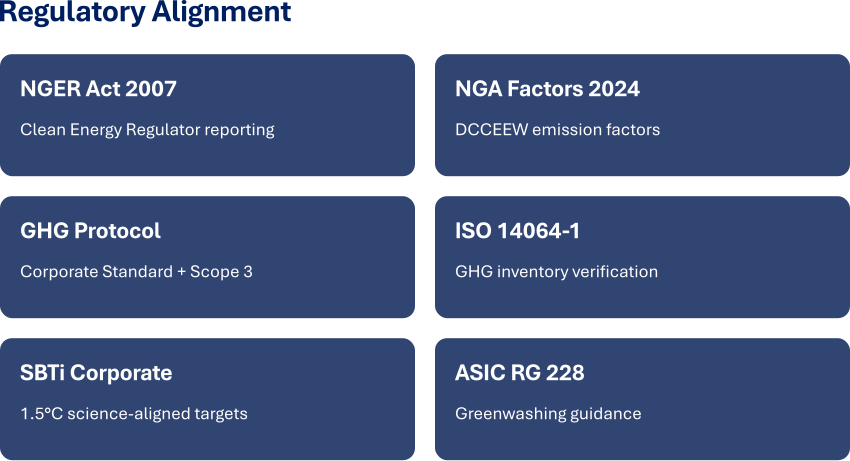
The tool is built for regulatory alignment across six frameworks: NGER Act 2007, NGA Factors 2024, GHG Protocol, ISO 14064-1, SBTi Corporate, and ASIC RG 228. Its reporting tab produces submission-ready metrics and compliance outputs across eight regulatory and voluntary frameworks.
Case study: Crown
Trace worked with Crown to deliver two sustainability initiatives with measurable outcomes. We supported the implementation of a Central Energy Plant with the aim of a 68% reduction in CO2 emissions per annum through gas and electricity reductions, unlocking both operational and financial benefits including $8.3 million in savings per annum.
We also created a web-based Delta T Quick Assessment and Calculator for Crown's portfolio companies and buildings, tracking energy savings, emissions reductions, and associated annual cost savings.
Sustainability reporting doesn't have to be overwhelming. As one of Australia's leading supply chain consultancies with proven expertise in creating sustainable results, Trace can guide organisations from supply chain mapping and risk assessment through to emission calculation, reporting, and decarbonisation initiatives.
We work alongside your team to develop sustainability strategies that use requirements as a foundation for identifying efficiencies, strengthening stakeholder relationships, and building a measurable, lasting competitive advantage.
AASB S2 is Australia's mandatory climate-related financial disclosure standard, aligned with the International Sustainability Standards Board's IFRS S2. It requires organisations to disclose climate-related risks and opportunities across four pillars: governance, strategy, risk management, and metrics and targets.
Who does AASB S2 apply to?
AASB S2 applies to large Australian entities in phases. Group 1 entities, those with two of the following: 500 or more employees, $1 billion or more in consolidated gross assets, or $500 million or more in consolidated revenue, were required to report from 1 January 2025. Groups 2 and 3 follow in subsequent years.
What is Scope 3 emissions reporting?
Scope 3 emissions are indirect greenhouse gas emissions that occur across an organisation's value chain, including upstream supplier emissions and downstream customer use of products. Under AASB S2, material Scope 3 emissions must be measured and disclosed, making supply chain emissions data a critical input for compliance.
How can Trace help with sustainability reporting?
Trace helps Australian organisations navigate sustainability reporting from end to end, including supply chain mapping, emissions calculation, AASB S2 disclosure preparation, and decarbonisation strategy. Trace has also developed .Carbon, an integrated GHG emissions calculator and sustainability disclosure tool built for regulatory alignment across six frameworks.
Sustainability
Thank you! Your submission has been received!
Oops! Something went wrong while submitting the form.
Procurement Operating Models: How to Move From Cost Centre to Strategic Function
Most organisations say they want strategic procurement. Few have built the operating model to deliver it.
The gap is visible in how procurement teams spend their time. If the majority of effort goes into processing purchase orders, chasing approvals, managing contracts after they have been signed, and responding to urgent requests from the business, then the function is operating transactionally regardless of what the org chart says. Strategic procurement, the kind that actively drives cost reduction, manages supply risk, builds supplier capability, and creates competitive advantage, requires a deliberately designed operating model that aligns people, processes, governance, and technology around value creation rather than transaction processing.
This article provides a practical framework for designing a procurement operating model that works in an Australian context. It covers the common structural choices, the maturity journey, the capability requirements, and the implementation approach that distinguishes successful procurement transformations from the ones that stall after the strategy deck is presented.
What a Procurement Operating Model Actually Is
An operating model is not an org chart. It is the integrated design of how a function delivers its outcomes. For procurement, it covers five interconnected elements:
Structure defines where procurement sits in the organisation, how it is organised internally (by category, by business unit, by geography, or some combination), and where decision rights sit. The three dominant structural models are centralised, decentralised, and centre-led.
Process defines how work flows through the function: from demand identification and sourcing strategy through to contract execution, supplier management, and performance reporting. The maturity and standardisation of these processes determines whether procurement operates consistently or ad hoc.
People and capability defines what skills the function needs, at what levels, and how those skills are developed and maintained. The difference between a transactional and a strategic procurement function is almost entirely a capability question.
Governance defines how decisions are made, who has authority to commit spend at each threshold, how procurement interacts with finance and the business, and how performance is measured and reported.
Technology and data defines the systems that enable procurement activity: e-procurement platforms, contract management tools, spend analytics, supplier portals, and the data infrastructure that underpins visibility and decision-making.
A well-designed operating model integrates these five elements so they reinforce each other. A poorly designed one, or one that has evolved organically without deliberate design, creates friction, duplication, and gaps that the team spends its energy working around rather than delivering value through.
The Structural Choice: Centralised, Decentralised, or Centre-Led
The structural question is where most organisations start, and where many get stuck.
Centralised procurement consolidates all procurement activity into a single function that manages sourcing, contracting, and supplier management on behalf of the entire organisation. The advantages are clear: spend visibility, leverage through aggregation, consistent process, and strong governance. The disadvantage is equally clear: distance from the business. A centralised team that does not understand the operational context of what it is buying will make technically correct but practically poor sourcing decisions. Centralised models work best in organisations with relatively homogeneous spend categories and a strong mandate from the executive to consolidate.
Decentralised procurement distributes procurement responsibility to individual business units, sites, or functions. Each unit buys what it needs, often with its own processes and supplier relationships. The advantages are responsiveness and local knowledge. The disadvantages are fragmented spend, limited leverage, inconsistent process, poor visibility, and compliance risk. In practice, many organisations that describe themselves as having "no procurement function" are actually operating a decentralised model by default: everyone is buying, nobody is coordinating.
Centre-led procurement is the model most Australian organisations should be targeting. It centralises strategic activities (category strategy, major sourcing events, contract frameworks, supplier management standards, spend analytics) while delegating operational procurement (call-offs against established contracts, low-value purchasing, local supplier engagement) to the business. The centre sets the rules, builds the tools, and manages the categories. The business operates within that framework with appropriate autonomy.
The centre-led model works because it resolves the fundamental tension between leverage and responsiveness. It captures the aggregation benefits of centralisation while preserving the operational agility of decentralisation. But it requires clear role definitions, strong governance, and a level of trust between the centre and the business that does not exist by default. It has to be built.
The Maturity Journey: Where Most Organisations Get Stuck
Procurement maturity models typically describe four or five stages, from ad hoc purchasing through to strategic value creation. The labels vary, but the pattern is consistent:
Stage 1: Reactive. No formal procurement function. Buying happens across the organisation without coordination. No spend visibility. No category management. No supplier strategy. This is more common than it should be, particularly in mid-sized organisations and in sectors like hospitality, health, and property where procurement has historically been an administrative rather than a strategic function.
Stage 2: Tactical. A procurement team exists and manages major purchases, but operates primarily as a processing function. The team runs tenders, negotiates contracts, and manages compliance, but has limited influence over what gets bought, when, or from whom. Spend analytics are basic or manual. Supplier management is reactive: the team engages with suppliers when there is a problem, not proactively to drive performance.
Stage 3: Structured. Category management is in place for major spend areas. Sourcing strategies exist and are executed through a defined process. Spend visibility is reasonable. The procurement team has a seat at the table for major investment and operational decisions, though influence varies by category and by the personal credibility of the procurement lead. This is where most "good" procurement functions in Australia currently sit.
Stage 4: Strategic. Procurement is fully integrated into business planning. Category strategies align with organisational strategy. Supplier relationships are managed as assets, with structured performance management, development programmes, and innovation partnerships. Total cost of ownership drives sourcing decisions, not just unit price. The CPO reports to the CEO or CFO and is a genuine member of the leadership team. Relatively few Australian organisations have reached this stage consistently across all categories.
The gap between Stage 2 and Stage 3 is where most procurement transformations stall. The reason is almost always capability. Building category management capability, developing should-cost models, implementing structured supplier management, and shifting the team's mindset from processing to analysing requires investment in people that many organisations are reluctant to make. They want the outcomes of Stage 3 or 4 procurement with the headcount and skill profile of Stage 2. That does not work.
Capability: The Make-or-Break Factor
The single most important determinant of procurement operating model effectiveness is the capability of the people in the function. Process, governance, and technology all matter, but they are enablers. Without the right people, doing the right work, at the right level of skill, no operating model will deliver its intended outcomes.
The capability requirements shift as the operating model matures. At Stage 1 and 2, the dominant skills are administrative: order processing, contract administration, compliance checking. At Stage 3 and 4, the dominant skills are analytical and commercial: market analysis, should-cost modelling, negotiation strategy, supplier relationship management, stakeholder engagement, and category strategy development.
This creates a transition challenge. The people who are excellent at Stage 2 work are not necessarily the people who will excel at Stage 3 work. The skills are genuinely different. Some team members will develop into the new model with coaching and training. Others will not. Managing that transition with honesty and respect, while simultaneously delivering on the promise of the new model, is one of the hardest aspects of procurement transformation.
The practical approach is to invest in three areas simultaneously. First, recruit for the capability you need at the senior end: experienced category managers who have done the work before and can demonstrate what "good" looks like to the rest of the team. Second, develop existing team members through structured training, mentoring, and exposure to increasingly complex work. Third, supplement with external specialist support for specific categories or initiatives where internal capability does not yet exist. This is where a firm like Trace adds the most value: providing senior procurement practitioners who can execute immediately while building internal capability alongside the existing team.
Governance: The Invisible Architecture
Governance is the element of the operating model that gets the least attention in design and causes the most friction in operation. It covers three things: decision rights, escalation paths, and performance measurement.
Decision rights define who can approve what. At what spend threshold does a category manager have authority to award a contract? When does it escalate to the CPO? To the CFO? To the board? Poorly defined decision rights create bottlenecks (everything escalates because nobody is sure of their authority) or risk (decisions are made without appropriate oversight because the governance framework is unclear).
Escalation paths define how disagreements between procurement and the business are resolved. When a business unit wants to sole-source a supplier and procurement recommends a competitive process, who decides? When a supplier relationship is underperforming but the business unit wants to retain them, who has the final say? Without clear escalation paths, these disagreements become political battles that damage relationships and slow decision-making.
Performance measurement defines what success looks like. If procurement is measured solely on cost savings, the function will optimise for lowest price, potentially at the expense of quality, risk, and supplier sustainability. If procurement is measured on a balanced scorecard that includes savings, supplier performance, contract compliance, risk management, and stakeholder satisfaction, the function will optimise for value. What gets measured gets managed, and the choice of metrics shapes the operating model more powerfully than most organisations realise.
Technology: An Enabler, Not a Strategy
The temptation in any operating model redesign is to lead with technology. Buy a new e-procurement platform, implement a contract management system, deploy a spend analytics tool, and expect the operating model to transform. It does not work that way. Technology amplifies whatever operating model it sits on top of. If the underlying processes are poor, the data is messy, and the team does not have the capability to use the tools, technology investment will deliver expensive disappointment.
The right sequence is: design the operating model first, define the processes, build the capability, then implement the technology that enables and accelerates the model. For most Australian organisations, the technology priorities in a procurement transformation are spend visibility (you cannot manage what you cannot see), contract management (knowing what you have committed to and when it expires), and workflow automation (removing manual processing from routine procurement activities so the team can focus on strategic work).
Getting the Sequencing Right
Procurement transformations fail more often on sequencing and change management than on strategy. The common pattern is: develop an ambitious target operating model, present it to the executive, get approval, and then attempt to implement everything simultaneously. The result is overwhelm, resistance, and regression to the old way of working within six to twelve months.
The approach that works is phased implementation with early wins. Start with spend visibility: consolidate spend data, classify it by category, and present the executive team with a clear picture of what the organisation is spending, with whom, and under what contract arrangements. This step alone often reveals enough opportunity to fund the next phase. Then build category management capability in two or three high-value categories where the opportunity is greatest and the business stakeholders are most receptive. Deliver measurable results in those categories. Use those results to build credibility and mandate for expanding the model across the portfolio.
This takes 12 to 24 months for a mid-sized organisation and 24 to 36 months for a large, complex one. There are no shortcuts. But the compounding effect of each phase building on the last means the function's impact accelerates over time.
How Trace Consultants Can Help
Trace Consultants is an Australian procurement, supply chain, and operations advisory firm. We work with organisations across retail, FMCG, hospitality, infrastructure, government, and defence to design and implement procurement operating models that deliver measurable value.
Operating model design. We work with CPOs and executive teams to design procurement operating models that fit their organisation's size, complexity, maturity, and strategic objectives. Our approach is practical, phased, and grounded in what actually works in Australian organisations, not theoretical frameworks imported from global consulting playbooks. Learn more about our procurement capability.
Category management and sourcing execution. We provide experienced category managers who can execute sourcing events, build category strategies, and deliver results while developing internal capability alongside your team. Explore our procurement services.
Procurement transformation and change management. We support the full lifecycle of procurement transformation: from maturity assessment and target operating model design through to implementation, capability building, and performance measurement. See our project and change management capability.
Organisational design for procurement functions. We help organisations get the structure, roles, and governance right, including the sensitive transition from transactional to strategic operating models that requires careful management of existing teams. Explore our organisational design services.
If your procurement function feels busy but not impactful, the problem is almost certainly in the operating model. The team is not lacking effort. It is lacking the structure, capability, governance, and tools to convert effort into value.
Start with an honest assessment of where you sit on the maturity curve. Map your spend. Identify the categories where the opportunity is greatest. And invest in the capability that will move the function from processing transactions to driving strategic outcomes.
The organisations that treat procurement as a strategic function outperform those that treat it as an administrative one. The operating model is what makes the difference.
Hormuz is the first chokepoint to break. The Malacca Strait, Lombok, and Sunda are next in line. Australia's supply chain strategy needs a geographic reset
Building Northern Resilience: Why Australia's Supply Chain Strategy Needs a Geographic Reset
The Hormuz crisis has focused national attention on a single chokepoint. That is understandable. The closure of the strait has removed roughly 20% of global oil supply from the market, triggered the largest coordinated release of strategic petroleum reserves in history, and pushed Australian fuel prices to record levels. But focusing on Hormuz alone misses the deeper structural lesson.
Australia's fuel security, and its broader supply chain resilience, does not depend on one chokepoint. It depends on a chain of maritime chokepoints stretching from the Persian Gulf through the Indian Ocean to the Indonesian archipelago. The Strait of Hormuz. The Strait of Malacca. The Lombok Strait. The Sunda Strait. These waterways carry the vast majority of Australia's maritime trade: roughly 83% of imports and 90% of exports transit through Southeast Asian sea lanes.
Hormuz is the first link in that chain to break. The question that government, defence, and infrastructure leaders should be asking is not "how do we respond to this crisis?" It is "what happens if the next disruption is closer to home?"
This article examines the layered geographic vulnerability of Australia's supply chains, the case for a deliberate northward shift in resilience infrastructure, and the practical supply chain planning that government, defence, and critical infrastructure operators should be undertaking now.
The Chain of Chokepoints: Australia's Layered Vulnerability
The standard framing of Australia's fuel vulnerability focuses on import dependency: Australia imports roughly 90% of its refined fuel, has only two operating refineries, and holds reserves well below the International Energy Agency's 90-day standard. All of that is true, and all of it matters. But it is only the first layer.
The second layer is the refinery dependency. Australia does not import crude from the Gulf in significant volumes. It imports refined products from Asian refineries in Singapore, South Korea, and China. Those refineries depend on Gulf crude. So the Hormuz disruption hits Australia indirectly, through the refining system that sits between the Gulf and Australian fuel terminals. That creates a lag (the subject of the first article in this series) but it also creates a concentration risk: a small number of refining hubs, located in a small number of countries, processing crude from a single dominant supply region.
The third layer, and the one that has received the least attention, is the geographic corridor through which refined products reach Australia. Every tanker, container ship, and bulk carrier arriving at an Australian port from Asia transits through the narrow waterways of Southeast Asia. The Malacca Strait is 1.5 miles wide at its narrowest point and carries the highest concentration of commercial shipping of any waterway on earth. The Lombok and Sunda straits are the primary alternatives, but they are not wide-open ocean: they are defined corridors with their own navigational constraints and geopolitical contexts.
If a disruption in the Middle East were to coincide with, or trigger, disruption in Southeast Asian sea lanes, whether through state-level coercion, grey-zone activity, piracy escalation, or broader regional conflict, Australia would not simply face expensive fuel. It would face physically constrained access to refined products, containerised goods, and industrial inputs. The rerouting options are limited: sailing around Australia's south adds days to every voyage and does not solve the problem of constrained origin-end loading.
This is not a theoretical scenario. The 2023 Defence Strategic Review warned explicitly that Australia's assumed strategic warning time had eroded. The current crisis is demonstrating in real time how quickly maritime disruption can cascade through supply chains. The lesson is that resilience planning needs to account for disruption at any point along the maritime corridor, not just at the most distant chokepoint.
The Case for a Northern Shift
Australia's current fuel and supply chain infrastructure is concentrated in the south and east. The two operating refineries are in Brisbane and Geelong. The major fuel import terminals are in Sydney, Melbourne, Brisbane, and Fremantle. The national fuel distribution network is designed to flow product from these coastal terminals inward by road and rail.
This configuration works when the supply chain is functioning normally. It is structurally vulnerable when it is not. If imports through Southeast Asian sea lanes are constrained, southern and eastern terminals are the last to receive supply, because they are the furthest from the origin of inbound shipping. Northern Australian ports, by contrast, are geographically closer to alternative supply corridors and to the Pacific routes that bypass Southeast Asian chokepoints entirely.
ASPI has argued that the centre of gravity in Australia's fuel security debate must shift north. The logic is straightforward: distributed fuel resilience requires storage, terminal capacity, and distribution infrastructure positioned across the continent, not concentrated in the population centres of the southeast. Larger northern storage facilities, greater redundancy in import terminals, and expanded capacity to move fuel across the continent during disruption would all materially improve Australia's ability to sustain operations under constrained supply.
This is not solely a fuel argument. The same geographic logic applies to defence logistics, critical mineral processing, food distribution, and industrial supply chains. Northern Australia is closer to allied staging areas, closer to emerging Indo-Pacific trade corridors, and better positioned to receive supply from diversified sources (including the United States, which is now shipping emergency fuel to Australia on 55 to 60-day voyages from the Gulf Coast). Infrastructure investment in the north serves multiple strategic objectives simultaneously: fuel security, defence readiness, economic development, and supply chain diversification.
What Government Agencies Should Be Doing Now
The National Fuel Security Plan agreed by National Cabinet on 30 March 2026 addresses the immediate crisis: emergency reserve releases, fuel quality standard relaxation, Export Finance Australia underwriting for additional cargoes, and a national fuel supply taskforce. These are necessary short-term measures. But the crisis has exposed structural weaknesses that short-term measures cannot fix.
Rethinking strategic reserves
Australia uses more energy from diesel alone than from electricity. Yet the country has failed to meet the IEA's 90-day reserve requirement since 2012. Current reserves of approximately 30 to 39 days provide a narrow buffer that is adequate for short disruptions but wholly inadequate for a sustained closure measured in months. The Hormuz crisis should accelerate investment in the Boosting Australia's Diesel Storage Programme and expand its scope to include northern and remote storage facilities capable of supporting defence, mining, and agricultural operations during prolonged disruption.
Building distributed terminal capacity
The current fuel distribution model relies on a small number of major import terminals. If any of those terminals becomes inaccessible (due to disruption, infrastructure failure, or capacity saturation during a supply surge), there is limited redundancy. Investment in additional terminal capacity, particularly in northern Australia and along the western coast, would provide alternative entry points for fuel imports and reduce the concentration risk inherent in the current network.
Mapping n-tier supply chain dependencies
Government procurement frameworks typically manage direct supplier relationships. The Hormuz crisis has demonstrated that the critical vulnerabilities often sit two or three tiers upstream: the refinery that processes the crude, the shipping line that carries the cargo, the insurance market that underwrites the voyage. Government agencies need to build n-tier supply chain maps for critical categories (fuel, fertiliser, medical supplies, defence materiel, food distribution) that identify chokepoint dependencies and concentration risks across the entire supply chain, not just the direct contract.
Fixing procurement contract frameworks
As discussed in earlier articles in this series, many government procurement contracts lack effective fuel escalation mechanisms, or contain no provision for cost escalation beyond annual CPI review. This is a structural weakness that predates the current crisis but is now causing real operational consequences: suppliers absorbing cost increases they cannot sustain, which will eventually lead to service degradation, variation claims, or supplier failure. The crisis should trigger a systematic review of procurement contract templates across Commonwealth and state agencies, with specific attention to fuel and energy cost escalation, force majeure provisions, and change-in-law clauses linked to the Liquid Fuel Emergency Act.
Integrating fuel security into defence logistics planning
The Australian Defence Force's fuel requirements are significant and operationally critical. The current crisis has reinforced the case for accelerating defence-grade energy systems that reduce reliance on imported petroleum, including synthetic fuels, hybrid energy systems for bases, and distributed fuel storage positioned for operational flexibility rather than peacetime efficiency. Defence logistics planning must assume that fuel supply disruption is a feature of the operating environment, not an exceptional event.
What Critical Infrastructure Operators Should Be Doing
Airports, ports, hospitals, water utilities, telecommunications networks, and energy generators all depend on liquid fuel, whether for primary operations, backup power, or logistics. The Hormuz crisis is a stress test for their supply chain resilience, and the results should inform investment decisions for the next decade.
Audit your fuel supply agreements. Do you have a direct supply agreement with a major fuel distributor that provides priority allocation during constrained supply? Or are you purchasing on the spot market, where you will be lowest priority in a rationing scenario? The difference matters enormously when supply tightens.
Test your backup power assumptions. Many critical facilities rely on diesel generators for backup power. The assumption is that fuel will be available to run them. In a sustained supply disruption, that assumption may not hold. What is your generator runtime at current fuel stocks? What is your resupply plan if fuel deliveries are delayed by days or weeks?
Map your logistics dependencies. Every item that arrives at your facility by truck carries a diesel cost. In a rationing scenario, your suppliers' ability to deliver may be constrained before your own operations are directly affected. Understanding which suppliers operate their own fleets (and have fuel security) versus those that rely on third-party logistics (and are more vulnerable to rationing) is critical planning information.
Stress-test your continuity plans against the current scenario. Most business continuity plans model short-duration disruptions: a 48-hour power outage, a one-week supply interruption. The Hormuz crisis is a multi-month event with uncertain duration. Does your continuity plan account for sustained cost escalation, supplier financial distress, and potential rationing of a critical input? If not, it needs to be updated.
The Longer View: From Crisis Response to Structural Resilience
Australia's geographic advantage, the vast distance that insulates it from most conflicts, has been treated as a substitute for resilience rather than a means of building it. The Lowy Institute has argued that comfort has diluted discipline: because supply chain dependency did not produce a lasting crisis during COVID, it was treated as acceptable. The current crisis is making the costs of that complacency visible.
The structural reforms required are not new ideas. Fuel reserve expansion, domestic refining support, distributed storage, northern infrastructure investment, procurement framework modernisation, and defence logistics transformation have all been discussed in policy circles for years. What the Hormuz crisis provides is the forcing function: the real-world demonstration that these investments are not theoretical hedges against improbable scenarios, but operational necessities for a country that imports 90% of its refined fuel through a chain of contested maritime corridors.
Every oil shock in modern history has generated a proportional policy response. The 1973 embargo accelerated France's nuclear programme. The 1979 Iranian Revolution drove Japan's energy efficiency transformation. The question for Australia in 2026 is whether this crisis will be the catalyst for genuine structural investment in supply chain resilience, or whether, as has happened before, the urgency will fade once prices moderate and the tankers start flowing again.
The organisations and agencies that use this moment to build resilience, not just respond to the crisis, will be the ones best positioned for whatever comes next. And something will come next. The geography of risk has not changed. Only the awareness of it has.
How Trace Consultants Can Help
Trace Consultants works with government agencies, defence organisations, and critical infrastructure operators across Australia on supply chain strategy, procurement, and operational resilience.
Supply chain resilience and risk assessment. We help organisations map their end-to-end supply chain dependencies, identify chokepoint risks and concentration vulnerabilities, and design resilience strategies that balance cost, service, and risk across the network. Explore our strategy and network design capability.
Government procurement advisory. We work with Commonwealth and state agencies on procurement framework design, contract structure review, and category management for critical supply categories. The current crisis is surfacing structural weaknesses in government procurement that require expert attention. See our government and defence sector page.
Defence and national security supply chain planning. We support defence logistics planning, sustainment supply chain design, and scenario modelling for contested supply environments. Our team brings deep experience in defence procurement and operational logistics. Learn more about our government and defence work.
Critical infrastructure supply chain review. For airports, ports, hospitals, and utilities, we provide rapid supply chain vulnerability assessments that identify fuel, logistics, and supplier dependencies and recommend practical resilience improvements. See our planning and operations capability.
The Hormuz crisis will end. The maritime geography that makes Australia vulnerable will not. The chain of chokepoints from the Persian Gulf to the Indonesian archipelago will remain, and the question of whether Australia has the distributed infrastructure, diversified supply corridors, and resilient procurement frameworks to withstand disruption at any point along that chain will persist long after oil prices moderate.
The time to invest in structural resilience is when the cost of not doing so is fresh in memory. That time is now.
Scenario Planning for CFOs: How to Stress-Test Your Procurement Spend in a $100+ Oil World
Most procurement portfolios in Australia were structured, priced, and contracted in a world where Brent crude sat between $70 and $85 per barrel. That world ended on 28 February 2026.
With the Strait of Hormuz effectively closed and oil prices fluctuating between $100 and $120 per barrel, every contract with a fuel, energy, transport, or commodity input component is being repriced, whether the contract anticipated it or not. The question for CFOs and Chief Procurement Officers is not whether their cost base is increasing. It is how much, where, and what they can do about it before the full impact lands.
This article provides a practical, step-by-step framework for stress-testing your procurement portfolio under sustained elevated oil prices. It is designed to be executed in days, not months, and to give executive teams the visibility they need to make informed decisions about contract management, supplier engagement, and budget reforecasting.
Why Procurement Portfolios Are More Exposed Than Most CFOs Realise
The direct cost of fuel and energy is visible and well understood. What is less visible is how deeply oil prices are embedded in the cost structure of almost every procurement category. A CFO looking at their fuel line item sees one number. But oil prices flow into freight rates, packaging costs, chemical inputs, bitumen, plastics, steel production energy costs, fertiliser, food ingredients, and dozens of other categories that are priced against energy-linked indices or cost structures.
In a $75 oil world, these embedded costs are stable and predictable. In a $100+ oil world, they are all moving simultaneously, but at different speeds and with different lag times. That creates a compounding effect that is easy to underestimate when each category is managed in isolation.
The second source of hidden exposure is contractual. Many procurement contracts include mechanisms designed to manage cost volatility: fuel escalation clauses, CPI adjustments, provisional sums, and rise-and-fall provisions. But these mechanisms vary enormously in design, responsiveness, and effectiveness. Some are well-constructed and activate automatically as benchmarks move. Others are poorly drafted, ambiguous, or reference indices that do not reflect actual cost movements. And a significant proportion of contracts, particularly in government procurement, contain no escalation mechanism at all.
In a period of rapid cost escalation, the gap between contracts with effective protection and contracts without it becomes the single largest driver of unbudgeted cost exposure. Identifying that gap is the first priority.
The Five-Step Stress Test
Step 1: Build Your Exposure Map
Start with your top 30 to 50 contracts by annual spend. For each contract, classify the primary cost driver into one of five categories:
Direct fuel and energy. Contracts where fuel or electricity is the primary input cost: fleet management, freight and logistics, equipment hire, generator supply, aviation.
Transport-intensive. Contracts where the goods or services delivered have a high transport cost component relative to total value: building materials, bulk commodities, food distribution, waste management.
Commodity-linked. Contracts where the input materials are priced against commodity indices that correlate with oil: bitumen, plastics, chemicals, steel, aluminium, packaging.
Labour-intensive with fuel exposure. Contracts where the supplier's cost base includes significant vehicle fleet or equipment fuel costs: cleaning, landscaping, security (mobile patrols), facilities maintenance.
Low exposure. Contracts where the primary cost driver is labour, software, professional services, or other inputs with minimal direct oil price sensitivity.
This classification does not need to be precise. It needs to be directionally correct. The goal is to separate your portfolio into high, medium, and low exposure tiers so that effort is focused where it matters.
Step 2: Audit Your Contractual Protection
For every contract in the high and medium exposure tiers, answer four questions:
Does the contract include a fuel or energy escalation clause? If yes, what index does it reference? How frequently does it adjust? Is the adjustment automatic or does it require a claim or negotiation? Is there a cap or collar?
Does the contract include a CPI adjustment? CPI adjustments provide some protection, but they lag actual cost movements by quarters, not weeks. In a rapid escalation, CPI clauses undercompensate in the short term. They are better than nothing, but they are not a substitute for a fuel-specific mechanism.
Does the contract include rise-and-fall or provisional sum provisions? These are common in construction and infrastructure contracts. The critical questions are whether the provisions are broadly enough drafted to capture fuel-linked cost increases, and whether the adjustment mechanism is responsive enough to track the pace of current movements.
Does the contract include a force majeure clause that could be triggered? The Hormuz closure and potential government-imposed fuel rationing raise legitimate force majeure questions. If the Australian government invokes the Liquid Fuel Emergency Act and imposes allocation controls, that is a new legal requirement post-dating most existing contracts. Many change-in-law clauses extend to subordinate legislation and government directions that affect a contractor's ability to perform or increase its costs. Legal analysis of these provisions should be underway now, not after rationing is announced.
For each contract, the audit produces a simple assessment: protected, partially protected, or unprotected. The unprotected contracts in high-exposure categories are your immediate priority.
Step 3: Model Three Price Scenarios
Build a simple scenario model using three oil price assumptions across a 6-month horizon (April to September 2026):
Scenario A: Resolution by mid-year. Brent crude returns to $85 to $90 by July. Diesel prices in Australia settle at 15 to 20% above pre-crisis levels. Freight surcharges moderate but do not fully unwind. Commodity input costs stabilise. Total additional procurement cost: 3 to 6% above baseline for high-exposure categories.
Scenario B: Prolonged disruption. Brent crude remains at $100 to $120 through September. Diesel prices stabilise at 30 to 40% above pre-crisis levels. Freight surcharges persist at 15 to 20%. Commodity inputs remain elevated. Supplier cost claims arrive across all major categories. Total additional procurement cost: 8 to 15% above baseline for high-exposure categories.
Scenario C: Escalation. Brent crude spikes to $140+ as strategic reserves are depleted and the conflict escalates. Diesel rationing is introduced in Australia, prioritising defence, emergency services, and agriculture. Commercial construction, logistics, and mining face supply curtailment. Total additional procurement cost: 15 to 25% above baseline for high-exposure categories, with material risk of project delays and supplier failure.
For each scenario, multiply the estimated percentage increase against the annual spend in each exposure tier. This gives you a total cost impact range that can be reported to the board and used to reforecast budgets.
The precision matters less than the discipline. A model that is directionally correct and available this week is infinitely more valuable than a precise model that arrives in June.
Step 4: Identify Decision Triggers and Response Levers
For each scenario, define the specific conditions that would trigger a management response, and the response itself.
Contract renegotiation triggers. At what cost level does an unprotected contract become material enough to warrant renegotiation? What is the contractual mechanism for reopening pricing: a scheduled review, a variation, a force majeure claim? Who needs to approve the renegotiation, and what is the lead time?
Supplier engagement triggers. At what point do you proactively engage your top 10 suppliers to understand their cost exposure and discuss collaborative responses? The answer should be "now", but the framework should define what that engagement looks like: a structured cost review, a shared scenario model, a joint identification of cost reduction levers.
Budget reforecast triggers. At what cost impact level does the procurement function need to formally reforecast and escalate to the CFO and board? Define the threshold (for example, a projected 5% increase in total addressable procurement spend) and the reporting format.
Project deferral or scope reduction triggers. For capital projects, at what cost escalation level does the business case need to be revisited? What projects could be deferred, rephased, or descoped to manage the budget impact? What is the cost of delay versus the cost of proceeding at elevated input prices?
Supplier failure early warning. Which of your critical suppliers operate on thin margins and are most vulnerable to a sustained cost increase they cannot pass through? What are the early indicators of financial distress (late deliveries, quality issues, delayed invoicing, unusual payment requests)? What is your contingency if a critical supplier exits the market?
Step 5: Execute the Engagement Plan
With the exposure map, contractual audit, scenario model, and decision triggers in place, the execution priorities become clear:
Week 1. Complete the exposure map and contractual audit for your top 30 contracts. Brief the CFO and executive team on the preliminary findings.
Week 2. Complete the scenario model. Identify the five to ten contracts with the largest unprotected exposure. Initiate supplier engagement for those contracts.
Week 3. Begin contract renegotiation or variation processes where required. Submit budget reforecast if the projected impact exceeds the defined threshold. Brief the board on the overall risk position and management response.
Ongoing. Update the scenario model fortnightly as market conditions evolve. Track supplier cost claims against the model to validate or challenge claim quantum. Monitor early warning indicators for supplier financial distress across the critical supplier base.
Common Gaps We See in Australian Procurement Portfolios
Having worked across procurement functions in retail, FMCG, hospitality, infrastructure, and government, there are several patterns that consistently create disproportionate exposure in a crisis like this.
Fuel escalation clauses that reference the wrong index. A clause tied to the Singapore Gasoil benchmark will produce a different outcome from one tied to the AIP Terminal Gate Price for diesel. In a volatile market, the basis risk between indices can be significant. Many contracts reference an index chosen for convenience rather than accuracy.
CPI adjustments treated as a substitute for fuel escalation. CPI movements lag fuel price movements by months. In a stable environment, the difference is immaterial. In the current environment, a contract relying solely on CPI adjustment is effectively unprotected for the first two to three quarters of the crisis.
Government contracts with no escalation mechanism at all. This is disturbingly common in Australian government procurement. Many panel arrangements, standing offer deeds, and period contracts were tendered and priced in a low-volatility environment with no provision for cost escalation beyond annual CPI review. Suppliers to government are absorbing cost increases they cannot pass through, which will eventually result in service degradation, variation claims, or supplier withdrawal.
Freight contracts with outdated fuel levy structures. Many shippers are running fuel levy mechanisms that were designed for a $70 to $85 oil environment and are not calibrated for the pace and scale of current movements. The lag between actual fuel cost and recovered levy is creating cashflow pressure for carriers and cost uncertainty for shippers.
No visibility over tier-two supplier exposure. Your direct supplier may have a reasonable cost structure, but if their key input supplier is exposed to Middle Eastern energy costs, that exposure will eventually flow through. Procurement functions that only manage direct supplier relationships have a blind spot that this crisis will exploit.
Minimum volume commitments in a demand-constrained environment. Some procurement contracts include minimum volume or take-or-pay commitments that were set during normal operating conditions. If diesel rationing forces production curtailment or project delays, organisations may find themselves contractually obligated to purchase volumes they cannot use, or paying penalties for shortfalls. These clauses need to be reviewed against downside scenarios now, not after a rationing order is issued.
Preparing for Rationing: The Scenario Most Procurement Teams Have Not Modelled
The Liquid Fuel Emergency Act 1984 has not been invoked as of early April 2026, but the government has publicly modelled scenarios involving 10%, 30%, and 50% supply reductions over 30-day periods. For procurement teams, the rationing scenario introduces a qualitatively different challenge: it is not just about cost, it is about physical availability.
Under the National Liquid Fuel Emergency Response Plan, priority allocation goes to defence, emergency services, hospitals, and food production. Commercial construction, logistics, manufacturing, and mining sit in lower priority tiers. That means a formal rationing regime could restrict your suppliers' ability to operate, deliver, or fulfil contracted obligations, regardless of price.
The procurement response to a rationing scenario has several dimensions. First, review whether government-imposed rationing constitutes a force majeure event under your key contracts, and whether change-in-law clauses would be triggered by a Ministerial direction under the Liquid Fuel Emergency Act. Second, understand which of your critical suppliers have direct fuel supply agreements with major distributors (giving them some security of allocation) versus those buying on the spot market (who would be first to lose access). Third, identify which activities you would defer, descope, or pause under each rationing tier, and pre-agree those decisions with internal stakeholders so they can be executed quickly if required.
The organisations that have done this planning in advance will respond to a rationing announcement with a structured operational adjustment. Those that have not will respond with ad hoc crisis management, which is always more expensive and more disruptive.
How Trace Consultants Can Help
Trace Consultants is a specialist supply chain, procurement, and operations advisory firm that works with Australian organisations across retail, FMCG, hospitality, infrastructure, government, and defence. We bring practical procurement expertise and deep sector knowledge to every engagement.
Procurement portfolio stress-testing. We build rapid scenario models that map your fuel, energy, and commodity cost exposure across your entire procurement portfolio, identify contractual gaps, and quantify the financial impact under multiple price scenarios. Our models are designed to be iterated as conditions change and to provide CFOs and boards with the decision-quality information they need. Learn more about our procurement capability.
Contract review and renegotiation. We work alongside your procurement team to audit fuel escalation mechanisms, benchmark contracted rates against current market pricing, and structure renegotiations that protect your position while maintaining critical supply relationships. For government clients, we bring deep understanding of Commonwealth and state procurement frameworks and the specific contractual challenges they create. Explore our procurement services.
Supply chain resilience and strategy. For organisations looking beyond the immediate crisis to build structural resilience into their supply chain and procurement operating model, we provide end-to-end strategy and implementation support. See our strategy and network design capability.
Government and defence advisory. We work with federal and state government agencies on procurement policy, supply chain risk, and operational resilience. The current crisis is surfacing structural weaknesses in government procurement frameworks that require urgent attention. See our government and defence sector page.
The procurement portfolio stress-test described in this article can be started today and completed within two to three weeks. It does not require new systems, new data, or new processes. It requires a structured approach, clear prioritisation, and the discipline to act on what the analysis reveals.
The organisations that will manage this period most effectively are those that know their exposure, have modelled the scenarios, and have defined their decision triggers before the next wave of cost pressure arrives.
Your procurement portfolio was built for a different world. The world has changed. The question is whether your response has changed with it.
Most boardrooms are focused on fuel prices. The bigger shock is coming through fertiliser shortages, food input inflation, and compounding freight surcharges.
Fertiliser, Food, and Freight: The Second-Order Supply Chain Shock Most Australian Executives Aren't Planning For
The headlines are about petrol prices. The boardroom conversations are about diesel. But the supply chain shock that will define Q3 and Q4 2026 for Australian retailers, food service operators, FMCG businesses, and agriculture is not the fuel crisis itself. It is the second and third-order effects that are still working their way through the system: fertiliser shortages, agricultural input cost inflation, and the compounding effect of elevated freight surcharges on every link in the food supply chain.
These effects operate on longer lag times than fuel prices. They are harder to see in real time. And for most Australian executives outside the agricultural sector, they are not yet on the radar. That is a problem, because by the time they show up in supplier cost claims and category P&Ls, the window for proactive response has already closed.
This article traces the physical mechanics of the fertiliser and food supply chain disruption, maps the timeline of impact for Australian businesses, and provides a practical framework for modelling the cost exposure before it arrives.
The Fertiliser Crisis: Bigger Than Most People Realise
The Strait of Hormuz is not just an oil chokepoint. It is a fertiliser chokepoint. Roughly 20 to 30% of globally traded fertiliser, including urea, ammonia, phosphates, and sulphur, normally transits through the strait. The Persian Gulf is the world's dominant production region for nitrogen-based fertilisers, with Saudi Arabia, the UAE, and Qatar supplying approximately 42% of Australia's total fertiliser import value in 2024.
Australia consumed 8.7 million tonnes of fertiliser in 2024, valued at A$5.5 billion. Of that, 7.9 million tonnes were imported. Domestic production is negligible: Australia's only urea manufacturing facility (Incitec Pivot's Gibson Island plant) closed in 2022, and the planned Perdaman facility in Western Australia will not be operational until mid-2027 at the earliest. Australia's largest ammonia plant has also been shut for maintenance during the crisis.
The numbers tell the story. Urea, which accounts for 44% of Australia's fertiliser consumption, has surged from around A$850 per tonne in late February to over A$1,400 per tonne in recent weeks: an increase of more than 60%. Nearly a million tonnes of fertiliser cargo are physically stranded in the Gulf. Fertilizer Australia, the sector's peak body, has warned the government that further shipping disruptions would have "catastrophic impacts on domestic agricultural output in the 2026 season."
Unlike oil, there are no internationally coordinated strategic reserves for fertiliser. No government stockpile to release. No emergency mechanism to bridge the gap. When fertiliser supply is disrupted, the only responses are to source from alternative origins (at higher cost and longer lead times), reduce application rates (accepting lower crop yields), or defer planting entirely.
Why the Timing Is Critical for Australia
The Hormuz closure could not have come at a worse time for Australian agriculture. Winter grain crops are typically sown between April and June. Most growers had secured 70 to 80% of their planting fertiliser (primarily MAP and DAP) before the crisis, but supplies of post-planting nitrogen inputs, specifically urea and urea ammonium nitrate, are now critically short.
This distinction matters. Planting fertiliser goes into the ground at sowing. Nitrogen top-up is applied during the growing season to drive protein content and yield. Without adequate nitrogen, crops still grow, but yields and quality fall materially. For wheat, the difference between a well-fertilised crop and an under-fertilised one can be 20 to 30% in yield and a downgrade from milling quality to feed quality, which carries a significant price penalty.
Industry analysts estimate Australia's wheat plantings could drop 10 to 12% this year, with further reductions in canola, which is a nitrogen-hungry crop. Some growers are shifting to less fertiliser-intensive crops like barley and pulses. Others, particularly those carrying high debt or coming off years of drought, may choose not to plant at all.
The ripple effects are significant. Australia is the world's fourth-largest wheat exporter. A material reduction in planted area or yield does not just affect individual farm economics. It reduces national export volumes, tightens domestic supply, and contributes to upward pressure on global grain prices at a time when Northern Hemisphere production is facing the same fertiliser constraints.
Tracing the Cost Transmission Into Food and Grocery
For executives in retail, FMCG, and food services, the question is: when and how does this show up in my cost base? The answer requires tracing three parallel cost transmission pathways, each with a different timeline.
Pathway 1: Freight surcharges (already arriving)
Every product that moves by truck, rail, or ship carries a fuel cost component. With diesel up 30 to 50% and major freight operators flagging 15 to 20% surcharge increases, this is the first and most visible cost impact. It is already flowing through to distribution centre operations, store deliveries, and last-mile logistics. For a national grocery chain or FMCG distributor, freight typically represents 3 to 8% of cost of goods sold. A 15 to 20% increase in freight costs adds 0.5 to 1.5 percentage points to total COGS, which is material on thin retail margins.
Timeline: immediate to 4 weeks.
Pathway 2: Supplier cost claims on materials and packaging (arriving now through May)
Packaging materials (plastics, glass, cardboard, aluminium) carry significant embedded energy costs. So do processing and manufacturing inputs. Suppliers who absorb these increases for a few weeks will eventually pass them through as formal cost claims to their retail and food service customers. The lag depends on contract structures, supplier cashflow resilience, and the pace of raw material inventory turnover.
Most FMCG and grocery suppliers operate on 60 to 90-day cost review cycles. Claims filed in April and May will reference cost increases accumulated since early March. The scale of individual claims will vary, but procurement teams should expect a broad-based wave of cost increase requests across categories with high energy, transport, or packaging input cost weightings.
This is the slow-burn pathway, and the one least visible to most executives today. Fertiliser costs are flowing into planting decisions right now. Those decisions will determine yield outcomes in the second half of the year. At the same time, on-farm fuel and chemical costs are rising, increasing the farm-gate cost of production for everything from grain and oilseeds to vegetables, dairy, and livestock feed.
The transmission mechanism is not instant. Grain harvested in Q4 2026 was planted in Q2 at higher input cost. Livestock producers feeding that grain face higher costs through the second half. Dairy and meat production costs rise accordingly. Fresh produce growers facing both fertiliser and fuel cost increases are already reducing planting schedules: half of Australian vegetable growers have reported they will run out of fertiliser within three weeks, and 27% have already cut production.
For grocery retailers and food service operators, this means farm-gate price increases on fresh produce, dairy, grain-based products, and meat that begin arriving in Q3 and persist into Q4. Food price inflation of 4 to 8% above baseline is a credible central estimate, with higher outcomes possible if the crisis extends and Northern Hemisphere production is also affected.
Timeline: 12 to 24 weeks.
The Compounding Effect: When All Three Pathways Converge
The critical insight for supply chain and procurement leaders is that these three pathways do not operate in isolation. They compound.
A product that costs more to grow (fertiliser), more to process (energy), more to package (materials), and more to deliver (freight) accumulates cost increases at every stage. A loaf of bread, for example, carries the cost of wheat (fertiliser and fuel-dependent), milling (energy-dependent), packaging (materials-dependent), and distribution (diesel-dependent). Each input has increased, and the cumulative effect is larger than any single line item suggests.
For a category manager looking at a supplier cost claim in June, the challenge is separating out how much of the claimed increase is driven by genuine input cost escalation versus opportunistic margin recovery. That requires granular visibility into the cost structure: what proportion of the product's cost is transport, what proportion is raw material, what proportion is energy, and how each of those has moved since the crisis began.
Organisations with mature should-cost models, clean input cost indices, and established supplier engagement processes will be able to validate claims quickly and negotiate from a position of knowledge. Those without that capability face a binary choice: accept claims at face value (and overpay), or reject them across the board (and risk supplier exits or service degradation at a time when alternative supply is scarce).
What This Means for Specific Sectors
Grocery and Supermarkets
National grocery chains face cost pressure across virtually every category simultaneously. Fresh produce (fuel and fertiliser), dairy (feed costs and energy), bakery (wheat and energy), packaged goods (materials and freight), and chilled/frozen (cold chain energy costs) are all exposed. The cumulative effect across a full-range supermarket could be a 3 to 6% increase in cost of goods sold by Q3, which translates to hundreds of millions of dollars annually for a major chain.
The strategic procurement response is to prioritise early engagement with key suppliers on a category-by-category basis, validate cost claims against independently sourced input cost data, and identify categories where substitution, reformulation, or specification changes could mitigate the impact.
FMCG and Packaged Goods
FMCG manufacturers face a margin squeeze between rising input costs and retailer resistance to shelf price increases. The pressure is greatest in categories with high raw material content (cleaning products, personal care, packaged food) and high transport intensity (beverages, bulky goods). Manufacturers with strong brands and limited private label competition have more pricing power. Those in commoditised categories face the hardest trade-off between margin and volume.
Food Services and Hospitality
Hotels, integrated resorts, quick-service restaurants, and contract caterers face a particularly acute version of the problem. Food and beverage cost structures are being compressed from above (input cost inflation) and below (consumer resistance to menu price increases in a cost-of-living environment). Unlike grocery retail, where price adjustments can be made weekly, many hospitality operators work with quarterly or seasonal menus, contracted rates for events and conferencing, and brand standards that limit substitution.
The scenario modelling priority is to stress-test the F&B P&L under a 15 to 25% increase in combined food and energy input costs over two quarters. For a large hospitality operator with $50 to $100 million in annual F&B procurement, the exposure is $7.5 to $25 million. Menu engineering, supplier rationalisation, waste reduction, and procurement process improvement become urgent operational levers, not long-term optimisation projects.
Agriculture
Farmers are the first link in the chain and the most exposed to both cost increases and physical supply constraints. Grain growers are making planting decisions right now with incomplete information about fertiliser availability and price. Livestock producers are watching feed costs rise and making stocking decisions that will affect production volumes for months. Vegetable growers are already cutting production schedules.
The farm-level response to high input costs has a direct downstream impact on every business that relies on agricultural output. Reduced plantings mean tighter supply. Tighter supply means higher prices. Higher prices mean more cost pressure on everyone from supermarkets to food manufacturers to restaurant operators.
A Practical Modelling Framework for Executives
Step 1: Map your food and agricultural input cost exposure
Identify which products and categories in your business have significant exposure to agricultural inputs, packaging materials, energy, and freight. Rank them by spend and by sensitivity to input cost changes. Focus on the top 15 to 20 categories that account for the bulk of your cost base.
Step 2: Build a timeline of expected cost impacts
Use the three-pathway framework above to map when cost increases are likely to arrive for each category. Freight surcharges are here now. Supplier cost claims on materials and packaging will peak in April to June. Agricultural input cost inflation will arrive in Q3. Overlay these timelines to understand the cumulative impact across your portfolio.
Step 3: Model three cost scenarios across a 6-month horizon
Scenario A (resolution by May): freight surcharges moderate, supplier claims are manageable, agricultural impact is limited. Total COGS increase: 2 to 4%.Scenario B (crisis extends through Q3): freight remains elevated, supplier claims accelerate, farm-gate prices rise materially. Total COGS increase: 5 to 8%.Scenario C (prolonged disruption into Q4): compounding effects across all three pathways, potential physical shortages in some categories. Total COGS increase: 8 to 12%.
Step 4: Identify your response levers
For each scenario, define the actions available: supplier renegotiation, specification changes, menu or range engineering, alternative sourcing, inventory buffer adjustments, and pricing pass-through. Quantify the impact of each lever and sequence them by speed of implementation and scale of effect.
Step 5: Engage suppliers before claims arrive
The organisations that engage suppliers proactively, with a clear framework for cost validation and a collaborative approach to shared problem-solving, will get better outcomes than those that wait for claims to land and then react defensively. Understanding your suppliers' own exposure to the same pressures is the foundation for a negotiation that protects both parties.
How Trace Consultants Can Help
Trace Consultants works with Australian retailers, FMCG businesses, hospitality operators, and food service organisations to build practical, data-driven responses to supply chain cost pressure. Our team brings deep procurement expertise and sector-specific operational knowledge to every engagement.
Procurement cost modelling and scenario analysis. We build rapid scenario models that map your food, packaging, energy, and freight cost exposure across your procurement portfolio, identify the categories most at risk, and quantify the financial impact under multiple disruption scenarios. Learn more about our procurement capability.
Supplier engagement and cost validation. We work alongside your procurement team to prepare for and respond to supplier cost claims, using independently sourced input cost data and should-cost modelling to separate genuine increases from margin recovery. Explore our procurement services.
F&B and back-of-house optimisation. For hospitality and food service operators, we help design procurement operating models, centralised ordering systems, and cost-of-goods frameworks that provide real-time visibility over input costs and margin performance. See our BOH logistics capability.
Supply chain strategy for retail and FMCG. From network design to inventory policy to supplier diversification, we help organisations build supply chains that are resilient to sustained cost pressure and supply disruption. Explore our strategy and network design services.
The second-order supply chain shock from the Hormuz crisis is not speculative. The fertiliser is not on the water. The planting decisions are being made right now. The cost transmission pathways are well understood, and the timelines are predictable within reasonable bounds.
The executives who will protect margins and maintain competitive position through the second half of 2026 are those who model the impact now, engage suppliers early, and activate response levers before the cost pressure becomes unavoidable.
The fuel crisis got everyone's attention. The food and fertiliser crisis will determine who navigates 2026 successfully and who doesn't.
Diesel powers 40% of mining, every construction site, and the freight network that moves everything Australians buy. The cost shock is repricing all of it.
Diesel is the Economy: How the Hormuz Crisis is Repricing Australian Supply Chain Cost Models
Diesel is not a line item. It is the economy.
It powers the trucks that deliver every product on every supermarket shelf. It runs the excavators, concrete pumps, and cranes on every construction site in the country. It fuels the haul trucks that move iron ore and coal from pit to port. It keeps cold chains running, waste trucks moving, and hospital backup generators turning over. When diesel prices move, everything moves with them.
In March 2026, diesel climbed above $3 per litre in several Australian capital cities. Terminal gate prices jumped 45 to 50 cents per litre in under two weeks. For a transport operator buying a standard 36,000-litre load, that translates to roughly $18,000 more per delivery than a fortnight earlier. For the mining sector, agriculture, construction, and logistics, the numbers scale accordingly.
This is not a temporary price blip. It is a structural repricing driven by the closure of the Strait of Hormuz, the effective removal of 20% of global oil supply from the market, and the cascading impact on Asian refineries that produce the vast majority of Australia's imported fuel. Diesel is the fuel type most exposed: Australia imports roughly 120,000 barrels per day of diesel from South Korea alone, and alternative supply routes from the US Gulf Coast take 55 to 60 days compared with the usual 7 to 14 from Asia.
For supply chain and procurement leaders, the question is not whether costs are rising. That is obvious. The question is how to model the impact, identify the contracts and cost lines most exposed, and make decisions that protect margin and continuity over the next two to three quarters.
Why Diesel, Specifically, Is the Pressure Point
Not all fuels are equally affected by the Hormuz disruption. Diesel carries disproportionate exposure for three reasons.
First, Australia's diesel deficit is the deepest of any fuel type. Domestic refineries (primarily Ampol's Lytton facility in Brisbane and Viva Energy's Geelong refinery) produce some petrol and jet fuel, but their output skews away from diesel. The gap between domestic diesel demand and domestic diesel production is larger than for any other refined product, making Australia almost entirely dependent on imports for the fuel that underpins its heaviest industries.
Second, diesel demand is structurally inelastic in the short term. A household can defer a weekend drive or combine errands to reduce petrol consumption. A mine cannot stop its haul trucks. A construction site cannot pause concrete pours. A cold chain operator cannot switch off refrigeration. The industries that consume the most diesel are the industries least able to reduce consumption quickly, which means demand holds firm even as prices spike.
Third, diesel is the fuel most likely to be rationed first if the crisis deepens. Defence, emergency services, and agriculture sit at the top of the priority allocation list under Australia's national liquid fuel emergency framework. Commercial construction, logistics, and mining fall below those categories, meaning that in a formal rationing scenario, the sectors that consume the most diesel face the greatest risk of supply curtailment.
Mapping the Cost Transmission: How Diesel Reprices Supply Chains
Diesel cost increases do not sit neatly in one budget line. They transmit through supply chains in layers, each with a different lag time and a different degree of visibility to the organisation paying the bill.
Layer 1: Direct fuel costs (immediate)
Any organisation that operates a vehicle fleet, runs diesel-powered equipment, or maintains backup generation feels this instantly. Fuel is typically the largest or second-largest variable cost for road freight operators, earthmoving contractors, and mining haul operations. A 30 to 50% increase in diesel prices flows through to operating costs within days.
For a mid-sized road freight operator with annual diesel spend of $5 to $10 million, a sustained 40% price increase adds $2 to $4 million per year in direct cost, against industry margins that typically sit between 3 and 7%. That is not a rounding error. It is an existential pressure.
Layer 2: Freight and logistics surcharges (2 to 6 weeks)
Transport contracts almost universally include fuel levy mechanisms, but those mechanisms lag actual costs by two to four weeks and are often calculated against benchmark indices that smooth out short-term volatility. In a rapidly escalating price environment, the gap between actual fuel cost and recovered fuel levy widens, creating cashflow pressure for carriers and cost uncertainty for shippers. Major freight operators including Toll, Linfox, and StarTrack have already flagged surcharge increases, and businesses across Australia are reporting 15 to 20% hikes in logistics costs.
Layer 3: Embedded energy in materials and inputs (4 to 12 weeks)
Steel, cement, glass, aluminium, and plastics all carry significant embedded energy costs. When diesel and broader energy prices rise, production costs for these materials increase, and those increases flow through to buyers with a lag of one to three months depending on contract structures and inventory buffers. The Housing Industry Association has warned that sustained fuel price increases could add $8,000 to $15,000 to the cost of building a new home, driven largely by the embedded energy cost of materials and the cost of transporting them to site.
Layer 4: Input cost inflation in agriculture and food (8 to 20 weeks)
Fertiliser prices have surged roughly 30% in the past month, driven by the loss of Gulf-origin urea exports that normally account for over 30% of global trade. Combined with higher on-farm fuel costs (for machinery, irrigation, and transport), this creates a compounding effect on farm-gate prices that will not fully manifest in grocery and food service costs until Q3 2026. The lag is long, but the impact is large: energy costs are embedded in every phase of the food supply chain, and analysts forecast food price inflation of 4 to 6% above baseline by mid-year, potentially higher if the crisis extends.
Sector Deep Dives: Modelling the Impact
Mining and Resources
Mining consumes approximately 40% of Australia's diesel. For a large iron ore operation in the Pilbara running a fleet of 200-tonne haul trucks, diesel consumption can reach 500,000 to 1 million litres per month per truck. At $3 per litre, that is $1.5 to $3 million per truck per month, compared with roughly $1 to $2 million at pre-crisis prices. Scale that across a fleet of 50 to 100 trucks and the annual cost increase runs into the hundreds of millions.
Some smaller mining companies have reported holding as little as five days of diesel supply. Coal miners operating near breakeven are particularly exposed: when the fuel cost of extraction rises faster than the commodity price received, operations become uneconomic. The scenario modelling question for mining CFOs is: at what sustained diesel price does each operation move from profitable to marginal to loss-making, and what is the lead time required to scale back production or mothball capacity?
Several WA mining operations have already halted due to fuel supply constraints, not just price. The distinction matters: price is a margin problem, but supply is an operational continuity problem. Both need to be modelled, but the response strategies are different.
Infrastructure and Construction
Construction firms get hit from two directions simultaneously. Directly, through the cost of running equipment and transporting materials, workers, and plant to site. Indirectly, through rising input prices for every material that carries embedded energy cost, which is essentially all of them.
Diesel powers earthmoving, piling, concrete pumping, crane operations, asphalt laying, and site logistics. A sustained 30 to 50% increase in diesel cost reprices every major project currently in delivery. The impact depends heavily on contract structure:
Fixed-price contracts expose the contractor to full margin erosion. A builder who priced a project at $2.50 per litre diesel is now operating at $3 or more, and unless the contract includes a fuel escalation clause, that cost is absorbed entirely from profit.
Cost-plus and alliance contracts pass the cost to the client, but the client must then decide whether to absorb the escalation, defer scope, or pause the project entirely. For government infrastructure projects funded from fixed budget envelopes, an unforeseen 15 to 20% increase in fuel-linked costs can force scope reductions or timeline extensions.
Design and construct contracts with provisional sums for fuel may provide some protection, but only if the provisional sum was sized realistically and the adjustment mechanism is responsive enough to track rapid price movements.
The National Housing Accord's target of 1.2 million new homes in five years was already under pressure from labour shortages and material costs. The diesel price shock compounds both: material costs rise (embedded energy), and the tradesperson driving a ute to site every day faces a direct hit to operating margin. Building industry insolvencies reached 3,596 in 2025, before this latest shock. The sector is fragile, and the fuel crisis is applying pressure to the thinnest part of the structure.
Retail, FMCG, and Grocery
For retailers and FMCG businesses, diesel cost increases arrive through the freight network and the supplier base. Every pallet that moves from a distribution centre to a store carries a freight cost that has just increased by 15 to 20%. Every supplier manufacturing or processing goods that require energy, transport, or agricultural inputs is accumulating cost increases that will flow through as price claims within 60 to 90 days.
The challenge for category managers and procurement teams is that these cost increases arrive in waves, not all at once. The first wave (freight surcharges) is already here. The second wave (supplier cost claims on materials and packaging) will arrive through April and May. The third wave (agricultural input cost inflation flowing through to fresh produce, dairy, and grain-based products) will land in Q3.
Organisations with strong cost-of-goods visibility, granular should-cost models, and established supplier engagement processes will be able to separate legitimate cost increases from opportunistic margin grabs. Those without that capability will either overpay or damage supplier relationships by pushing back on genuine claims, neither of which is a good outcome.
Transport and Logistics
For road freight operators, the maths is stark. Industry margins of 3 to 7% cannot absorb a 10 to 20% increase in operating costs. Fuel levy mechanisms provide some protection, but the lag between actual cost and recovered levy creates cashflow pressure in the short term, and in a sustained high-price environment, the risk is that shippers push back on levy increases or seek to cap them, forcing operators to absorb the difference.
The Australian Livestock and Rural Transporters Association has warned that the diesel price jump represents a direct threat to the viability of small and medium regional operators. For these businesses, there is no buffer: every additional dollar per litre comes straight off the bottom line until the levy catches up. The structural risk is that smaller operators exit the market, reducing freight capacity and creating a secondary supply chain constraint on top of the fuel price shock.
Hospitality and Food Services
Hotels, integrated resorts, and food service operators face a compressed cost structure. Food and beverage input costs are rising (fuel surcharges on deliveries, supplier cost claims on ingredients, fertiliser-driven farm-gate price increases). Energy costs for kitchens, laundries, and climate control are climbing. And unlike retailers who can adjust shelf prices relatively quickly, hospitality operators often work with fixed menu pricing, contracted rates, and seasonal price commitments that limit their ability to pass costs through in real time.
The scenario modelling priority for hospitality operators is to stress-test the F&B P&L under a 15 to 25% increase in combined food and energy input costs, sustained over two quarters. For a large integrated resort with $50 to $100 million in annual F&B spend, that is $7.5 to $25 million in additional cost. The question is: how much can be absorbed, how much can be recovered through pricing, and how much requires operational redesign (menu engineering, supplier consolidation, waste reduction, procurement process improvement)?
Building a Rapid Cost Exposure Model
Executives do not need a six-month consulting engagement to understand their exposure. They need a rapid, pragmatic model that can be built in days and iterated as conditions change. Here is a framework.
Step 1: Identify your top 20 to 30 contracts by annual spend. Focus on those with significant fuel, energy, or transport cost components. This typically covers 60 to 80% of procurement spend for most organisations.
Step 2: Map the fuel and energy cost structure within each contract. Identify whether the contract has a fuel escalation clause, a CPI adjustment mechanism, a provisional sum, or no protection at all. Quantify the gap between current pricing and projected pricing under a sustained $3+ diesel environment.
Step 3: Model three scenarios. Use a simple framework: current prices sustained for 90 days (base case), a further 20% escalation sustained for 90 days (downside), and a 30% reduction from current levels within 60 days (upside). Calculate the total cost impact under each scenario across your portfolio.
Step 4: Identify decision triggers. At what cost level does a specific contract become unviable? At what point does a project need to be paused, rephased, or renegotiated? At what inventory level does a stockout become likely? Define the trigger points in advance so decisions can be made quickly when conditions change.
Step 5: Engage suppliers proactively. Understanding your suppliers' exposure to the same cost pressures gives you the information to negotiate collaboratively. The suppliers who are most transparent about their cost structures are typically the ones you want to retain through a crisis. The ones who simply send a blanket 15% increase without supporting data are the ones whose claims need scrutiny.
How Trace Consultants Can Help
Trace Consultants works with organisations across mining, construction, infrastructure, retail, FMCG, hospitality, and government to build practical, data-driven responses to supply chain disruption. We are supply chain and procurement practitioners with deep sector knowledge and a focus on operational outcomes, not theoretical frameworks.
Procurement cost exposure modelling. We build rapid scenario models that map your fuel and energy cost exposure across your procurement portfolio, identify unprotected contracts, and quantify the financial impact under multiple price scenarios. Our models are designed to be iterated weekly as market conditions evolve. Learn more about our procurement capability.
Contract review and renegotiation support. We work alongside your procurement team to review fuel escalation mechanisms, benchmark contracted rates against current market pricing, and structure supplier negotiations that protect your position while maintaining critical supply relationships. Explore our procurement services.
Supply chain strategy and network resilience. For organisations considering supply corridor diversification, inventory policy changes, or network redesign in response to the crisis, we provide end-to-end strategy and implementation support. See our strategy and network design capability.
The organisations that will navigate this crisis most effectively are not the ones with the biggest balance sheets. They are the ones with the clearest visibility over their cost exposure, the most structured approach to scenario modelling, and the discipline to make decisions before conditions force their hand.
Start with your top 20 contracts. Map the fuel exposure. Model the scenarios. Identify the trigger points. Engage your suppliers. Do it this week.
Diesel is the economy. And right now, the economy is being repriced.
The Rolling Wave: Why the Worst of the Hormuz Supply Shock Hasn't Hit Australia Yet (and How to Model What Comes Next)
Most Australian executives are reacting to what has already happened. Fuel prices at the pump. Headlines about panic buying. Government excise cuts. But the physical reality of global supply chains means the full impact of the Hormuz closure has not yet arrived. It is still on the water, and in some cases, it is not on the water at all because the ships were never loaded.
The Strait of Hormuz effectively closed to commercial traffic on 4 March 2026. The last tankers departed the route around 28 February. Since then, roughly 20% of the world's daily oil supply and a significant share of global LNG and fertiliser exports have been cut off from international markets. Brent crude has surged past US$100 per barrel for the first time in years, and analysts warn of further escalation if the strait remains closed through April.
For Australia, the Hormuz supply chain impact is not a single event. It is a rolling wave that moves through multiple layers of the supply chain, each with its own transit time, inventory buffer, and breaking point. Understanding that wave, and modelling it with precision, is the difference between reactive cost absorption and proactive strategic positioning. This article lays out the physical mechanics of the disruption, maps the timeline of impact for Australian businesses, and provides a practical framework for scenario modelling that any supply chain or procurement leader can apply immediately.
Australia's Double Exposure: Two Steps Upstream
Australia's fuel vulnerability is often discussed in terms of global oil prices. That framing misses the structural reality. Australia does not import significant volumes of crude oil directly from the Persian Gulf. Instead, it imports roughly 90% of its refined petrol, diesel, and jet fuel from Asian refineries, predominantly in Singapore, South Korea, and China. Those refineries, in turn, depend heavily on Middle Eastern crude for their feedstock.
This means the Hormuz closure does not hit Australia directly. It hits the refineries that supply Australia, which then transmits the shock downstream as those refineries exhaust their crude inventories, reduce throughput, or divert output to higher-priority domestic markets. Several Asian governments have already imposed partial or full export restrictions on refined products. South Korea, which supplies roughly a quarter of Australia's fuel imports (including around 120,000 barrels per day of diesel), has capped refined product exports at 2025 monthly averages. China has introduced similar restrictions on jet fuel exports.
The vulnerability sits two steps upstream in the supply chain. That is not a minor technical distinction. It is the entire basis for understanding the timing of the impact.
The Transit Time Chain: Mapping the Physical Pipeline
To understand when disruption arrives, you need to trace the physical journey of fuel to Australia. Under normal conditions, the pipeline looks like this:
Leg 1: Persian Gulf to Asian refinery. Crude oil tankers departing ports like Ras Tanura (Saudi Arabia) or Mina al Ahmadi (Kuwait) transit the Strait of Hormuz, cross the Indian Ocean, and pass through the Strait of Malacca to reach refining hubs in Singapore, South Korea, or eastern China. Transit time for a VLCC (very large crude carrier) on this route is approximately 10 to 18 days depending on destination, with Singapore at the shorter end and South Korea at the longer end.
Leg 2: Refining. Crude oil is processed into refined products (petrol, diesel, jet fuel) at the destination refinery. Typical refining cycle time, including storage and scheduling, adds 5 to 10 days.
Leg 3: Asian refinery to Australian port. Refined product tankers depart Singapore, Ulsan (South Korea), or Chinese export terminals and sail to Australian ports including Melbourne, Sydney, Brisbane, and Fremantle. Transit time ranges from 7 to 14 days depending on origin and destination.
Total pipeline under normal conditions: approximately 4 to 6 weeks from Gulf crude loading to Australian fuel terminal.
That pipeline is now broken at Leg 1. The last crude cargoes to depart the Gulf before the closure would have reached Asian refineries by mid to late March. Those refineries are now processing their final pre-closure crude inventories. Once those inventories are exhausted, refinery throughput will fall, refined product availability will tighten, and the flow of fuel to Australia will slow sharply.
Analysts project that most fuel deliveries to Australia could effectively cease by around 20 April, depending on the pace of inventory drawdown at Asian refineries and the availability of alternative crude sources. The Australian government has arranged emergency imports directly from the United States, with nearly two million barrels expected to arrive between mid-April and early May. But the transit time from the US Gulf Coast to Australia is 55 to 60 days, compared with 7 to 14 days from the usual Asian supply corridor. Freight costs are roughly four times higher on the US route.
The Mid-April Cliff: Why the Next Three Weeks Are Critical
The concept of an "oil cliff" around mid-April has gained traction among energy analysts. The reasoning is straightforward. Since the closure on 4 March, the world has been drawing down existing inventories and strategic petroleum reserves to bridge the gap. The United States and other nations have released approximately 400 million barrels from strategic reserves, the largest coordinated release on record. Sanctions on some Russian and Iranian oil have been temporarily lifted to provide additional supply.
These measures have kept prices from spiking even further. But they are finite. Analysts estimate that by mid-April, the combined effect of strategic reserve depletion and the exhaustion of pre-closure crude in the Asian refining system could double the effective daily supply loss to approximately 10 million barrels per day, roughly 10% of global consumption.
For Australian businesses, this means the period from mid-April through May is likely to be the most acute phase of the disruption, not the past four weeks. The price increases and sporadic shortages experienced so far are the first tremor. The main shock is still arriving.
Australia entered this crisis with an estimated 36 days of petrol, 34 days of diesel, and 32 days of jet fuel in reserve. Those are the largest stockpiles the country has held in 15 years, but they are still well below the 90-day cover required under International Energy Agency guidelines (a standard Australia has not met since 2012). Under emergency allocation, where priority is given to defence, essential services, and critical infrastructure, available reserves for commercial distribution could cover roughly 20 to 26 days of normal demand.
A Practical Scenario Framework for Australian Executives
Reacting to today's prices is not a strategy. What executives need is a structured way to model the range of plausible outcomes and make decisions ahead of each scenario materialising. The following framework uses three scenarios across a 90-day horizon (April to June 2026), calibrated to the physical supply chain dynamics described above.
Scenario 1: Resolution by Late April (Optimistic)
A ceasefire or diplomatic resolution leads to partial reopening of the Strait by late April. Tanker traffic resumes cautiously, with elevated insurance premiums and war-risk surcharges persisting for months. Asian refinery throughput recovers to 80% of normal by mid-May.
Implications for Australia: Fuel prices remain elevated (20 to 30% above pre-crisis levels) through Q2 but do not spike further. Diesel availability stabilises by late May. Freight surcharges persist through Q3. Fertiliser prices remain 10 to 15% above baseline through the first half of the year. Total additional cost burden for a mid-sized logistics-dependent business: 5 to 10% of operating expenditure.
Scenario 2: Prolonged Closure Through June (Base Case)
The Strait remains effectively closed through June, with limited transit via Iranian-controlled channels (available to select Chinese, Malaysian, and Pakistani vessels only). Strategic reserves are depleted by late April. Alternative crude sources (West Africa, Latin America, US shale) partially offset the shortfall but at significantly higher cost and longer transit times.
Implications for Australia: Fuel prices spike a further 30 to 50% above current levels in the May to June window. Diesel rationing becomes likely for non-essential commercial use. Freight surcharges increase to 15 to 25% of contracted rates. Fertiliser shortages become acute, with downstream food price inflation of 8 to 15% by Q3. Construction project timelines extend by 4 to 8 weeks due to diesel allocation constraints. Mining operations face production curtailment decisions. Total additional cost burden: 12 to 20% of operating expenditure for exposed sectors.
Scenario 3: Escalation and Extended Disruption (Downside)
The conflict escalates, with sustained damage to Gulf energy infrastructure (refineries, export terminals, pipelines). The Strait remains closed beyond June. Secondary disruptions emerge in Southeast Asian shipping lanes. Oil prices reach US$150 to $200 per barrel.
Implications for Australia: Formal fuel rationing is introduced. Non-essential air travel is curtailed. Major construction projects are paused or rephased. Food supply chains experience widespread disruption as fertiliser shortages compound fuel cost increases. Recession risk becomes material, with GDP growth reduced by 0.5 to 1.0 percentage points. Businesses without pre-existing fuel cost pass-through clauses in their supply contracts absorb margin destruction.
Sector-by-Sector Impact: Where the Pain Concentrates
Mining and Resources
Mining consumes approximately 40% of Australia's diesel. That concentration creates a stark policy dilemma: diesel allocated to mining supports export revenue and national income, but diesel allocated away from mining means shortages in food distribution, construction, and transport. Mid-tier miners without long-term fuel supply agreements are most exposed. The scenario modelling question for mining executives is not whether costs will rise, but at what diesel price point specific operations become uneconomic, and what the lead time is to curtail or mothball production.
Infrastructure and Construction
Diesel powers earthmoving, concrete delivery, crane operations, and site logistics. A sustained 30 to 50% increase in diesel costs reprices every major project currently in delivery. For projects under fixed-price contracts, the margin impact is immediate and potentially severe. For cost-plus or alliance contracts, the question shifts to the client's willingness to absorb escalation and the availability of contractual mechanisms (fuel escalation clauses, provisional sums) to manage the exposure. Airport expansions, road projects, hospital builds, and defence infrastructure are all in the firing line.
Retail, FMCG, and Grocery
The impact here is layered. First-order: freight surcharges increase the cost of moving goods from distribution centres to stores. Second-order: supplier cost increases (packaging, raw materials, energy) flow through with a 60 to 90-day lag. Third-order: fertiliser-driven increases in farm-gate prices for fresh produce and staple grains hit grocery shelves in Q3. Category managers need to be modelling vendor cost claims now, not waiting for them to arrive.
Hospitality and Food Services
Food and beverage cost structures in hotels, integrated resorts, and quick-service restaurants are being compressed from multiple directions: input cost inflation, energy surcharges, and supplier availability constraints. Operators with centralised procurement functions and strong cost-of-goods visibility will navigate this more effectively. Those relying on fragmented, outlet-level purchasing will experience margin erosion they may not fully understand until it is too late. The scenario modelling priority for hospitality operators is to stress-test their F&B P&L under a 15 to 25% increase in combined food and energy input costs sustained over two quarters.
Agriculture
Australian agriculture is both a beneficiary (higher global commodity prices for exports) and a victim (higher input costs for fuel, fertiliser, and chemicals). Over 30% of globally traded urea, the most widely used nitrogen fertiliser, normally transits the Strait of Hormuz. Unlike oil, the fertiliser sector has no internationally coordinated strategic reserves. Global fertiliser prices are forecast to rise 15 to 20% during the first half of 2026, with flow-on effects to planting decisions, yield projections, and ultimately food prices. Grain and livestock producers need to model input cost scenarios against forward commodity prices to determine whether current planting and stocking plans remain viable.
Transport and Logistics
Fuel is typically the largest or second-largest cost line for road freight operators. Most transport contracts include fuel levy mechanisms tied to benchmark indices, but those mechanisms often lag actual costs by two to four weeks. In a rapidly moving price environment, that lag creates cashflow pressure for operators and cost uncertainty for shippers. The strategic question for logistics leaders is whether their current fuel levy and surcharge structures are fit for purpose in a sustained high-price environment, or whether they need renegotiation.
Government and Defence
Government procurement contracts frequently lack fuel escalation mechanisms, or include them in ways that are slow to activate and limited in scope. Suppliers to government face a real risk of being locked into contracts that are uneconomic under current conditions, which will eventually lead to either service degradation, variation claims, or outright supplier failure. Defence supply chains face additional complexity: fuel security for operations, strategic reserve management, and the accelerated need for distributed logistics capability in northern Australia. The crisis has made the case for supply chain resilience investment at the policy level far more concrete than any white paper could.
What to Do This Week: Five Actions for Supply Chain Leaders
Map your fuel and energy cost exposure across your top 20 contracts. Identify which contracts have fuel escalation clauses, CPI adjustments, or provisional sums that provide protection, and which do not. Quantify the gap.
Run a 90-day scenario model on your procurement spend. Use the three scenarios above as a starting framework. Stress-test your cost base under each scenario and identify the decision points: at what price level do you need to renegotiate, substitute, defer, or exit?
Engage your critical suppliers now, not when they send you a cost increase. Understanding your suppliers' own exposure to fuel and input cost pressures gives you the information to negotiate collaboratively rather than reactively.
Review your inventory policy for essential inputs. If you operate on lean, just-in-time inventory for fuel-sensitive inputs (chemicals, packaging, raw materials), consider building a short-term buffer while availability exists. The cost of carrying additional inventory is far less than the cost of a stockout in a tightening market.
Pressure-test your logistics network. If your supply chain depends on a single port, a single carrier, or a single origin market, now is the time to identify alternatives. The organisations that diversify their supply corridors before the crunch will have options. Those that wait will be competing for the same scarce capacity as everyone else.
How Trace Consultants Can Help
Trace Consultants is an Australian supply chain, procurement, and operations advisory firm that works with organisations across retail, FMCG, hospitality, infrastructure, government, and defence. We are practitioners, not theorists, and our work is grounded in the physical and commercial realities of how supply chains actually operate.
Scenario modelling and procurement stress-testing. We build rapid, data-driven scenario models that map your cost exposure under multiple disruption scenarios, identify your most vulnerable contracts, and quantify the financial impact across your procurement portfolio. Learn more about our procurement advisory services.
Supply chain strategy and network resilience. We help organisations design supply chain networks that balance cost, service, and resilience, including supply corridor diversification, inventory policy optimisation, and contingency planning for sustained disruption. Explore our strategy and network design capability.
Supplier engagement and contract review. We work alongside your procurement team to review critical supplier contracts, identify gaps in cost escalation mechanisms, and structure negotiations that protect your position without destroying supplier relationships. See how we work with procurement teams.
Sector-specific operational support. Whether you operate integrated resorts, retail networks, construction projects, or government logistics, we bring deep sector knowledge and a practical operating lens to every engagement. See the sectors we work across.
The window for proactive planning is narrowing. The physical supply chain dynamics described in this article are not speculative. They are the mechanical consequence of a strait that has been closed for over a month, inventory buffers that are being drawn down daily, and alternative supply routes that take weeks longer than the corridors they are replacing.
The executives who will navigate this period most effectively are those who understand the timeline, model the scenarios, and act before the next phase of the disruption arrives. The worst of the Hormuz supply shock has not hit Australia yet. But it is coming, and the organisations that prepare now will be the ones that maintain operational continuity, protect margins, and emerge in a stronger competitive position on the other side.
Strategy, category management, cost reduction, supplier relationships, sustainability and more. Trace's framework for building a procurement function that delivers real value.
Procurement excellence is the difference between a function that processes purchase orders and one that actively drives cost reduction, manages supplier risk, and delivers strategic value for the business. For Australian organisations navigating concentrated supply markets, rising input costs, and increasing compliance obligations, getting procurement right matters more than it ever has.
Trace's Procurement Excellence Framework provides a structured approach to assessing and improving procurement performance across seven dimensions: strategic procurement, sustainable procurement, category management, cost reduction and spend analytics, procure-to-pay optimisation, contract performance and KPI management, and supplier relationship management.
1. Strategic Procurement
Procurement is increasingly at the forefront of organisational strategy. Geopolitical shifts, supply chain disruption, and cost volatility have fundamentally changed how Australian organisations need to think about what they buy, from whom, and on what terms. A reactive, transactional procurement function is no longer adequate.
Strategic procurement starts with aligning the function to the organisation's broader goals and ensuring it has the mandate, capability, and governance to deliver.
Key questions to assess your procurement strategy:
Direction and alignment
How does procurement align with and support the organisation's strategic goals?
What specific outcomes is procurement expected to deliver: cost reduction, risk mitigation, innovation, sustainability?
Spend and process
What is the total spend across categories, and how is it managed?
Are there inefficiencies or areas of excessive cost in the current procurement process?
Have changes in business volume affected what should be procured, and when?
Supplier strategy
Who are the critical suppliers, and what are their strengths and vulnerabilities?
How are supplier relationships managed to ensure quality, reliability, and strategic value?
Risk and resilience
What risks exist in the supply base: disruption, geopolitical exposure, compliance gaps, single-source dependency?
What mitigation strategies are in place, and are they adequate for the current environment?
Sourcing strategy
What sourcing approaches are being used across categories, and are they fit for purpose?
How is competitive tension maintained across the supplier base?
Sustainability and ethics
How does procurement support the organisation's sustainability and ESG commitments?
Are suppliers assessed against ethical, environmental, and modern slavery standards?
Technology and data
What procurement technologies are in use, and are they generating actionable insight?
How is spend data used to inform decisions on suppliers, categories, and risk?
Performance measurement
What KPIs measure procurement's contribution to the business?
How is procurement's performance tracked and reported to leadership?
How Trace Consultants can help: We work with Australian organisations to assess procurement strategy, identify where the function is underperforming relative to its potential, and design a clear roadmap for improvement. Whether the starting point is a rapid diagnostic or a full strategy reset, we bring the structure and sector experience to make it actionable.
2. Sustainable Procurement
Sustainable procurement has moved well beyond a reporting checkbox. Australian organisations are now subject to mandatory climate-related financial disclosures under the Australian Sustainability Reporting Standards, modern slavery reporting obligations, and growing customer and investor expectations around supply chain transparency. Procurement is the function best placed to act on all of these.
Sustainable procurement describes how the sourcing of goods and services can deliver positive environmental, social, and governance outcomes alongside commercial value.
Five key considerations:
Environmental
Are you sourcing products and services that are energy-efficient, low-emission, and designed to minimise waste?
Are supplier emissions being tracked and included in your Scope 3 reporting?
Social
Do you have a supplier due diligence process that identifies modern slavery, labour, and human rights risks in your supply chain?
Is your Modern Slavery Statement backed by active supplier assessment, or is it a compliance document only?
Governance
Are procurement decisions based on total cost of ownership, or purchase price alone?
Do your supplier contracts include sustainability KPIs, and are they actively monitored?
How Trace Consultants can help: We help organisations assess the maturity of their sustainable procurement practices and design practical improvement roadmaps. We focus on embedding sustainability into category strategies and supplier management frameworks, so it creates commercial value rather than just compliance activity.
3. Category Management
Category management divides procurement spend into discrete groups and applies tailored strategies to each, based on the specific characteristics of the supply market, the organisation's needs, and the value at stake.
It is the most effective way to move from transactional purchasing to strategic procurement. Well-executed category management typically delivers savings of 5 to 15% of category spend, alongside improvements in supplier performance, risk management, and compliance.
Trace Consultants' three-step approach:
1. Category analysis
When did you last review your categories and the market conditions they operate in?
Identify cost savings potential through rate benchmarking and spend consolidation
Map areas of concentrated spend and supplier dependency
Model current trends, supply market shifts, and competitive options
Assess risks with existing suppliers and emerging category dynamics
2. Strategic alignment
Are your category strategies aligned to the organisation's current priorities?
Define supplier strategy for each category: where to build strategic relationships and where to maintain competitive tension
Identify gaps between current procurement approach and strategic objectives
Ensure category plans reflect the organisation's sustainability, risk, and capability goals
3. Category execution
What opportunities exist to implement improvements across categories?
Execute sourcing and procurement strategies through well-run go-to-market processes
Ensure compliance with procurement policies and governance frameworks
Monitor supplier and category performance and adapt strategies as markets evolve
How Trace Consultants can help: We help organisations review their category portfolio, identify where the most value sits, and build or refresh category strategies that are commercially grounded and operationally realistic. We work across direct and indirect spend, and across both government and commercial procurement environments.
4. Cost Reduction and Spend Analytics
Cost reduction in procurement is not simply about negotiating lower prices. It requires a clear picture of what is being spent, with whom, against what contracted terms, and where variances and inefficiencies are hiding. Without that foundation, savings are guesswork.
Spend analytics provides the fact base that makes targeted, evidence-based cost reduction possible.
Trace Consultants' structured approach:
1. Benchmarking analysis
When did you last compare your spend against market data and industry benchmarks?
Identify spending anomalies and variances using data tools and AI-assisted analysis
Compare current spend against historical data, peer benchmarks, and contracted rates
Investigate root causes of budget deviations and cost drift
2. Scope and rate review
Are the scopes and rates in your contracts still aligned to the organisation's current needs?
Identify services to scale, consolidate, or eliminate
Renegotiate terms with suppliers where market conditions have shifted
Leverage volume consolidation and benchmarking to improve commercial outcomes
3. Contract and KPI review
What opportunities exist to recover value from existing contracts?
Audit supplier performance against contractual commitments
Implement three-way matching to verify that invoices reflect agreed scopes and rates
Identify and close gaps between contracted and actual spend
How Trace Consultants can help:We help organisations build the spend visibility needed to drive meaningful cost reduction: consolidating data, identifying leakage, benchmarking against the market, and translating findings into a clear savings program.
5. Procure to Pay Optimisation
Procure-to-pay (P2P) covers the full process from requisitioning goods and services through to supplier payment. When P2P works well, it is invisible: purchases are made efficiently, invoices are processed accurately, and suppliers are paid on time. When it doesn't, it creates cost, compliance risk, and supplier relationship damage.
Many Australian organisations have P2P processes that have grown organically over time, with manual workarounds, inconsistent compliance, and limited visibility across the end-to-end flow.
Trace Consultants' three-step approach:
1. Maturity and risk assessment
How mature and efficient is your current P2P process?
Benchmark against industry standards and identify the highest-risk gaps
Assess compliance with procurement policies and financial controls
2. Scope and rate validation
Are the goods and services being procured consistent with contracted specifications and approved scopes?
Review rates charged against agreed terms and flag discrepancies
Identify scope creep and unauthorised spend
3. Optimisation and technology
What opportunities exist to streamline, automate, or digitise your P2P process?
Define requirements for a technology solution aligned to the organisation's needs
Build the business case for an integrated P2P platform where appropriate
Support implementation and change management through to go-live
How Trace Consultants can help:We conduct P2P maturity assessments, identify optimisation opportunities, and support the design and implementation of improved processes and technology solutions. Our focus is on practical outcomes: reducing manual effort, improving compliance, and giving the organisation better visibility over what it spends.
6. Contract Performance and KPI Management
A contract is only as valuable as the performance it drives. Many Australian organisations invest significant effort in going to market and negotiating commercial terms, then manage the resulting contracts reactively: reviewing them when problems arise rather than actively tracking performance against agreed outcomes.
The foundation of effective contract management is a well-defined scope. Without clear scope, KPIs are contested, change requests proliferate, and the value negotiated during procurement erodes quickly.
What good contract performance management looks like:
Contracts with clearly defined scopes, deliverables, and performance standards
Regular performance reviews against agreed KPIs, with documented outcomes
Dashboards and scorecards that give both parties visibility over performance in real time
Structured processes for managing scope changes, variations, and disputes
Governance frameworks that assign clear accountability for contract outcomes
How Trace Consultants can help:We help organisations establish the contract governance frameworks, performance metrics, and reporting tools needed to protect the value of their supplier agreements. This includes scope realignment, KPI design, scorecard development, and ongoing contract health reviews.
7. Supplier Relationship Management
The quality of supplier relationships has a direct impact on procurement outcomes. Suppliers allocate their best people, their most competitive pricing, and their most innovative ideas to the customers they value most. Organisations that treat suppliers as interchangeable vendors rarely access the full value those suppliers are capable of delivering.
Effective supplier relationship management (SRM) requires more than a performance scorecard. It requires deliberate segmentation of the supplier base, clear governance, and genuine investment in the relationships that matter most.
Four components of an effective SRM approach:
1. Supplier segmentation
Which suppliers are strategic, and which are transactional?
Allocate relationship management resources based on strategic importance and commercial value, not just spend volume
2. SRM governance
Are internal ownership of supplier relationships clearly defined?
Do you have regular structured engagement with strategic suppliers, or only when problems arise?
Is there executive oversight of the most critical supplier relationships?
3. Performance management
Are KPIs defined for each strategic supplier, and are they tracked consistently?
Do your supplier scorecards drive improvement, or just record history?
How are underperforming suppliers managed, and what are the escalation paths?
4. Value creation
Where can strategic supplier partnerships generate value beyond cost reduction?
Are you engaging suppliers on innovation, sustainability, and operational improvement?
Are long-term initiatives (packaging, waste reduction, sustainability targets) embedded in supplier agreements?
How Trace Consultants can help:We help organisations design and implement SRM frameworks that are proportionate to the supplier base and genuinely improve commercial outcomes. This includes supplier segmentation, KPI and scorecard design, governance structure, contract optimisation, and negotiation strategy for strategic supplier relationships.
Ready to improve your procurement function?
Trace Consultants works with government, healthcare, and commercial organisations across Australia to assess procurement performance, design improvement roadmaps, and implement change that delivers measurable outcomes.
Oil above $120 per barrel. Insurance premiums five times higher. Rerouted ships adding two weeks to transit times. The Iran conflict is not a distant geopolitical event, it is a landed-cost problem landing on Australian desks right now.
Iran Fuel Crisis: What Australian Supply Chain and Procurement Leaders Must Do Now
The Strait of Hormuz has effectively closed to commercial shipping. Oil is trading above $120 per barrel, the highest since 2008. War risk insurance premiums on Gulf-transiting vessels are running four to five times their pre-conflict levels. Ships are diverting around the Cape of Good Hope, adding ten to fourteen days and significant fuel surcharges to every voyage. Qatar has declared force majeure on its LNG exports. UAE aluminium shipments have stopped.
This is not a risk to model for next year's budget. It is a cost event happening now, and for Australian businesses with exposure to petrochemical supply chains, imported bulk materials, or energy-intensive operations, the impact on landed costs is already measurable.
The question is not whether your organisation is exposed. It is whether you know where, by how much, and what you are going to do about it in the next thirty days.
What Has Actually Happened
On 28 February 2026, US and Israeli forces struck Iran, triggering an active military conflict that has escalated into a regional crisis with direct consequences for global energy supply and freight markets. Iran retaliated by targeting Gulf neighbours including the UAE and Saudi Arabia, and has effectively closed the Strait of Hormuz to commercial shipping.
The Strait of Hormuz is the world's most critical energy chokepoint. Approximately 20 million barrels of oil per day transit through it under normal conditions, representing roughly one fifth of global petroleum consumption. It also carries around 20 per cent of global LNG trade. The International Energy Agency has assessed this as the largest supply disruption in the history of the global oil market, exceeding the 1973 oil embargo, the Iranian Revolution in 1979, and the Russia-Ukraine energy shock of 2022.
The mechanism matters for supply chain leaders. Unlike a sanctions-driven disruption (which allows for rerouting and substitution over time), this is a physical blockage of a chokepoint. Gulf producers including Saudi Arabia, Iraq, Kuwait, and the UAE cannot export when the strait is closed, regardless of how much oil they want to pump. Storage tanks fill. Production shuts in. Supply simply stops.
The freight impact compounds from there. Vessels divert around Africa. Transit times blow out. Bunker fuel costs surge because oil is expensive. Carriers pass fuel surcharges through to shippers. War risk insurance, when available at all, is running at multiples of normal rates. Port congestion is building at alternative hubs as vessel bunching creates berthing delays of three to seven days. The result is a landed cost shock that hits every category with a meaningful freight component.
How to Assess Your Exposure: The Two Dimensions That Matter
Not all categories are equally exposed. The right framework plots two variables against each other: the degree to which your supply chain is connected to the Hormuz corridor, and freight cost as a percentage of landed cost for that category.
Categories with high exposure on both dimensions are the ones that demand immediate action. Categories with high Hormuz exposure but lower freight cost percentage are supply-disrupted but may have more margin to absorb the shock. Categories with high freight cost but lower Hormuz exposure are exposed to fuel surcharge passthrough from Cape rerouting, but not to the underlying supply squeeze.
The critical quadrant, where both dimensions are high, contains the categories that are being hit hardest right now: fertilisers and agricultural inputs, UAE-sourced aluminium, bulk plastics and polyolefins, synthetic textiles (polyester, nylon, spandex), petrochemical feedstocks, and urea-derived products.
The N-Tier Problem Most Organisations Are Missing
Here is where most Australian businesses are making a critical analytical error. They are looking at their Tier 1 supplier list, finding that most of their direct suppliers are not in the Gulf, and concluding their exposure is limited. That analysis is wrong.
The real risk is two tiers deeper.
Your Tier 1 suppliers (the companies you pay directly) may be based in Asia, Europe, or Australia. But your Tier 2 suppliers, the companies that supply your suppliers, often source raw materials and feedstocks from the Gulf. And at Tier 3, you reach the raw material and commodity producers themselves: petrochemical plants, fertiliser manufacturers, aluminium smelters. Gulf-origin risk concentrates at this tier.
A practical example: an Australian retailer buys plastic packaging from a manufacturer in Vietnam (Tier 1). That manufacturer sources polypropylene resin from a petrochemical company in South Korea (Tier 2). That South Korean company sources naphtha feedstock from refineries connected to Gulf crude supply (Tier 3). The Australian retailer has no direct supplier in the Gulf, but the input cost shock flows through every layer of that chain and emerges as a price increase at Tier 1 within weeks.
This is why meaningful exposure mapping for the current crisis requires going beyond your direct supplier list. It requires understanding where your suppliers source their inputs, and where those inputs are ultimately derived.
For procurement strategy and supply chain resilience work, this kind of N-tier visibility is not a nice-to-have in a crisis. It is the analytical foundation without which you cannot make sound sourcing decisions.
Sector-by-Sector Exposure: Where Australian Organisations Are Vulnerable
Retail and FMCG
Australian retail and FMCG businesses face a compounding shock. Petrochemical-derived packaging, HDPE bottles, PET containers, and polypropylene film, is surging in cost because the feedstocks are Gulf-linked. Last-mile logistics costs are rising as diesel surcharges flow through from major 3PLs. Freight lead times on all imported ranges are extending by ten to fourteen days as ships take the Cape route. For businesses where packaging is eight to fifteen per cent of COGS, a twenty to thirty per cent uplift on packaging inputs is a material margin event.
For retail and FMCG supply chain teams, the priority is identifying which SKUs carry the heaviest packaging cost exposure and whether any forward-buying of packaging materials at current prices is practical before costs escalate further.
Agribusiness and Food Manufacturing
Fertilisers are the most time-critical exposure in this crisis. Approximately one third of global fertiliser trade transits the Strait of Hormuz, including large volumes of nitrogen exports. Urea prices have surged from around $475 per metric tonne to $680 per metric tonne since the conflict began. The Northern Hemisphere spring planting window is open now. If shipments remain blocked, the cost impact flows through to agricultural commodity prices and food manufacturing COGS in the second half of 2026.
Cold chain logistics are also directly affected. Refrigerant gases, food-grade CO2, and LPG used in food processing operations are all exposed to the Gulf energy disruption. For large food manufacturers, the energy cost of production is rising at the same time as input costs and freight costs.
Infrastructure and Construction
Infrastructure projects with aluminium, HDPE piping, or PVC specified are at immediate risk of both supply disruption and cost escalation. UAE aluminium supply has effectively stopped. Jebel Ali, the largest port in the Middle East, has ceased normal operations for non-Iranian and non-Chinese flagged vessels. Structural aluminium, aluminium extrusions, and aluminium cladding are all in the critical exposure quadrant.
For contractors operating on fixed-price contracts, the situation requires urgent legal review. Force majeure clauses and cost variation mechanisms need to be examined now, before claims are needed, not after.
Mining and Resources
Australian mining operations face what is arguably the most immediate and severe exposure of any sector. Diesel is the single largest operating cost for most open-cut mining operations, and it is now priced in a $100-plus per barrel oil environment with no near-term relief in sight.
The second-order impact is on ammonium nitrate (ANFO), the primary explosive used in mining. ANFO pricing is closely linked to urea, which has surged forty-three per cent since the conflict began. For mining companies running large drill-and-blast programmes, this is a direct operating cost increase that will flow through to production costs quickly.
Government and Defence
Defence and government procurement faces a dual exposure. Operational fuel budgets, covering jet fuel for RAAF aviation, diesel for vehicle and generator fleets, and refined fuel for naval operations, are directly hit by the oil price environment. Capital programmes sourcing aerospace-grade aluminium alloys, structural polymers, and imported capital equipment are facing both supply disruption and freight cost increases of eight to fifteen per cent on landed cost.
For government supply chain teams, the planning horizon needs to extend. The short-cycle procurement instincts that work in stable markets are not adequate for a disruption that the IEA has assessed may take quarters, not weeks, to resolve.
Healthcare and Medical Devices
Pharmaceutical APIs and medical-grade plastics are the two critical exposure categories for healthcare supply chains. A significant share of global API manufacturing relies on Gulf petrochemical precursors that are now either unavailable or sharply more expensive. IV bags, syringes, sterile packaging, and disposable medical consumables are all petrochemical-derived and have limited short-term substitution options.
For health and aged care procurement teams, the priority is identifying which consumable categories have less than ninety days of inventory cover and whether any forward-buying at current prices is preferable to buying at higher prices in sixty days.
What Procurement Leaders Need to Do Now
The decisions that matter most in this environment are not complex, but they do require speed and analytical rigour. Here is a practical framework by timeframe.
In the next thirty days
The first priority is exposure mapping. Pull your top fifty spend categories and plot them against the two-dimension matrix: Hormuz supply chain connection, and freight cost as a percentage of landed cost. This gives you a clear view of where your critical exposure sits versus categories that are less urgent.
The second priority is contract review. Many freight contracts include fuel surcharge passthrough mechanisms that may allow your freight providers to charge significantly more without renegotiation. Understanding exactly what your contracts say before those invoices arrive is essential.
The third priority is a forward-buy assessment for your critical quadrant categories. For non-perishable categories where stock is still available at pre-conflict prices, the case for building thirty to sixty days of additional inventory is strong. The question is whether your working capital position and warehouse capacity can support it.
The fourth priority is a board briefing. CEOs and CFOs who do not yet have a clear picture of their organisation's total landed cost exposure need one. A well-structured briefing, showing exposure by category, quantifying the potential cost impact under a range of disruption durations, and presenting a response plan, is the foundation for sound executive decision-making in this environment.
In the next thirty to ninety days
The medium-term priority is a formal N-tier supplier mapping exercise across your highest-risk categories. This means going beyond your Tier 1 list and mapping where your suppliers source their inputs, which of those sources are Gulf-connected, and what alternative origins exist.
For most Australian organisations, this mapping does not currently exist. Building it is not a trivial exercise, but it is the analytical foundation required for decisions about supplier diversification, contract renegotiation, and supply chain redesign.
The second medium-term priority is scenario modelling. The three scenarios that matter are a four-week disruption (the optimistic case), a twelve-week disruption, and a six-month disruption. Each implies a materially different landed cost profile, inventory requirement, and margin impact. Having those models built before the disruption extends is far preferable to building them under pressure.
The CEO and CFO Lens: Structural vs. Temporary
Senior leaders face a choice in how to categorise this disruption. Is it a temporary spike to absorb and wait out, or is it a structural signal about the concentration risk in global supply chains that requires a more fundamental response?
The honest answer is that it is both, depending on the category.
For energy-intensive operations with no short-term fuel alternatives, this is a cost to manage through pricing decisions, efficiency improvements, and careful working capital management. The disruption will eventually resolve.
For supply chains that depend on Gulf-origin petrochemical feedstocks at Tier 2 and Tier 3, the crisis is revealing a structural vulnerability that existed before this conflict and will persist after it resolves unless organisations actively diversify their supply chain origins. The 2022 Russia-Ukraine shock showed that geographic concentration risk in global commodity supply chains is a real and recurring threat. This crisis is the second major demonstration in four years.
The organisations that will be best positioned when the Strait eventually reopens are those that used this disruption to actually fix the underlying exposure, not just wait it out.
How Trace Consultants Can Help
Trace Consultants works with Australian procurement, finance, and operations leaders to understand and act on supply chain risk. In the current environment, we are helping clients across four specific areas.
Exposure mapping and category assessment. We can rapidly map your top spend categories against the freight impact matrix, identify where your critical and freight-exposed categories sit, and prioritise the response. Most organisations can have a clear exposure picture within two weeks. Explore our procurement and sourcing capability
N-tier supplier analysis. We conduct structured Tier 2 and Tier 3 mapping for your highest-risk categories, quantifying the cost impact and identifying alternative origins. This is the analytical foundation for sound sourcing decisions in a disrupted market. Explore our supply chain resilience and risk services
Scenario modelling and board-ready briefings. We build three-scenario models (four-week, twelve-week, and six-month disruption) against your actual spend and margin data, and produce executive-level briefings structured for CFO and CEO decision-making. Explore our planning and operations capability
Procurement strategy and contract review. We review your freight and supply contracts for surcharge passthrough exposure, identify renegotiation opportunities, and help develop category strategies that build in supply chain resilience for the medium term. Explore our strategy and network design services
If you have not yet taken stock of your organisation's exposure to the current freight crisis, the place to start is simple: pull your top fifty spend categories, identify which have a meaningful freight component, and ask your procurement team or major suppliers where the inputs are sourced at Tier 2.
That conversation will either confirm your exposure is manageable, or it will reveal vulnerabilities that need addressing urgently. Either way, having the information is better than operating without it while costs are rising.
The organisations that navigate this period well will be those that moved quickly, got clear on their exposure, and made deliberate decisions rather than waiting for the situation to clarify itself. In a crisis of this scale, waiting for clarity is itself a decision, and usually not the right one.
China dominates global manufacturing, imports nearly half its oil through Hormuz, and controls the clean energy supply chains the world will rely on next. Understanding that tension is essential for Australian businesses.
China in the Hormuz Crisis: What It Means for Australian Supply Chains
China is the world's largest oil importer, the dominant manufacturer of solar panels, EV batteries, and rare earth-processed materials, the biggest buyer of Australian resources, and the country that has pre-positioned itself most deliberately for the energy transition that every oil shock accelerates. In the Hormuz crisis, it is all of these things simultaneously, which makes its supply chain story far more complex than the headlines suggest.
For Australian businesses, understanding China's position in this crisis is not optional. China sits at both ends of the supply chains that matter most to Australia: as the buyer of our resources, the manufacturer of our goods, and the competitor for the clean energy markets we are trying to enter. The Hormuz disruption is reshaping all three of those relationships at once, and the effects will be felt in Australian procurement, trade, and industry for years.
This article maps China's supply chain position through the crisis, separating short-term pain from long-term structural advantage, and tracing the implications for Australian businesses on both sides of that ledger.
China's Energy Exposure: Bigger Than Most Assume, But Better Buffered Than Most
The numbers on China's Hormuz exposure are striking. Over 55 per cent of China's oil imports come from the Middle East, with the vast majority of that supply transiting the Strait of Hormuz. War on the Rocks Before the war, China received 5.35 million barrels of oil per day via the strait. Foreign Policy That is not a marginal dependency. That is a structural one.
But China did not walk into this crisis unprepared. The PRC has the largest onshore crude stockpiles in the world, with inventory levels estimated at 1.2 billion barrels as of January 2026, implying around 108 days of import cover. Atlantic Council Beijing saw the signals early. In the first two months of the year, China accelerated its efforts to build its oil stockpile, with crude imports soaring 15.8 per cent compared to a year earlier. CNBC
China is 85 per cent energy self-sufficient. War on the Rocks It has significant domestic coal and gas production, an advanced nuclear programme, and the world's largest fleet of renewable energy generation assets. China is also better positioned due to its partnership with Iran and Russia, which has allowed it to continue importing pipeline natural gas over land from Russia. Time And in a geopolitical twist, Iran appears to be offering China preferential treatment: Iran is weighing allowing cargoes traded in Chinese yuan to transit through Hormuz, a move that would tilt energy flows toward China and challenge the US dollar's dominance in global markets. Time
The short version: China has a cushion. It is absorbing a serious supply shock, but it is not facing the kind of acute crisis that Japan, South Korea, or India are experiencing. The more important question is what happens if the disruption extends beyond three months, and what the structural consequences are regardless of when it ends.
The Manufacturing Cost Problem: Where China's Short-Term Pain Is Real
The cushion does not eliminate the pain. It defers it, and it shapes how the pain lands.
Higher energy costs feed directly into production costs for steel, chemicals and electronics, squeezing margins and weakening export competitiveness at a moment of intense trade friction. World Economic Forum This is not theoretical. China dominates roughly 30 per cent of global manufacturing. Since energy is required to power manufacturing and logistics, and China dominates 30 per cent of global manufacturing which impacts 80 per cent of the world, these impacts have ripple effects in the supply chain. Lma-consultinggroup
The sectors most affected within China are the same sectors that supply the world: steel, aluminium, cement, ceramics, petrochemicals, plastics, synthetic textiles, and electronics assembly. All are energy-intensive. All are absorbing cost increases that will flow through into the export prices of Chinese-manufactured goods within weeks. For Australian importers of Chinese-manufactured products, which covers an enormous range of categories from consumer electronics to construction materials to packaging, this is a near-term cost pressure that needs to be factored into procurement budgets now.
The competitive dynamic is also worth noting. China may gain external competitiveness from the Iran crisis, relative to the West. But its domestic demand may be hit unless consumption-targeted fiscal policy comes to the rescue, which looks unlikely in light of Chinese economic policy announcements. Bruegel In other words, Chinese exporters may hold their prices steady or absorb some margin compression to maintain market share, which would dampen the pass-through to Australian importers in the short term. But the underlying cost base is rising, and that will eventually be reflected in pricing.
For Australian procurement teams managing Chinese supplier relationships, this is a category management question with two dimensions: understanding which product lines carry the most energy-intensive manufacturing footprint, and building the supplier financial health visibility to know which partners are under genuine stress.
What China's Supply Chain Stress Means for Australian Exporters
China's manufacturing cost pressure creates a direct flow-on effect for Australian exporters of the inputs that feed Chinese industry.
Iron ore is the most obvious. China's steel production is the single largest determinant of global iron ore demand, and Pilbara producers are the dominant supplier. A slowdown in Chinese manufacturing output driven by energy cost pressure is, in historical patterns, a signal for softening iron ore demand in the short term. But the relationship is more nuanced during an energy shock than during a demand recession. Chinese steelmakers are still producing; they are producing with higher input costs and under margin pressure, which tends to drive them toward procurement optimisation rather than volume reduction. In that environment, reliable supply at contracted prices is more valuable than usual. Australian iron ore exporters with long-term supply relationships and reliable logistics are better positioned than spot-market oriented suppliers.
Metallurgical coal follows a similar logic. Energy-intensive Chinese steel production, squeezed by oil and gas cost increases, will be seeking every efficiency it can find. Premium hard coking coal from Queensland, which enables more efficient blast furnace operation, holds its value in that environment in a way that lower-quality thermal coal does not.
The agricultural dynamic is also significant. For China, the main threat from the Iran conflict is that it could retard consumption globally, with obvious consequences for Chinese exports. Bruegel Slowing domestic demand in China as energy-driven inflation erodes household disposable income means that Chinese consumers are spending a larger share of income on energy and a smaller share on discretionary items. For Australian agricultural exporters, the direct food and beverage trade with China is therefore somewhat at risk of volume softening in the short term, even as food prices rise globally. The more valuable opportunity is in the secondary markets: Japan, South Korea, Southeast Asia, all of which are scrambling for food supply security and are turning to Australian suppliers with greater urgency than they were three months ago.
China's Long-Term Structural Position: The Clean Energy Supply Chain Play
Here is where the China story becomes genuinely important for Australian businesses to understand, because it is counterintuitive and underappreciated.
Every oil shock in modern history has accelerated the energy transition policy response proportionally to the pain it inflicts. The 1973 embargo accelerated nuclear in France. The 1979 crisis drove Japan's efficiency push. The Hormuz crisis of 2026 is doing the same across every import-dependent economy simultaneously, but at far greater scale and with far more mature clean energy technology available to deploy.
The structural winner from that global acceleration is China, and the mechanism is its dominance of clean energy supply chains. China controls approximately 80 per cent of global solar panel manufacturing capacity, more than 60 per cent of EV battery production (led by CATL and BYD), the majority of rare earth element processing globally, and a dominant position in wind turbine manufacturing. As the WEF noted, as more importers look towards electrification to become less reliant on oil and gas markets, they could in turn increase their dependence on China due to its dominance of clean energy supply chains. World Economic Forum
Every government that responds to the Hormuz crisis by accelerating EV adoption mandates, renewable deployment targets, or grid electrification investment is, at the level of supply chains, increasing its procurement dependency on Chinese manufacturers. That is true for Japan, South Korea, Germany, India, and Australia alike. The geopolitical tension in that dynamic is real and is already being discussed in policy circles: reducing oil dependency may mean substituting one form of supply chain dependency for another.
For Australian businesses, this long-term dynamic has several practical implications.
The Australian-China Supply Chain Relationship: Three Shifts to Understand
Shift 1: China will remain a dominant manufacturer of inputs to Australia's energy transition, even as Australia diversifies away from Chinese goods in some categories.
The policy direction in Australia is clear: accelerate renewable deployment, electrify transport, build sovereign battery manufacturing capability. The supply chain reality is that the components required to execute that transition, solar panels, battery cells, inverters, EV drivetrains, and associated electronics, are overwhelmingly sourced from Chinese manufacturers. That dependency is not resolved in the short term. Australian businesses and government agencies planning major energy transition capital programmes need to understand that their tier-one supplier is increasingly price-competitive and domestically stressed simultaneously, which creates both opportunity (lower prices on some categories) and risk (delivery reliability as Chinese manufacturers manage their own input cost pressures).
Shift 2: China's resource procurement from Australia is becoming more, not less, strategic.
As China's oil import vulnerability has been exposed, Beijing's interest in securing alternative energy supply chains has intensified. Australian lithium, cobalt, nickel, and rare earth elements are not just commodities in that context. They are strategic inputs to the supply chain through which China will maintain its clean energy manufacturing dominance. That gives Australian resource exporters considerably more leverage in commercial negotiations than a spot commodity framework would suggest. Long-term contracts with price escalation clauses tied to the critical minerals market cycle, rather than simple volume offtake agreements, are worth revisiting in the current environment.
Shift 3: Australian manufacturing that competes with Chinese imports is facing a temporary reprieve that will not last.
Chinese manufactured goods are becoming marginally more expensive in the short term as energy costs inflate. For Australian manufacturers in sectors where they compete directly with Chinese imports, such as aluminium fabrication, certain plastics and resins, building products, and some food processing categories, this creates a brief window of relative cost competitiveness. That window is likely to close within 12 to 18 months as the crisis resolves or as Chinese manufacturers optimise around higher energy costs. It is not a strategic shift; it is a cyclical one. Building a business case for Australian manufacturing investment on the assumption that Chinese cost advantages will persist at the current reduced level would be a mistake.
The Rare Earths Chain: Where Australia and China Are on Different Sides
One supply chain where Australia and China sit in genuine strategic tension is rare earth elements. China processes approximately 85 to 90 per cent of the world's rare earths, even though Australia produces a significant share of the raw ore. The Hormuz crisis has accelerated already-existing Western policy intent to diversify rare earth processing away from Chinese control, for exactly the same reasons it has accelerated energy diversification: the lesson that strategic dependency on a single supplier or chokepoint is a systemic risk.
Lynas Rare Earths, headquartered in Perth, is the only significant producer of separated rare earth materials outside China at scale. Its position in the post-Hormuz strategic environment is considerably stronger than it was before February 2026. Australian government policy supporting domestic rare earth processing, combined with allied nation demand for non-Chinese supply, creates a genuine industry-building opportunity that is now much easier to make the case for politically.
For Australian government and defence sector clients working on sovereign industrial capability and critical supply chain strategy, the rare earths processing question is live, consequential, and now has the political momentum it previously lacked. The supply chain design work required to build that capability is complex: processing infrastructure, logistics from mine to plant, offtake contracting with allied nation buyers, and workforce planning for a skills set that barely exists in Australia today. This is exactly the kind of strategy and network design challenge that requires both technical supply chain expertise and sector knowledge.
The China-Led LNG Pricing War: What It Means for Australian Producers
One underappreciated dynamic in the LNG market is playing out between China and European buyers. The current crisis may reverse the 2022 pattern. As the loss of Qatari supply tightens global LNG markets, Asian buyers may be willing to outbid Europe for available cargoes. China, Japan, South Korea, and Taiwan together accounted for approximately three-quarters of all LNG imported across Asia in 2025. Atlantic Council
For Australian LNG producers, this creates an interesting commercial environment. Asian buyers who are outbidding European buyers for spot LNG cargoes are also, simultaneously, accelerating their shift to long-term contracts with non-Gulf suppliers. Australian LNG is at the top of that preferred supplier list for Japan, South Korea, and Taiwan, not just because of geography and reliability, but because the geopolitical calculus of a stable democratic supplier has never been more explicitly valued.
The commercial implication for Woodside, Santos, and the major joint venture operators is that the contracting window for long-term supply agreements at favourable terms is open now, and it will not remain open indefinitely once the crisis resolves. The operational implication is that throughput optimisation and logistics reliability are now actively monitored by customers in a way they were not before the crisis. Any disruption to Australian LNG delivery in the current environment would be noticed and remembered by buyers making twenty-year contracting decisions.
What Australian Supply Chain Leaders Should Take From the China Story
The China lens on the Hormuz crisis produces several specific actions for Australian businesses.
For procurement leaders managing Chinese supplier relationships, the immediate task is a manufacturing energy intensity review. Identify which product categories and which specific suppliers carry the highest energy cost exposure in their production processes, and model the likely pricing impact over a 90-day horizon. Build that into budget forecasts before the invoices arrive.
For businesses importing Chinese manufactured goods, the more complex question is what a structurally more expensive China means for sourcing strategy over a two to three-year horizon. The Hormuz crisis is compounding cost pressures that were already building from demographic change, rising Chinese labour costs, and geopolitically motivated supply chain diversification by Western multinationals. The crisis is not the cause of a China plus one strategy; it is an accelerant of one that was already rational. For Australian FMCG and manufacturing clients, that conversation is worth having now rather than after the next disruption forces it.
For resource exporters, the strategic framing of commercial relationships with Chinese buyers needs to reflect the new geopolitical context. Resources that feed China's clean energy manufacturing dominance are strategic commodities, not bulk commodities. Contracting structures, pricing mechanisms, and relationship management should reflect that.
For government and policy clients, the rare earths and critical minerals processing question is now a genuine near-term opportunity, not a long-term aspiration. The political will, the allied nation demand, and the private capital interest are all converging in a way they were not before February 2026. The supply chain design and capability-building work needs to start now.
How Trace Consultants Can Help
Trace Consultants works with Australian businesses across resources, FMCG, retail, hospitality, government, and defence on the supply chain challenges the Hormuz crisis is surfacing in the China relationship.
Chinese supplier exposure mapping. We help procurement functions understand their tier-two and tier-three exposure to Chinese manufacturing energy intensity, identifying which categories carry the most risk of cost pass-through and which suppliers are under genuine financial stress. Explore our procurement service.
Strategic sourcing review for China-exposed categories. For businesses where China plus one diversification is now a live question, we provide the sourcing strategy, supplier market analysis, and transition planning to make that shift without disrupting operational continuity. Explore our strategy and network design service.
Critical minerals and resources supply chain design. For Australian resource exporters and government clients building sovereign processing capability, we bring the network design, logistics strategy, and contracting framework expertise to turn strategic ambition into operational plans. Explore our government and defence sector work.
Supply chain resilience frameworks. For any business whose China exposure was not mapped before this crisis, a multi-tier resilience assessment is the starting point. We build frameworks that give leadership genuine visibility into where supply chain risk sits, rather than a compliance document that sits on a shelf. Explore our resilience and risk management service.
If your business has significant China exposure, on either the import or export side, three questions define your starting position.
First: which of your Chinese suppliers carry high energy intensity in their manufacturing process, and have you modelled what a sustained 20 to 30 per cent increase in their input costs does to your landed cost? If you have not, that analysis needs to happen in the next two to four weeks, not the next quarter.
Second: if you are an Australian exporter with China as a primary market, how much of your commercial relationship is structured around spot or short-term arrangements? The current environment is one where Chinese buyers have reasons to lock in reliable supply from stable partners. That is a contracting opportunity worth pursuing now.
Third: if your business is planning capital investment in energy transition infrastructure, what assumptions have you made about the supply chain for the components you will need? The Hormuz crisis has not made Chinese manufactured solar, battery, and EV components unavailable. It has made the strategic dependency on them more visible, and more likely to attract policy and procurement responses that will reshape those supply chains over the next five years.
The businesses that navigate this well will be the ones that looked at the China supply chain story clearly, without either dismissing the short-term risks or overstating the long-term structural shifts. Both are real. The task is to manage both at the same time.
The closure of the Strait of Hormuz is the largest energy supply disruption since the 1970s. For Australian supply chains, the picture is more nuanced than most headlines suggest.
The Hormuz Crisis and Australia's Supply Chain Opportunity: Who Wins, Who Loses, and What to Do Next
The Strait of Hormuz has effectively closed. Since late February 2026, when US and Israeli strikes on Iran triggered a full-scale retaliatory campaign, tanker traffic through one of the world's most critical shipping chokepoints has fallen to near zero. Brent crude surged past $120 per barrel at its peak. QatarEnergy declared force majeure on LNG exports. The International Energy Agency called it the greatest global energy security challenge in history.
For most of the world, the story is about pain. For Australia, it is considerably more complicated.
Australian supply chains are not passive bystanders to this crisis. Some are direct beneficiaries, repriced upward by a shock they had nothing to do with. Others face genuine exposure through energy costs, imported inputs, and trade route disruption. And for a subset of industries, the Hormuz crisis is accelerating structural shifts that will play out over the next decade.
This article maps those dynamics through a supply chain lens: tracing the commodity flows, identifying the n-tier winners and losers, and spelling out what Australian procurement and supply chain leaders should be doing right now.
Why Australia's Position Is Structurally Different
Most of the world's major economies sit on the wrong side of Hormuz. Japan sources roughly 90 per cent of its crude from the Middle East. South Korea gets around 70 per cent of its oil through the strait. India is heavily exposed on both crude and fertiliser. China relies on the strait for approximately half of its crude imports and a third of its LNG. Europe entered the crisis with gas storage at just 30 per cent capacity following a harsh winter.
Australia's exposure is different in kind. As a net energy exporter, Australia produces more oil, gas, and LNG than it consumes. Its largest LNG projects, Gorgon, Wheatstone, Darwin LNG, and Woodside's North West Shelf, export northward and eastward into Asian markets from facilities that are entirely outside any Hormuz risk corridor. Its agricultural sector produces enormous surpluses that the rest of Asia desperately needs. Its critical minerals sector holds resources that every accelerated energy transition on the planet will require.
That does not mean Australia is unaffected. Domestic fuel prices are rising in line with global crude markets. Imported inputs across manufacturing, packaging, and agriculture are becoming more expensive. And supply chain leaders who built strategies around cheap, reliable global logistics are facing a very different operating environment.
But Australia's net position, looked at through a proper supply chain lens, is one of structural advantage, provided businesses and government can move quickly enough to capitalise on it.
The LNG Chain: Australia as the Obvious Alternative
The Hormuz crisis has effectively taken approximately 20 per cent of global LNG supply offline. Qatar, the world's third-largest LNG exporter, halted production at its Ras Laffan facilities following Iranian strikes in early March. Dutch TTF gas prices nearly doubled. European gas storage, already depleted, now needs to inject roughly 60 billion cubic metres before winter, a target that looks increasingly difficult to meet.
Into that gap, Australian LNG is now among the most strategically valuable commodities in the world.
Woodside Energy, Santos, and the joint venture operators of Gorgon and Wheatstone are not sitting on stranded assets. They are sitting on infrastructure that Japan, South Korea, Taiwan, and to a lesser extent China are now actively seeking to maximise contracts for. In the short term, spot LNG prices in Asia more than doubled in the first week of the crisis, reaching multi-year highs. In the medium term, the crisis is accelerating long-term contracting decisions that buyers had been deferring.
The supply chain implication here runs deeper than commodity pricing. For procurement leaders at Asian industrial companies who have been buying flexible short-term LNG contracts to manage cost, the Hormuz crisis has made that strategy look dangerously exposed. Long-term contracts with politically stable suppliers outside any conflict zone are now being repriced not just financially, but strategically. Australia, as a democratic nation with rule of law, secure port infrastructure, and a demonstrated track record of uninterrupted LNG delivery, is in a category of one for buyers who want to de-risk.
For Australian LNG operators, this means a contracting window that may not stay open indefinitely. The supply chain leadership task is to move procurement structures, logistics capacity, and operational throughput to match the demand signal while it is strongest.
The Fertiliser Chain: An Underappreciated Australian Advantage
The fertiliser story is one of the least-reported n-tier consequences of the Hormuz disruption, and it has direct relevance for Australian agriculture.
The Gulf Cooperation Council states produce roughly 14 per cent of global urea and account for approximately 45 per cent of global sulphur supply. Both transit the Strait. Qatar alone has annual urea production capacity of 5.6 million metric tonnes, around 14 per cent of global supply, and has halted production. Globally, urea prices rose 19 per cent within the first week of the conflict. The American Farm Bureau warned that US farmers who had not pre-ordered fertiliser would face shortages going into the spring planting season.
Australia's position here is a genuine structural advantage that most commentary has missed. Incitec Pivot, headquartered in Brisbane, operates domestic nitrogen fertiliser manufacturing at Gibson Island and Phosphate Hill. Australian grain and livestock farmers sourcing domestically produced fertiliser are insulated from the worst of the Gulf supply shock in a way that farmers in India, Brazil, and Southeast Asia are not.
The downstream consequence for Australian agriculture is significant. As global grain yields come under pressure from fertiliser shortages and diesel cost increases across major producing regions, Australian grain exporters selling into Asian markets face less competition and stronger pricing. The same applies to Australian beef and dairy. Asian food security anxiety is real, and Australia sits at the top of the preferred supplier list for a range of agricultural commodities in Japan, South Korea, and parts of Southeast Asia.
For supply chain leaders in the Australian agribusiness sector, the question is not whether demand is rising. It is whether logistics, cold chain, and export processing infrastructure can scale fast enough to meet it. Port capacity, refrigerated container availability, and bulk grain logistics will all face pressure as export volumes attempt to increase.
The supply chain resilience planning work required here is not theoretical. It is a practical, near-term operational question about throughput, logistics contracting, and inventory positioning.
The Critical Minerals Chain: Structural Repricing With a Long Tail
Every oil shock in modern history has generated a proportional policy response. The 1973 embargo accelerated France's nuclear programme. The 1979 Iranian Revolution drove Japan's energy efficiency push. The Hormuz crisis of 2026 is accelerating something larger: a structural shift away from fossil fuel dependency that will require unprecedented volumes of critical minerals over the next two decades.
Australia is the world's largest producer of lithium, a top-three producer of cobalt, and holds significant reserves of nickel, manganese, and rare earth elements. These are not peripheral inputs to the energy transition: they are tier-one feedstocks for the batteries, motors, and grid infrastructure that will replace the oil and gas now flowing, or not flowing, through the Strait of Hormuz.
The supply chain dynamic here operates on a longer timeframe than LNG or fertiliser, but it is more durable. EV adoption decisions being accelerated right now in Japan, South Korea, India, and across Southeast Asia will translate into lithium procurement demand over the next three to five years. Battery gigafactory investment decisions being made in Germany, the United States, and South Korea will translate into Australian mineral contracts within the decade.
What makes this particularly significant for Australian supply chains is that the geopolitical dimension is now fully priced into buyer decision-making. Japanese and Korean industrial policy has shifted explicitly toward "economic security" procurement criteria, which means they are now actively seeking to source critical minerals from stable, democratic, allied nations. Australia sits at the intersection of geological endowment and geopolitical preference in a way that no other country does at scale.
For Australian mining and processing companies, the supply chain task is to build the logistics, processing, and contracting infrastructure that can turn geological advantage into reliable, contract-ready supply. For government and defence clients working on sovereign capability and critical supply chain strategy, this is also a policy design question that Trace's government and defence practice is well-positioned to support.
The Shipping Chain: What Hormuz Means for Australia's Trade Routes
The near-closure of the Strait of Hormuz is redirecting significant shipping volumes via the Cape of Good Hope, adding 10 to 14 days to voyages that previously transited the Gulf. This has a direct impact on Australian importers and exporters who depend on shipping services that are suddenly much more expensive and much less predictable.
For Australian importers of petrochemicals, resins, plastics, and manufactured goods from Asia and Europe, the supply chain signal is straightforward: landed costs are rising, lead times are extending, and the container shipping capacity that was available three weeks ago is now doing longer voyages and is effectively tighter. The logistics cost surge is not yet fully visible in most supply chains. Industry experts have noted that the initial ocean impact typically takes 10 to 14 days to appear, but the real pressure hits within two to five weeks as diverted containers arrive in clusters, terminal congestion rises, and drayage demand outpaces truck and chassis availability.
Australian retailers, FMCG operators, and manufacturers importing from Asia should not be waiting to see this in their cost lines before acting. Inventory positioning, safety stock reviews, and carrier contract reassessments are actions that should be happening now.
For Australian exporters, the picture is more nuanced. LNG and bulk commodities moving northward are less affected by Cape rerouting. But for containerised agricultural exports and manufactured goods, changes to shipping service networks, port call patterns, and vessel scheduling are already emerging and will need to be actively managed.
The warehousing and distribution and planning and operations implications of this are real. Businesses that have run lean inventory models predicated on stable, short lead times are now carrying structural risk that their operating models were not designed to absorb.
The Petrochemical Chain: Australian Manufacturers Face Input Cost Pressure
Not all the news for Australian supply chains is positive. The Hormuz disruption has shut down a significant portion of global petrochemical production. The Gulf Cooperation Council states produce approximately 12 per cent of global ethylene annually, and QatarEnergy has halted polymer, methanol, and urea production. Polyethylene and polypropylene prices are rising globally.
For Australian manufacturers who import resin, packaging materials, or petrochemical intermediates, this translates directly into input cost pressure. The industries most exposed include food and beverage packaging, consumer goods manufacturing, construction materials, and automotive components. Chemical and steel manufacturers in Europe and the UK have already imposed surcharges of up to 30 per cent on energy and feedstock costs, and those pricing pressures will flow through global supply chains within weeks.
The strategic response for Australian businesses in these categories requires segmentation. Companies that pre-purchased polymer stocks or locked in fixed-price supply contracts before February 2026 are in a materially different position to those buying on spot or short-term arrangements. For the latter group, the immediate supply chain priority is to understand tier-two and tier-three exposure: not just which direct suppliers are affected, but which of those suppliers' suppliers are now dealing with Gulf input shortages or rerouting costs.
This is precisely the kind of multi-tier supply chain visibility work that most Australian businesses have not done. The WEF's Global Value Chains Outlook 2026 found that nearly three in four business leaders now prioritise resilience investments, treating them as a driver of growth rather than a cost. The Hormuz crisis is the forcing function that moves that aspiration into operational reality.
The Helium Thread: A Hidden Risk for High-Tech Industries
One of the least visible but most consequential n-tier effects of the Hormuz disruption involves helium. Qatar is the world's second-largest helium producer, supplying approximately one-third of global supply. Its production facilities at Ras Laffan have halted. The United States is the world's largest producer and is now the primary supply source for a market that has suddenly lost a third of its volume.
Helium is a critical input for semiconductor manufacturing. It is used in wafer fabrication to maintain inert atmospheres and as a coolant in certain manufacturing processes. A sustained helium shortage will constrain chip fab throughput in Taiwan, South Korea, and Japan, at the same moment those industries are already stretched by AI-driven demand.
For Australian businesses in the technology, defence, and advanced manufacturing sectors that depend on semiconductors, this is a third-order supply chain risk: energy shock, to LNG and helium offline, to chip supply tightening, to delivery lead times extending across a range of electronic products. The timeline for this to show up in procurement is roughly 60 to 90 days.
Businesses that experienced the semiconductor shortages of 2021 and 2022 will have a sense of what this can do to production schedules and product availability across industries from automotive to industrial equipment. The lesson from that episode, which many businesses took but many did not, is that visibility into tier-three and tier-four supply chains is not a luxury: it is a competitive requirement.
The Structural Demand Shift: Australia's Long-Game Advantage
Beyond the immediate crisis dynamics, the Hormuz disruption is accelerating a structural demand shift that will define supply chains for the next decade. Every economy that has just been reminded of its fossil fuel vulnerability is now accelerating its energy transition, with more urgency and more political mandate than before.
European Commission President Ursula von der Leyen explicitly called for accelerated nuclear investment at the 2026 Nuclear Energy Summit, describing the crisis as a stark reminder of the vulnerabilities created by dependence on external energy sources. Governments across Asia are fast-tracking renewable deployment and EV adoption mandates that previously moved at a more cautious pace. The economic case for electrification has strengthened materially: when oil is at $120 per barrel, the payback arithmetic on an EV changes in every market simultaneously.
Australia benefits from this structural shift through three supply chains that interact: critical minerals (lithium, cobalt, nickel, rare earths), agricultural exports to food-insecure Asian nations accelerating their own energy transitions, and clean energy infrastructure itself, where Australia has enormous potential as both a domestic market and a green hydrogen export hub.
The supply chain design challenge that follows from this is not simple. Scaling critical mineral production requires capital, logistics infrastructure, processing capacity, and workforce. Scaling agricultural export capacity requires port investment, cold chain logistics, and freight capacity. Scaling clean energy requires network design, technology procurement, and a supply chain workforce that does not currently exist at the scale required.
These are exactly the kinds of strategy and network design and workforce planning challenges that Australian supply chain consultants can add genuine value to, provided they bring sector knowledge as well as methodological capability.
What Australian Supply Chain Leaders Should Do Right Now
The temptation in a crisis is to wait and see. That is almost always the wrong call when the underlying structural shift is as significant as this one.
For procurement leaders, the immediate priority is a full review of import exposure across three categories: energy and petrochemical inputs, shipping cost and lead time assumptions, and any materials that transit the Strait or depend on Gulf producers at tier two or tier three. Many Australian procurement functions do not have this visibility mapped. Building it now, before the cost impacts hit, is far more useful than building it after.
For supply chain directors, safety stock and inventory positioning need to be reviewed against a 90-day disruption scenario, not a two-week one. The 2021 and 2022 disruption cycles taught that businesses which treated them as short-term aberrations ended up resetting safety stock levels too quickly, only to be caught short again. The Hormuz disruption has the potential to persist for months, not weeks.
For boards and CFOs, the strategic question is which side of this disruption your business sits on. If you are a net exporter of energy, food, or minerals, this is an opportunity window that warrants accelerated investment in logistics capacity, contracting, and market access. If you are a net importer of petrochemicals, electronic components, or manufactured goods, this is a risk event that warrants a proper multi-tier supply chain risk assessment, not a management update.
The resilience and risk management work required in either case is substantive. It is not a spreadsheet exercise. It requires structured supplier mapping, scenario modelling, and in some cases network redesign.
How Trace Consultants Can Help
Trace Consultants works with Australian businesses across retail, FMCG, hospitality, government, and defence on exactly the supply chain challenges this crisis is surfacing.
Multi-tier supply chain risk assessment. We map your supply chain beyond tier one, identifying where Gulf feedstock, Hormuz-transiting logistics, or helium-dependent inputs sit in your procurement base. Most Australian businesses have not done this work. We have.
Inventory and safety stock optimisation. We help businesses recalibrate safety stock, lead time assumptions, and replenishment parameters for a world where shipping lead times are longer and less predictable. This is practical, model-based work that produces real operational decisions. Relevant for FMCG, retail, and manufacturing clients: explore our planning and operations service.
Procurement strategy for exporters. For Australian LNG, agricultural, and minerals businesses facing a repriced demand environment, we help design the contracting strategy, logistics partnerships, and operational capacity to capture the opportunity. Explore our procurement service.
Supply chain network design for the energy transition. For clients investing in critical minerals, clean energy infrastructure, or export processing capacity, we bring the network design and logistics strategy capability to turn investment into operational reality. Explore our strategy and network design service.
Resilience frameworks for government and defence. The Hormuz crisis has made sovereign supply chain capability a live policy question across Australian government. We support government clients to design resilience frameworks, conduct capability assessments, and build supply chain strategies that account for geopolitical risk. Explore our government and defence sector work.
If you are not sure where to start, three questions will tell you quickly how exposed or advantaged your business is.
First: where do your critical inputs sit relative to the Hormuz corridor? Not just your direct suppliers, but their suppliers. If you cannot answer that question confidently for your top ten spend categories, that is the starting point.
Second: does your current safety stock and inventory strategy reflect a world where lead times can extend by two to four weeks with no warning? If it was designed for a pre-2020 logistics environment and has not been fundamentally rethought since, it almost certainly does not.
Third: if your business is a net exporter of commodities that are now in shortage globally, what is your capacity to scale, and what are the logistics, contracting, and workforce constraints that would prevent you from doing so within six months?
The businesses that come out of this crisis in a stronger position will not be the ones that waited to see how it resolved. They will be the ones that mapped their position clearly, made deliberate decisions about where to invest and where to protect, and moved while the market was still in motion.
The supply chain work AI does brilliantly sits in the middle of every decision process. The work that actually matters — defining the problem and owning the outcome — still belongs to people.
Where AI Fits in Supply Chain (And Where It Doesn't): The Middle Steps Framework
Most conversations about AI in supply chain are happening at the wrong altitude. Either it is going to automate everything and half the profession is redundant, or it is overhyped and the fundamentals have not changed. Neither framing is useful, and neither is how the best supply chain organisations are actually thinking about it.
The more productive question is a narrower one: where does AI earn its keep in supply chain decisions, and where does deploying it create more noise than signal?
The answer, when you map AI capability against how supply chain decisions actually get made, is surprisingly precise. AI does the middle steps brilliantly. It struggles badly at the beginning and the end. Understand that boundary clearly, and you can deploy AI in a way that genuinely sharpens outcomes. Ignore it, and you will spend a lot of money on tools that produce confident-sounding answers to the wrong questions.
At Trace, we are not approaching AI cautiously. We are pointing it directly at the work our clients need done, because the leverage is real and the opportunity to compress timelines and sharpen analysis is significant. But we are doing it with a clear view of where it earns its keep and where experienced practitioners are irreplaceable. That view shapes everything in this article.
The Ten-Step Arc of a Supply Chain Decision
Before arguing about where AI fits, it helps to be explicit about the arc itself. Whether you are a COO at a major retailer, a procurement director in the public sector, or a supply chain lead at an FMCG manufacturer, the sequence is recognisable.
Step 1: Define the real problem. Not the presenting symptom. The actual problem. Inventory write-offs are a symptom. The problem might be forecast accuracy, supplier lead time variability, or a category management gap. Getting this right requires judgment, curiosity, and the ability to hold a room of people with competing interests and surface the truth.
Step 2: Gather stakeholder requirements and constraints. What does the business actually need from the outcome? What are the non-negotiables: budget, timeframe, risk appetite, industrial relations constraints, board sensitivities? This requires relationship capital, political awareness, and the ability to read what is not being said in a meeting.
Step 3: Set the decision criteria. How will we know a good answer from a bad one? What are we optimising for, and what are we willing to trade off? This is a human conversation because it is fundamentally about values and priorities, not data.
Step 4: Collect, cleanse, and structure data. Pull together the relevant data sets, identify the gaps, normalise formats, and build a clean analytical foundation.
Step 5: Analyse, identify patterns, and surface anomalies. Run the numbers. Identify where performance is strong and where it has degraded. Find the correlations that are not obvious to the human eye buried in millions of rows.
Step 6: Model scenarios and test sensitivities. What happens to the answer if demand spikes 20%? If the primary supplier exits? If lead times blow out by six weeks? Build the range.
Step 7: Generate options and draft recommendations. Take the analysis, synthesise it into credible options, and build the structured case for each.
Step 8: Make the decision. Own it. With a name on it.
Step 9: Implement. Change management, sequencing, stakeholder communication, supplier conversations, workforce transitions. The messy, relationship-intensive work of making something actually happen.
Step 10: Review, learn, and course-correct. Hold the outcome accountable against the intent. Adjust. Feed the learning back into the next cycle.
Why AI Owns Steps Four to Seven
Steps four through seven are where AI's core capabilities, namely pattern recognition, speed, scale, and tirelessness, are genuinely transformative. The clearest way to demonstrate this is to look at the specific problems it solves in each step.
Step 4: Data Collection and Cleansing
In supply chain, data fragmentation is one of the most stubborn operational problems. A typical mid-size Australian retailer or distributor will have purchasing data in one ERP, warehouse performance data in a separate WMS, supplier lead time history scattered across buyer inboxes and spreadsheets, and customer demand signals split between a POS system and an e-commerce platform that do not talk to each other. Pulling all of that together, normalising formats, resolving duplicate supplier codes, and building a single analytical foundation used to consume weeks of analyst time and still produced inconsistent results.
AI-assisted integration tools can ingest from disparate source systems, apply transformation logic, flag data quality issues for human review, and produce a clean, structured foundation faster and more reliably than any manual process. For a procurement programme covering several hundred suppliers and a few thousand SKUs, this is not a marginal efficiency gain. It is the difference between being able to run the analysis at all and being unable to.
The practical implication for clients is straightforward: what previously sat inside a twelve-week diagnostic can now be delivered at equivalent depth in six, with the remaining time invested in implementation, capability transfer, and making sure the change actually sticks.
The important caveat is that AI cannot tell you whether the data reflects reality. If the ERP has been coded inconsistently by different buyers over three years, or if stock-on-hand figures are unreliable because cycle counting has lapsed, the AI will work confidently with bad data. The practitioner who set the decision criteria at step three needs to have flagged those data risks before the analytical work begins. That is a human responsibility.
Step 5: Pattern Recognition and Anomaly Detection
This is where AI genuinely sees things that humans miss, and the supply chain applications are specific and significant.
Demand forecasting is the clearest example. A demand planning AI running across three years of weekly sales data across 40,000 SKUs will surface seasonal patterns, inter-SKU cannibalisation effects, and slow-moving inventory clusters that a human analyst would take months to identify, and could easily get wrong given the combinatorial complexity. More importantly, it will do this at SKU level, not just at category level, which is where the actual inventory holding and service decisions are made. Australian FMCG and retail businesses that have moved to AI-assisted demand planning consistently report meaningful improvements in forecast accuracy, with corresponding reductions in both stockouts and excess inventory. A five-percentage-point improvement in forecast accuracy across a large SKU base carries substantial working capital implications.
Supplier performance monitoring is a second area where AI pattern recognition produces results that humans operating manually cannot replicate at scale. A procurement team managing 200 suppliers across a complex categories portfolio faces a genuine bandwidth problem when it comes to continuously tracking on-time-in-full performance, price variance against contracted rates, lead time drift, and quality reject rates across all 200 vendors. The result is that supplier performance problems are typically identified late, after they have already caused operational disruption.
AI tools that continuously monitor supplier performance data can flag drift in delivery reliability weeks before it becomes a stockout, identify systematic overbilling against contracted rates, and surface which suppliers are trending toward non-compliance before the relationship deteriorates. For organisations managing significant supplier networks in retail, FMCG, or construction and infrastructure, this is a category shift in procurement intelligence. It gives a procurement team the visibility that previously required a much larger headcount to maintain, and it points their attention at the exceptions that actually matter.
Inventory anomaly detection addresses one of the most persistent and expensive problems in supply chain operations. Slow-moving and obsolete inventory (SLOB) typically accumulates gradually and is often not identified until a financial year-end stock count forces a write-down. AI tools running continuously across inventory data can identify SKUs where coverage is building relative to demand trends, flag items where sales velocity has dropped below the replenishment trigger, and surface potential obsolescence risks months earlier than a manual review cycle would. For an organisation carrying tens or hundreds of millions in inventory, the working capital benefit of earlier identification and intervention is direct and measurable.
Step 6: Scenario Modelling
Scenario modelling has historically been one of the most resource-intensive steps in any supply chain programme, constrained as much by computational time as by analytical skill. A distribution network design exercise involves evaluating combinations of facility locations, transport mode splits, inventory positioning strategies, and service level commitments across a large and variable demand base. Building a model capable of evaluating even a few dozen scenarios meaningfully used to require weeks of specialist work, which meant the sensitivity analysis was inevitably limited and the confidence intervals on the recommended design were wider than they should have been.
AI and advanced optimisation engines have changed this. A network design exercise that previously generated and evaluated 30 to 40 scenarios can now evaluate thousands, testing the optimal design against a range of demand futures, fuel cost trajectories, and labour market assumptions in a fraction of the elapsed time. The practical impact is not just faster analysis. It is better decisions, because the recommended design has been stress-tested against a far wider range of plausible futures. We can now model distribution scenarios across an entire network in hours or days, not weeks. That compression goes directly into more time on implementation and execution, which is where client value is actually realised.
The same principle applies to procurement scenario modelling. When evaluating a major category sourcing strategy, the question is never just who is the cheapest supplier today. It is what the total cost of ownership looks like at different volume commitments, across different contract lengths, under different risk scenarios including supplier insolvency, logistics disruption, and regulatory change. AI-assisted scenario tools can model these trade-offs at a granularity and speed that changes what is analytically feasible within a normal project timeframe.
S&OP and integrated business planning is a third domain where AI delivers tangible value. Many Australian organisations run S&OP processes that are more administrative ritual than genuine decision-making forum. The bottleneck is usually that building the demand, supply, and financial reconciliation for the monthly cycle consumes so much analyst time that little is left for the actual discussion. AI-assisted planning tools that automate the reconciliation work and surface key exceptions for human discussion are shifting the S&OP meeting from data presentation to genuine scenario analysis, which is what it was always supposed to be.
Step 7: Options Synthesis and Recommendation Drafting
Given a well-structured analytical output from steps four through six, AI can generate a coherent options paper, surface the key trade-offs between alternatives, and draft the narrative structure of a recommendation. This is not the same as making the recommendation. It is compressing the distance between raw analysis and a structured decision document from days to hours, freeing up senior practitioners to focus on sharpening the argument, testing the logic, and pressure-testing the assumptions rather than building the document architecture from scratch. That is where consultant time should go, and AI is creating the space to put it there.
Why Humans Must Own Steps One to Three
The failure mode for most AI deployments in supply chain is not that the tools are bad. It is that organisations skip the front end, or assume AI can handle it.
Step 1: Problem Definition Is Irreducibly Human
AI can help you analyse the problem you hand it. It cannot tell you whether you have handed it the right problem. An AI tool asked to optimise inventory will optimise inventory. Whether inventory optimisation is actually the binding constraint on your supply chain performance, or whether the real issue is forecast methodology, procurement lead times, or an incentive structure that rewards the wrong behaviour, is a diagnostic question that requires human judgment, experience, and the willingness to challenge the brief.
What this looks like in practice: a large Australian retailer presents with persistently high inventory write-offs. The tempting move is to deploy an inventory optimisation tool. The actual problem, on investigation, is that the buying team is making range decisions based on historical sales data that systematically undercounts online channel demand. The inventory optimisation tool would have worked diligently on a problem that was not the constraint. The write-offs would have continued.
Or consider a distribution network where transport costs are running above benchmark. The presenting problem looks like a carrier contract issue. The actual problem is a warehouse slotting configuration that produces excessive pick path distances, driving up labour time and creating a ripple effect on dock scheduling that causes late departures and missed delivery windows that the carrier then charges for. AI applied to the transport contract would not have found that.
The most expensive supply chain mistakes do not happen in the analysis. They happen when a team spends six weeks solving the wrong problem with impeccable rigour.
Step 2: Stakeholder Requirements Involve Politics, Trust, and Relationship Capital
Understanding what the CFO is genuinely concerned about, as opposed to what she said in the steering committee, requires a human in the room who can read the dynamic, ask the awkward question, and build enough trust to get the real answer. AI cannot attend a discovery workshop and sense when the head of operations is sandbagging the data, or when the procurement director's stated preference for a single-source strategy is actually being driven by a supplier relationship that the organisation has not surfaced in the brief.
This matters because the requirements that shape a good solution are often held by people with strong incentives not to share them fully. The warehouse manager who does not want the slotting review because he knows it will expose years of ad hoc decisions. The buyer who does not want the category analysis because it will surface the off-contract spend she has been approving. A skilled practitioner can work around this. An AI tool cannot.
Reading the room in a stakeholder workshop, knowing which recommendation a leadership team will actually execute versus the one they will nod at and ignore, building trust with a procurement director who has been burned by consultants before: these are not soft skills. They are the hardest skills in consulting, and they are now the most valuable.
When two options trade off cost against service level, or short-term cash against long-term supplier relationships, the weighting applied to those trade-offs is a leadership decision. It reflects what the organisation actually cares about, and that cannot be delegated to an algorithm.
A concrete example: an AI-assisted network design might identify a configuration that minimises total landed cost by consolidating two distribution centres into one. The model is correct. But the CFO's real constraint is that the lease on one of those DCs cannot be exited for four years without a material break cost, and the board has already approved a capital plan that assumes it remains operational. The decision criterion that makes that option impractical was never in the model because it was never surfaced in the problem framing. That is a human failure at step three, and no amount of analytical quality at steps four through seven can compensate for it.
Why Humans Must Own Steps Eight to Ten
The back end of the arc is where AI's limitations become most acute, and where the consequences of misunderstanding those limitations are most serious.
Step 8: Decisions Require Ownership
AI can produce a recommendation. It cannot be held accountable for it. In supply chain, where a wrong call on a major procurement contract or a network footprint decision can have multi-year financial consequences, accountability is not optional. Someone has to put their name on the outcome, defend it to the board, and own the consequences. That person needs to understand why they made the call, not just what the model suggested.
There is a growing pattern in Australian organisations, visible particularly in large procurement and logistics transformations, where AI-generated recommendations are being treated as decisions rather than inputs. The risk is not only governance failure, though it is that too. It is that the organisation loses the ability to learn from its own choices, because no one has exercised the judgment muscle that makes future decisions better. When a machine handles the data extraction, the scenario modelling, and the first draft of the analysis, what is left is the hard stuff: the decisions that actually define outcomes. That judgment cannot be outsourced.
Step 9: Implementation Is a Human Endeavour
A major supplier consolidation programme involves more than selecting the winning suppliers on an analytical scorecard. It requires managing the exit of incumbent suppliers who may hold knowledge, tooling, or secondary capacity the organisation has not fully accounted for. It requires negotiating transition plans that protect continuity while moving volume. It requires managing internal stakeholders who have existing relationships with the exiting suppliers and may resist the change. It requires sequencing the transition to avoid service disruption during peak trading periods. Each of those activities requires a skilled practitioner who can read the room, adapt the approach, and navigate resistance without escalating conflict.
The same applies to warehouse and distribution network changes. Standing up a new DC configuration, transitioning 3PL providers, or implementing a new WMS requires change management at an operational level: training workforces, managing the parallel run period, handling the inevitable exceptions that the model did not anticipate, and maintaining service levels throughout. AI can support this work by tracking milestones and flagging dependencies. It cannot lead the work itself.
Where supply chain consulting used to front-load value in the diagnostic and back off at implementation, the real value is increasingly in the back half: the capability transfer, the change leadership, and making sure the outcome actually sticks. AI accelerates the front and creates the space to invest more in the back. That is a better service for clients, and it is how the best engagements are being structured now.
Step 10: Learning Requires Human Reflection
Supply chain organisations that improve over time are those where senior leaders genuinely interrogate what happened, why, and what they would do differently. An AI system will faithfully track performance against KPIs. It will not tell you that the forecast error is being driven by a cultural resistance to sharing commercial intelligence between the sales and supply chain teams, and that the fix is a different conversation, not a better algorithm.
Post-implementation reviews are consistently the most neglected step in the cycle. Organisations that build compounding capability over time are those that invest in genuine reflection and feed those lessons back into the next cycle of problem definition. That is steps one through three again, and it is entirely human.
The "Less Is More" Principle in AI Deployment
Alongside the middle-steps framework sits a second challenge that does not get enough airtime: the proliferation problem.
Organisations are now deploying AI across supply chain functions at pace: demand planning tools, procurement intelligence platforms, inventory optimisation engines, logistics visibility platforms, workforce scheduling systems, and generative AI for analysis and reporting. The result in many cases is not a smarter supply chain. It is a fragmented one.
Each tool has its own data model, its own interface, and its own logic for generating recommendations. The result is a proliferation of signals that frequently conflict. The demand planning system says increase safety stock. The inventory optimisation tool says reduce it. The procurement platform flags a supplier risk that has not been integrated into either model. The people in the middle of all this are not more empowered. They are more confused.
The organisations getting the most from AI in supply chain are not the ones with the most tools. They are the ones with the fewest.
A single, well-integrated demand planning AI that is properly trained on clean data, well understood by the team, and connected to the downstream planning process will generate more value than five AI tools operating in silos. The discipline is in choosing where to concentrate AI investment and having the organisational will to resist the pressure to adopt every new capability that crosses the desk.
Three questions worth asking before adding an AI tool to the stack:
Does it connect to the existing data foundation? Standalone tools that operate on their own data extract are almost always inferior to tools integrated with the core ERP or planning environment. A procurement intelligence platform that cannot read from the same supplier master as the ERP will generate insights that are immediately challenged on data integrity grounds, which is how those tools end up going unused.
Does it cover a step where AI genuinely earns its keep? Using an AI tool to support problem definition or decision-making is a misapplication. Using it to compress data analysis and scenario modelling is the right deployment. The question is not "how do we use AI in procurement?" It is "which steps in our procurement decision process are currently the bottleneck, and is AI the right tool to address them?"
Can the team actually explain what it does? If the practitioners using the tool cannot articulate the logic, even at a high level, the organisation has substituted one form of uncertainty (not knowing the answer) for a more dangerous one (not knowing why the tool produced that answer). When an inventory optimisation recommendation drives a buying decision on a high-value SKU, the buyer needs to be able to explain to the category manager why the system generated that output, and to override it when the underlying assumptions do not hold.
What This Means for Supply Chain Leaders
The middle-steps framework has practical implications for how supply chain and procurement leaders should approach AI investment.
Invest in human capability at the front and back end. As AI handles more of the analytical middle, the value of genuinely senior judgment at steps one to three and eight to ten increases. AI will increasingly commoditise the outputs that consulting firms have charged a premium for: the benchmarking decks, the first-pass analysis, the data crunching. The organisations and advisers that remain valuable are those who combine sharp analytical tools with the judgment, domain expertise, and implementation capability that no algorithm replicates. The Trace Consultants team is structured on exactly this basis.
Define AI use cases by step, not by function. Rather than asking "how do we use AI in procurement?" ask "where in the procurement decision arc are we currently most constrained?" In most organisations the bottleneck is not the analysis. It is the problem definition at the front, or the decision and implementation accountability at the back. More AI in the middle will not fix either of those.
Build an integrated data foundation first. The organisations that get the most from AI-assisted supply chain analysis have consistently done the hard work of building clean, connected data. AI applied to poor data produces confident wrong answers faster. The foundational work of data governance and integration is unglamorous, but it is the prerequisite for everything that follows.
Set a tool ceiling and hold to it. Decide how many AI tools will operate across the supply chain function and resist pressure to exceed it. The ceiling forces prioritisation and integration, which are the two disciplines that separate supply chain teams that benefit from AI from those overwhelmed by it.
How Trace Consultants Can Help
Trace Consultants works with Australian organisations to design and implement supply chain and procurement improvements that deliver measurable outcomes, not just analytical outputs. We use AI where it earns its keep, and we deploy experienced practitioners at the front and back end where judgment, relationships, and accountability matter most. Shorter timelines on the analytical work means more time invested where client value is actually created: in the decisions, the implementation, and the capability transfer.
Problem definition and diagnostic work. Before any analytical work begins, Trace practitioners invest in rigorous problem definition: challenging the brief, aligning stakeholders, and setting decision criteria that reflect what the organisation is actually trying to achieve. This is where most supply chain transformations either earn their investment or waste it. See our planning and operations and strategy and network design capabilities.
AI-assisted analysis at scale. For the analytical middle steps, including data consolidation, pattern recognition, scenario modelling, and options synthesis, Trace uses AI tooling to compress timelines and raise quality. Our technology capability supports clients in selecting, integrating, and extracting value from AI tools in supply chain and procurement environments.
Procurement intelligence and sourcing. Our procurement team uses AI-assisted spend analysis, supplier benchmarking, and market intelligence to compress the analytical work in major sourcing programmes, then brings experienced practitioners to the decision and negotiation table where AI stops being useful.
Implementation and change management. The back end of the arc, covering decision, implementation, and review, is where Trace's project and change management capability comes in. We stay through implementation, because that is where supply chain value is either realised or lost.
If your organisation is actively evaluating AI investment in supply chain, three starting points are worth considering.
First, map your current decision processes against the ten-step arc above and identify where the actual bottlenecks sit. In most organisations the constraint is not the analysis. It is the problem definition at the front, or the decision and implementation accountability at the back. More AI in the middle will not fix either of those.
Second, audit the AI tools you already have before adding more. Are they integrated? Can the practitioners using them explain the logic? Are they generating consistent signals or conflicting ones? Consolidation frequently delivers more value than additional investment.
Third, identify the one or two places in your supply chain where better, faster analytical capability in steps four through seven would most change the quality of decisions. Then invest there, with an integration-first approach and a clear accountability structure wrapped around the output.
The Bottom Line
AI is not going to run your supply chain. It is going to do some of the most time-consuming and error-prone analytical work in your supply chain faster, more consistently, and at greater scale than any team of people can. That is genuinely valuable, and organisations that have not harnessed it yet are leaving real efficiency on the table.
The organisations winning with AI in supply chain are not the most automated. They are the ones that have been precise about where to point it: at the analytical middle, with experienced practitioners anchoring both ends. The supply chain director who hands a leadership team a scenario model they can act on this week rather than next quarter. The procurement team that can see the category risks hiding in their spend data that nobody had time to find manually. The workforce planner working from a demand forecast they actually trust.
The middle steps belong to the machine. The first three and the last three belong to people. Get that boundary right and AI becomes one of the most powerful tools in the supply chain arsenal. Get it wrong and it is an expensive source of confident-sounding noise.
From allocation clauses to reserve policy, government fuel procurement in Australia needs a structural rethink. Here's what good looks like — and how to get there.
Fuel Procurement in Australian Government: Why the Current Framework Is Failing and What to Do About It
Australia's government fuel procurement framework was designed for a stable world. Fixed-price contracts, annual tender cycles, centralised fleet management, and reserve requirements calibrated against short-term disruptions. It was a reasonable framework for a reasonable operating environment.
The operating environment is no longer reasonable.
Wholesale diesel is up 67% in three weeks. The Strait of Hormuz — through which a fifth of the world's seaborne oil and gas flows — has been effectively closed since 28 February 2026. Australia has been non-compliant with the International Energy Agency's 90-day reserve requirement since 2012. Over 107 fuel stations across NSW have experienced diesel shortages. And the government agencies and departments that are most dependent on guaranteed fuel supply — emergency services, defence logistics, critical infrastructure operators, health facilities — are discovering, in real time, that their procurement frameworks were not built for this.
This article addresses what government agencies and departments need to do — immediately and structurally — to fix Australia's public sector fuel procurement.
The Structural Problem in Government Fuel Procurement
Government fuel procurement in Australia has three embedded structural problems that the current crisis has made impossible to ignore.
Problem 1: Contracts Optimised for Price, Not Resilience
The Commonwealth Procurement Rules and equivalent state frameworks are oriented towards value for money, competition, and transparency. Those are the right principles for normal procurement. In fuel procurement, they have produced contracts that prioritise the lowest available price at tender time over supply security, allocation guarantees, and emergency access provisions.
A contract that wins on price but contains force majeure clauses allowing the supplier to reduce or suspend delivery under a declared supply emergency — without reciprocal obligations to the agency — is not a value-for-money outcome when the emergency arrives. It is a liability dressed up as a saving.
Problem 2: Decentralised Purchasing Without Consolidated Visibility
Fuel procurement in most Australian government agencies is operationally decentralised. Fleet managers, site operations teams, and facility managers purchase fuel for their own operations through local supply arrangements, fleet cards, or site-specific contracts. There is no consolidated view — at the agency level, let alone the whole-of-government level — of total fuel dependency, contracted supply position, stock levels, or exposure to supplier concentration.
When Treasury is trying to understand Australia's fuel vulnerability in a crisis, it is working from aggregated national statistics rather than a granular, current view of what government itself holds and what government itself needs. That visibility gap makes both crisis response and strategic planning significantly harder than it needs to be.
Problem 3: Reserve Policy Disconnected from Operational Reality
Australia's Minimum Stockholding Obligation (MSO) framework, introduced in 2021, requires bulk fuel importers and refineries to hold minimum stock levels. These are national aggregate measures. They do not directly translate into operational stock availability for government agencies in specific locations, at specific times, for specific operational requirements.
A government health facility in regional WA, a Defence logistics base in the Northern Territory, or an emergency services fleet depot in western NSW may all be at genuine operational risk even when national aggregate reserve figures appear adequate — because the distribution supply chain between the national aggregate and those specific locations is the link that breaks first in a crisis.
What Government Agencies Need to Do Right Now
Audit Your Actual Fuel Position — Not the Aggregate
The starting point is a consolidated view of your agency's fuel exposure. That means pulling together fuel consumption data by fleet type, facility, and location; current stock positions at each location; contracted supply arrangements including supplier identity, contract terms, allocation provisions, and force majeure clauses; and the operational dependency profile — which programmes and functions become non-operational if fuel supply is constrained and for how long.
Most agencies have components of this data in different systems. Very few have it consolidated in a form that supports decision-making. Doing this work now, in the current crisis, is urgent. Doing it before the next crisis is essential.
Read Your Contracts
This sounds elementary. It is not being done. The specific provisions that matter right now are the force majeure clause — what triggers it, what obligations it suspends, and whether the agency has any reciprocal rights; the allocation clause — how supply is allocated between customers if total supply is constrained, and what basis the agency's allocation is determined on; the deemed performance clause — whether the supplier can reduce delivery frequency or volume and still be considered to have met their contractual obligations; and the price adjustment mechanism — how and when prices can be varied, and what the review period is.
If those clauses are not clear in your current contracts, that is itself useful information. Ambiguous contracts in a crisis are resolved in favour of the better-resourced party, which is rarely the government agency.
Identify Your Critical Fuel-Dependent Operations
Not all government functions carry the same operational risk in a fuel-constrained environment. Emergency services, health facilities, water and waste treatment, corrections, remote service delivery, defence operations, and critical infrastructure management all have genuine non-negotiable fuel requirements. Administrative functions, vehicle fleets used for non-urgent activities, and facilities with alternative energy sources do not carry the same risk profile.
A triage framework — identifying which operations require guaranteed fuel supply under any scenario, which can operate with reduced fuel availability, and which can be suspended without immediate harm — is the foundation of a crisis response plan. It is also the foundation of a sensible procurement strategy, because guaranteed allocation provisions cost money and should be applied to the operations that genuinely need them.
Engage Your Suppliers Directly
Government agencies with fuel supply contracts should be having direct conversations with their suppliers right now about supply position, allocation priority, and forward delivery schedule. Do not wait for a formal communication. Call. Understand your supplier's current supply position, what their allocation methodology looks like under a constrained scenario, and what communication you can expect if your allocation changes.
The agencies that have these conversations in March are better positioned than those that discover their allocation has been reduced in April when the delivery does not arrive.
What Good Government Fuel Procurement Looks Like
Beyond the immediate crisis response, the structural design of government fuel procurement needs to change. Here is what good looks like.
Whole-of-Government Fuel Category Strategy
Fuel procurement across Australian government — Commonwealth, state, and territory — should be managed as a coordinated category, not a series of disconnected agency-level contracts. A whole-of-government approach aggregates purchasing power, standardises contract terms, and creates the consolidated visibility that is currently absent.
The category strategy should cover: supplier portfolio management — which suppliers hold what proportion of government volume, with diversification requirements that prevent single-supplier concentration; contract term structure — the mix of fixed-price, index-linked, and spot procurement that balances price certainty with flexibility; allocation and priority frameworks — contractual provisions that define government's priority access in a supply-constrained scenario; and performance and compliance monitoring — the data systems and reporting requirements that create real-time visibility of supply position across the portfolio.
This is not a new idea. Whole-of-government procurement approaches are well established in ICT, property, and major goods categories. Fuel has not been treated with the same strategic discipline because it was never a sufficiently painful category to attract senior attention. It is now.
Resilience Provisions as Mandatory Contract Terms
Government fuel contracts should include mandatory resilience provisions that are non-negotiable in the tender process. These include: guaranteed minimum allocation volumes under a declared supply emergency; defined escalation pathways if allocation is reduced below the guaranteed minimum; reciprocal suspension rights for the agency if the supplier cannot meet allocation obligations; and defined response time requirements for supply emergency notifications.
These provisions add cost. The appropriate response to that is to accurately value the operational cost of not having them — which the current crisis has made relatively easy to calculate — and to include that cost-risk analysis in the business case for the contract.
Strategic Stock Positioning for Critical Operations
For government facilities and operations where fuel is genuinely mission-critical, on-site strategic stock positioning — sized to provide a minimum of thirty days of operational supply independent of the distribution network — should be a capital infrastructure requirement, not an optional facility management decision.
This applies specifically to: major hospital and health facility campuses; emergency services depots and communication facilities; water and wastewater treatment plants; Defence logistics facilities; remote service delivery operations with long resupply lead times; and corrections facilities.
The capital cost of adequate on-site fuel storage is modest relative to the operational cost of those facilities losing power or mobility in a supply disruption. It should be treated as essential infrastructure, not discretionary storage.
Index-Linked Pricing with Regular Review Cycles
Government fuel contracts should move from fixed-price annual arrangements — which require costly tender processes to reset and create inflexibility in volatile markets — to index-linked pricing with defined review cycles. Index-linked arrangements, referenced to the AIP Terminal Gate Price or an appropriate international crude benchmark, provide both parties with a fair and transparent pricing mechanism that adjusts automatically without requiring contract renegotiation.
This approach also eliminates the perverse incentive that fixed-price contracts create for suppliers in a rising market: the temptation to manage supply to contracted accounts as conservatively as possible when they can sell the same product for more elsewhere.
The Policy Dimension: Australia's Fuel Security Framework
Government agencies operate within a policy framework that shapes what is and is not possible in fuel procurement. Several elements of that framework need urgent attention.
The IEA compliance gap. Australia has been non-compliant with the IEA's 90-day emergency reserve requirement since 2012. The MSO framework has improved the position but has not closed the gap. The case for a genuine 90-day strategic reserve — held in a form that is actually deployable, not just counted in aggregate statistics — is now unanswerable. The current crisis is making the political economy of that investment significantly more tractable than it was three months ago.
Prioritisation framework clarity. When fuel is scarce, who gets it? The current framework provides general guidance — critical services, defence, essential freight — but the operational mechanics of how that prioritisation is implemented, verified, and enforced are underdeveloped. Government agencies need clarity on where they sit in the prioritisation framework and what that means for their supply position in each crisis scenario.
Refining capacity and allied access. The closure of Australia's last major domestic refineries was a reasonable commercial decision at the time. In the current environment, the question of whether Australia should have guaranteed access to allied refining capacity — through formal arrangement with Singapore, Japan, or South Korea — is an active policy question with supply chain implications that need to be modelled and assessed.
Fuel procurement reform as part of broader supply chain resilience. Fuel security does not sit in isolation. It is part of a broader supply chain resilience agenda that includes critical minerals, pharmaceutical supplies, food security, and digital infrastructure. Government agencies that approach fuel procurement reform in isolation will miss the opportunity to build the integrated resilience frameworks that the current environment demands.
How Trace Consultants Can Help
Trace Consultants works with Commonwealth and state government agencies on supply chain strategy, procurement design, risk management, and organisational capability. In the context of the current fuel supply chain crisis, we are supporting government clients with:
Fuel exposure assessment and risk framework. We conduct structured assessments of government agency fuel exposure — consolidating consumption, stock, contract, and operational dependency data — and develop risk frameworks that identify critical vulnerabilities and priority actions. This gives leadership a clear, evidence-based view of their actual position. Our resilience and risk management practice is designed for exactly this environment.
Fuel procurement strategy and contract design. Our procurement team designs fuel procurement strategies that balance price efficiency, supply security, and compliance with government procurement frameworks. We understand Commonwealth and state procurement rules and know how to build resilience provisions into contracts within those frameworks — without creating unnecessary cost or procurement complexity.
Whole-of-agency category management. For agencies ready to consolidate their fuel procurement from a decentralised model to a managed category approach, we design the category strategy, develop the consolidated view of demand and spend, and manage the supplier engagement process. This is where structural supply security improvement and meaningful cost savings are achievable simultaneously.
Supply chain resilience and continuity planning. For agencies that need to develop or update their operational continuity plans for a fuel-constrained environment, our planning and operations practice provides the scenario modelling, triage framework, and communication strategy that leadership needs.
Government and defence sector expertise. Our government and defence practice has deep experience working with Commonwealth and state government agencies on complex procurement and supply chain challenges. We understand the governance environment, the policy constraints, and the operational requirements that make government supply chain work different from the private sector.
Three actions for government agency procurement and supply chain leaders this week.
Commission a consolidated fuel exposure audit — consumption, stock, contracts, and operational dependencies — so you have a single, current view of your agency's position. Second, convene a cross-functional review of your top three fuel supply contracts with legal, operations, and finance in the room — understand your contractual position before you need to rely on it. Third, identify your ten most fuel-critical operations and assign a senior responsible officer to each, with a clear brief to assess and manage supply security for that operation over the next ninety days.
The current crisis has created both the urgency and the political space to do the procurement reform work that should have been done years ago. Government agencies that use this moment well will emerge with procurement frameworks that genuinely serve their operational requirements. Those that manage the immediate crisis and return to business as usual will face the same vulnerabilities again — sooner than they expect.
NSW Farmers have farmers days from empty. WA is calling it a food security issue. Here's the fuel supply chain strategy Australian agriculture needs now.
No Diesel, No Harvest: Building a Fuel Supply Chain Strategy for Australian Agriculture
The NSW Farmers President said it plainly in March 2026: "Right now, we've got farmers across the country who have run out, or are running out of fuel, while others are only a week or two away from empty."
The town of Robinvale — one of Victoria's primary fruit-growing regions — ran completely dry. The town's service station owner, in business for 25 years, said he had never seen anything like it. In Western Australia, the Nationals called it what it is: a food security issue. "No diesel means no tractors in paddocks, no trucks moving grain, and no food reaching processors and supermarket shelves."
The Iran war did not create Australian agriculture's fuel vulnerability. It exposed it. This article is about building the fuel procurement and supply chain strategy that the agricultural sector needs — not just for the current crisis, but permanently.
Why Agriculture's Fuel Exposure Is Different
Every industry is feeling the impact of the current fuel shock. Agriculture's exposure is different in three specific ways that make it more severe and less forgiving than almost any other sector.
Seasonal irreversibility. A manufacturer who cannot get diesel for a week slows production and catches up later. A farmer who cannot get diesel during seeding misses the window. The crop is not planted. The production is not recovered. As WA farmers pointed out in March 2026, a delay of even a few days during the seeding window can materially reduce yields. A delay of two weeks can mean the crop is not viable. There is no second chance within the season.
Geographic isolation. Large-scale agricultural operations in Australia are, by definition, located in regional and rural areas. Those areas sit at the end of long, thin distribution supply chains. When fuel supply tightens, urban and metropolitan demand concentrates supply close to distribution hubs. Regional independent distributors — many of them small operators without the purchasing power or contractual priority of major metropolitan accounts — get rationed first.
Diesel dependency without substitute. Tractors, harvesters, irrigation pumps, grain augers, seed drills, spray rigs, trucks, and the entire post-farm logistics chain all run on diesel. Unlike some commercial operations that can accelerate electrification or shift modes in response to a cost shock, agricultural operations running current equipment fleets have no short-term substitute for diesel. The dependency is structural.
The combination of these three factors — irreversible timing, geographic isolation, and zero substitutability — means that agricultural fuel supply chain risk is categorically more severe than it appears in aggregate national reserve statistics.
What the Current Crisis Has Revealed About Agricultural Fuel Supply Chains
Several structural weaknesses in agricultural fuel procurement and supply chains have been made visible by the current disruption. Each one is fixable. None of them has been systematically addressed.
Over-Reliance on Spot and Independent Distributors
Most Australian farming operations — particularly mid-scale family enterprises — source their fuel from independent regional distributors rather than directly from major fuel companies. Those distributors source from the wholesale spot market. When supply tightens, the spot market is the first to be rationed. Major fuel companies prioritise existing contracted wholesale accounts. Independent distributors, buying spot, lose access first.
Tamworth-based Transwest Fuels, supplying more than 2,000 farmers and agricultural customers, declared zero supply at Newcastle and Brisbane terminals in early March. Those 2,000 farming operations had no backup.
The lesson is not that independent distributors are unreliable partners — most of them have served regional agricultural communities well for decades. The lesson is that a procurement strategy based entirely on spot market access through a single distributor has no resilience when the spot market dries up.
On-Farm Storage Positioned for Normal Operations, Not Disruptions
On-farm diesel storage — the bulk tanks that most larger agricultural operations maintain — is sized for normal operational convenience, not crisis buffering. A farming operation that needs 10,000 litres a week may hold 15,000 litres on-farm: enough for ten days of normal operations. In a supply disruption, that buffer is consumed at normal operational tempo while resupply is uncertain.
The Australian Government's release of 762 million litres from domestic reserves in mid-March — prioritised for regional, agricultural, and maritime customers — provided temporary relief. But operations that had already exhausted their on-farm reserves before the release could not wait for the resupply chain to clear.
No Forward Procurement or Price Risk Management
Agricultural businesses manage commodity price risk for their outputs — wheat, canola, cattle — with increasing sophistication. Many use forward contracts, options, and cash flow hedging strategies to manage the uncertainty of commodity markets.
The same discipline is almost entirely absent on the input cost side. Fuel procurement for most farming operations is reactive: you order when you need it, you pay the spot price, and you absorb whatever the market delivers. In a stable fuel environment, that approach is administratively simple and financially adequate. In a volatile one, it means you are exposed to both price shocks and supply shocks simultaneously, with no mitigation.
Absence of Cooperative Procurement Structures
Agricultural cooperatives exist in Australia for good reasons — they allow individual farming operations to aggregate purchasing power in markets where scale matters. That cooperative logic has not been applied systematically to fuel procurement, despite fuel being one of the largest variable input costs in the sector.
A group of ten to twenty farming operations in a region, procuring fuel jointly through a single bulk contract with a major fuel company, would have fundamentally different supply security and pricing outcomes than the same operations buying independently through the spot market. The procurement infrastructure to do this exists. The practice does not.
Scenarios Australian Agricultural Businesses Need to Plan For
Scenario 1: Conflict Resolves Within 8 Weeks
Fuel prices remain elevated for several months before normalising. The immediate physical shortage resolves as the government's reserve release flows through regional distribution networks and panic buying subsides. Agricultural operations that have fuel now can complete their planting windows. Those that ran dry during the critical window in March have already absorbed the production loss.
In this scenario, the critical priority for agricultural businesses is rebuilding on-farm storage reserves immediately — not to pre-crisis levels, but to a higher strategic minimum that provides genuine buffer for the next disruption.
Scenario 2: Disruption Continues for 3–6 Months
A sustained disruption overlapping with harvest season is the scenario that generates the most severe agricultural impact. Diesel supply remains constrained. Independent distributors continue operating under reduced allocations. Government reserve releases help but do not eliminate supply gaps in the most isolated areas.
National Farmers' Federation president Hamish McIntyre has warned that food prices could rise by as much as 50% if fuel shortages persist through seeding season and disrupt the agricultural supply chain. Treasury's own modelling suggests a seven-day fuel shortage during peak harvest could reduce agricultural GDP by 2.3% for that quarter.
In this scenario, agricultural businesses without direct supply contracts with major fuel companies, without on-farm storage buffers, and without cooperative procurement arrangements are at genuine operational risk.
The most important planning horizon for agricultural businesses is not the current crisis — it is the recognition that fuel supply and price volatility is a permanent feature of the operating environment. The 2025 Iran conflict caused a short-term price spike that resolved within weeks. The 2026 conflict is categorically different in scale and duration. The next disruption — whatever its cause — will not wait for the sector to have built its resilience.
The agricultural operations best positioned in the next disruption will be those that used the current one to restructure their fuel procurement, rebuild their on-farm storage, and build the supply relationships that give them priority access when the spot market dries up.
Building a Resilient Fuel Supply Chain for Agricultural Operations
Step 1: Establish Direct Supply Relationships with Major Fuel Companies
The most important single action for a large-scale agricultural operation is to move from spot market procurement through an independent distributor to a direct supply contract with a major fuel company — Ampol, Viva Energy, BP, or a comparable wholesale supplier.
Direct contracts provide contractual priority in a supply-constrained environment, agreed allocation mechanisms, defined delivery lead times, and pricing structures that can include forward price fixing or index-linked escalation rather than pure spot exposure. They require volume commitments that smaller operations cannot meet individually, which is where cooperative procurement becomes relevant.
Step 2: Build On-Farm Storage to a Strategic Minimum
The right on-farm storage minimum is not ten days of normal operations — it is thirty days. In a supply disruption that lasts two to four weeks before government intervention restores normal supply chains, thirty days of on-farm storage means your operation runs without interruption. Ten days means you are in the queue with everyone else.
Tank installation costs and compliance requirements for bulk diesel storage have improved significantly in the past decade. For large cropping operations, the capital investment in additional on-farm storage capacity pays back quickly in both supply security and the ability to purchase in larger volumes at more favourable prices.
Step 3: Explore Cooperative Procurement with Neighbouring Operations
The cooperative procurement model for agricultural fuel is straightforward in concept: a group of farming operations in a geographic area aggregates their annual fuel demand and procures jointly under a single bulk supply contract. The aggregate volume — which might be five to ten million litres per year for a group of twenty mixed farming operations — is meaningful to a major fuel company. The individual volume of each operation is not.
Benefits beyond supply security include volume-based pricing that individual operations cannot access, shared logistics infrastructure (coordinated delivery scheduling reduces transport costs), and a collective voice in supply allocation decisions during disruptions.
Step 4: Implement Forward Price Risk Management
Fuel hedging strategies that are standard practice for large transport operators are available to large agricultural operations but rarely used. The simplest approach is a forward price agreement with a fuel supplier: you commit to purchasing a defined volume at a defined price for a defined period, typically three to six months forward. This eliminates spot price exposure for that volume, at the cost of not benefiting if prices fall.
More sophisticated strategies using commodity derivatives are available through agricultural banks and commodities brokers. For farming operations with fuel spend above $500,000 per year — not unusual for large cropping enterprises — formal price risk management on fuel makes sense for the same reason it makes sense on wheat or canola.
Step 5: Build Fuel Into the Seasonal Operations Plan
Fuel procurement planning should sit alongside seeding and harvest operations planning as an explicit item, not a background assumption. That means: What is our fuel requirement for the next three months by operation type? What is our current on-farm stock position? Who are our supply relationships and what is our allocation status with each? What are the trigger points — stock level, price movement, supply signal — at which we take specific procurement actions?
This is not complex planning. It is the same discipline that agricultural businesses apply to seed, fertiliser, and chemical procurement. Applying it to fuel, which is equally critical and equally price-volatile, closes a genuine gap in most operations' planning frameworks.
The Food Security Dimension
Australian agriculture's fuel supply chain problem is not just a farm management issue. As the Nationals in WA and NSW Farmers have both pointed out, it is a food security issue.
The agricultural supply chain — from paddock through to supermarket shelf — is a diesel-powered system at almost every link. Farm machinery, bulk grain handling, livestock transport, cold chain logistics for fresh produce, and the last-mile distribution that stocks regional supermarkets all run on diesel. When diesel supply is constrained in regional Australia, the entire food supply chain from those regions is at risk.
The National Farmers' Federation has been direct on this point: if diesel does not reach farmers during planting season, the production loss is not recoverable within that year. Higher food prices, reduced export volumes, and regional economic contraction follow. The government's emergency reserve releases and the temporary relaxation of fuel quality standards are necessary crisis responses, but they are not a supply chain strategy.
The supply chain strategy — for the agricultural sector, for the government agencies that regulate it, and for the food industry that depends on it — starts with building structural resilience into agricultural fuel procurement rather than relying on emergency government intervention every time a global supply shock occurs.
How Trace Consultants Can Help
Trace Consultants brings supply chain strategy, procurement, and resilience expertise to the agricultural and food supply chain sector. In the current environment, we are working with clients on:
Agricultural fuel procurement strategy. We design fuel procurement strategies for large-scale agricultural operations and agribusiness groups — covering supply relationship structure, contract design, on-farm storage optimisation, and price risk management frameworks. Our procurement team understands both the commercial and operational dimensions of agricultural supply chains.
Cooperative procurement design. For agricultural groups, regional cooperatives, and industry bodies looking to establish collective fuel procurement arrangements, we design the commercial structure, develop the procurement process, and manage the supplier engagement. This is where meaningful supply security and price improvement is achievable for operations that cannot get there individually.
Supply chain resilience assessment. Our resilience and risk management practice conducts structured assessments of agricultural supply chain vulnerability — covering fuel, logistics, key inputs, and distribution — and develops resilience frameworks that address the structural gaps rather than just the current crisis.
Food supply chain strategy. For food businesses — processors, distributors, retailers — whose supply chains depend on agricultural production, we provide strategy and network design services that build fuel cost resilience into the broader food supply chain, including sourcing diversification, logistics network optimisation, and supplier risk management.
Government and policy engagement support. For agricultural industry bodies or regional organisations seeking to engage government on fuel supply prioritisation frameworks, we provide the supply chain analysis and commercial modelling that underpins credible policy submissions. Our government and defence sector expertise covers both the policy and the operational dimensions of this conversation.
For agricultural businesses reading this in the middle of the current crisis: secure your supply now. Call your distributor, understand your allocation position, and fill your on-farm tanks to capacity before the next supply tightening event. Do not assume the government's reserve release will reach your region before you need it.
For the medium term: use the current disruption as the forcing function to restructure your fuel procurement. Move from spot to contract. Build your on-farm storage to a genuine strategic minimum. Explore cooperative procurement with neighbouring operations. Get fuel into your seasonal planning process as an explicit managed item.
The current crisis will eventually resolve. The next one will not announce itself in advance. The operations that build structural resilience now will be the ones still farming profitably when it arrives.
Fuel surcharges are hitting 25% on domestic freight. Most Australian freight contracts weren't written for this. Here's what to change and how to do it.
Your Freight Contract Wasn't Written for This: How to Fix Fuel Surcharge Clauses Before the Next Shock
Fuel levey's are rising. Every major shipping line serving Australian trade lanes — MSC, Hapag-Lloyd, CMA CGM, OOCL, PIL, Swire — has issued emergency bunker surcharges in the past three weeks, effective immediately and on top of existing base rates, BAF, and all other applicable charges.
If you are a shipper, retailer, FMCG producer, or manufacturer with freight contracts signed before February 2026, you are now finding out whether those contracts protect you or expose you. For most Australian businesses, the answer is uncomfortable.
This article is about what to do about it — right now, and structurally.
What Is Actually Happening in the Freight Market
The mechanics are worth understanding clearly, because the same mechanism will trigger again.
The Strait of Hormuz has been effectively closed to Western commercial shipping since 28 February 2026. Every vessel that previously transited Hormuz has been rerouted around the Cape of Good Hope — adding approximately 3,500 to 4,000 nautical miles and significant additional bunker fuel consumption to every voyage. Marine fuel is priced off global crude oil benchmarks. When Brent crude trades above US$100 a barrel, the cost of moving a container from Asia to Australia increases materially — and carriers pass that cost on, in full, immediately.
This is not price gouging. It is the contractual and commercial mechanism that the freight industry relies on to remain solvent when input costs spike. The problem is not that carriers are issuing surcharges. The problem is that most Australian shippers signed freight contracts that were not designed to manage what happens when those surcharges arrive.
Wholesale diesel in Australia has risen more than 67% since the first week of March. The Australian Trucking Association noted that one in every twelve trucking businesses closed in the twelve months to November 2025 — before this crisis hit. Operators who cannot pass fuel cost increases through their contracts are now absorbing losses they cannot sustain. Shippers whose contracts do not clearly define surcharge mechanisms are receiving invoices they did not budget for and cannot dispute.
The Five Contract Failures That Are Hurting Shippers Right Now
Most freight contract problems in a fuel cost shock fall into one of five categories.
1. No Fuel Escalation Mechanism at All
The most basic failure: the contract has a fixed freight rate with no mechanism for fuel cost adjustment. This was acceptable when fuel prices were stable and predictable. It is not acceptable now. Without an escalation mechanism, one of two things happens: the carrier absorbs the cost and reduces service quality, or the carrier issues unilateral surcharges outside the contract. Neither outcome serves the shipper.
2. Escalation Mechanisms Tied to the Wrong Index
Many Australian freight contracts include fuel escalation clauses, but those clauses are tied to indices that no longer reflect actual cost movements. A clause tied to the Australian Institute of Petroleum's (AIP) weekly Terminal Gate Price (TGP) for diesel will track domestic retail movements reasonably well. A clause tied to an outdated base price, a fixed percentage band, or a lag-adjusted index can mean the escalation mechanism activates weeks after the cost has already hit the operator.
For international freight, contracts that do not reference the appropriate BAF (Bunker Adjustment Factor) index — or that cap BAF recovery at rates calibrated for a pre-crisis cost environment — leave carriers with no contractual mechanism to recover legitimate costs, which means surcharges are issued outside the contract entirely.
3. Force Majeure and Allocation Clauses That Only Protect the Carrier
Pull your freight contracts and read the force majeure provisions carefully. In most standard Australian freight contracts, force majeure clauses are written by carriers and protect the carrier's ability to suspend, reduce, or delay service. They rarely include reciprocal provisions that protect the shipper's ability to seek alternative supply at cost-parity rates, suspend minimum volume commitments, or access priority allocation in a constrained supply environment.
United Petroleum suspended all customer allocations in early March. If your fuel supply contract or freight arrangement has a similar clause and you have not read it, you are flying blind on your single most exposed input cost right now.
4. Minimum Volume Commitments Without Market Adjustment Rights
Freight contracts almost always include minimum volume commitments from the shipper in exchange for rate certainty from the carrier. In a normal market, this is a reasonable trade. In a disrupted market, a shipper who needs to reduce freight volume — because their own customers are buying less, or because their supply chain has been disrupted — may find themselves in breach of a minimum volume commitment at exactly the moment when they can least afford it.
The equivalent problem exists in the other direction: a shipper whose volumes are higher than contracted because they are trying to bring in emergency stock may find themselves outside their agreed rate bands and paying spot rates at the worst possible time.
5. Quote Validity Periods That No Longer Protect Anyone
Carriers are now issuing freight quotes with validity periods of 48 to 72 hours rather than the standard two to four weeks. This is commercially rational given daily fuel price volatility, but it renders any procurement process that takes longer than a week essentially meaningless. Shippers used to getting one monthly or quarterly rate from their logistics provider are now navigating a daily rate environment that their procurement processes were not designed for.
What Good Freight Contract Design Looks Like
The following principles apply to both domestic road freight contracts and international shipping arrangements, though the mechanics differ by mode.
Reference a Live, Public Index
Every freight contract should include a fuel escalation mechanism referenced to a live, publicly available index. For domestic road freight, the AIP's weekly TGP is the standard Australian reference. For international container shipping, the relevant BAF index varies by carrier and trade lane but should be explicitly named. The escalation formula — how the surcharge is calculated as the index moves — should be transparent and auditable.
Define the Trigger and the Review Frequency
The escalation mechanism needs a defined trigger — the percentage change in the index that activates a rate adjustment — and a defined review frequency. Monthly reviews were standard before the current crisis. In a volatile fuel environment, a fortnightly review cycle is more appropriate. The review frequency should be symmetric: if the index falls, the rate adjusts down at the same frequency it adjusts up.
Build Reciprocal Force Majeure Provisions
Force majeure provisions should be explicitly reciprocal. If a carrier can suspend or reduce service under a declared supply emergency, the shipper should have the equivalent right to suspend minimum volume commitments, seek alternative supply at commercially equivalent rates, and access priority allocation provisions under a declared national energy emergency. This is not currently standard in Australian freight contracts, but it is negotiable.
Separate Base Rate from Fuel Recovery
The cleanest contract design separates the base freight rate — covering labour, equipment, overhead, and margin — from the fuel recovery component. This transparency has two benefits: it makes the fuel cost visible and attributable, which simplifies budgeting and cost recovery conversations with your own customers, and it creates a clear audit trail when surcharge invoices arrive.
Protect Yourself on Quote Validity
For large or complex freight movements, negotiate a minimum quote validity period in the contract rather than relying on spot quotes. Even 72 hours of guaranteed pricing is enough to process a purchase order, get approval, and book the movement. The alternative — chasing a valid quote in a market moving daily — is an operational burden that compounds when you are trying to manage multiple lanes simultaneously.
Procurement Strategy: Beyond the Individual Contract
Fixing your freight contracts is necessary but not sufficient. The broader procurement strategy for freight needs to change in a high-fuel-cost environment.
Freight as a managed category. Most Australian businesses do not manage freight with the same category management rigour they apply to direct materials or major indirect spend categories. In a world where freight represents 5–15% of cost of goods for many businesses, and where that cost has just spiked 67%, freight deserves the same analytical attention as any other major cost category. That means understanding your total freight spend by lane, mode, and carrier, benchmarking against market rates, and managing the category with a documented strategy rather than habitual renewal. Our procurement practice works with clients to build freight category strategies that deliver structural cost advantage, not just point-in-time savings.
Supplier diversification. The current crisis has demonstrated what happens when a single carrier or fuel wholesaler restricts supply. Shippers with diversified carrier portfolios — primary, secondary, and spot capacity on each major lane — are navigating the disruption significantly better than those dependent on a single provider. This applies to domestic road freight, international container shipping, and fuel supply itself.
Mode optimisation. In a high-fuel-cost environment, mode choice becomes a procurement decision with real dollar consequences. Rail freight, coastal shipping (where available), and consolidated road movements all carry different fuel cost profiles. For businesses moving significant volumes between fixed origin-destination pairs, a mode optimisation analysis is worth conducting now rather than waiting for the market to stabilise.
Network design for fuel resilience. For businesses that have not reviewed their distribution network design in the last two to three years, the current cost environment is a forcing function. Networks designed for the $1.60-per-litre diesel world may not be optimised for $2.50. Strategy and network design that explicitly models fuel cost sensitivity is now a commercial necessity.
The Carrier Side of the Equation
It is worth acknowledging the position of freight operators, because the procurement strategy needs to work for both sides.
The Australian Trucking Association has been explicit: operators cannot absorb 67% diesel cost increases without passing them through. One in twelve Australian trucking businesses closed in the twelve months to November 2025 — before this crisis hit. Shippers who refuse to engage on fuel surcharges and instead shop for operators willing to absorb the cost are, as the ATA put it, contributing to the structural weakening of Australia's freight industry.
The goal of good freight procurement is not to eliminate the carrier's fuel cost recovery. It is to ensure that recovery happens through a transparent, contractually agreed mechanism rather than through unilateral surcharge notices that neither side can plan around. A well-designed fuel escalation clause protects the carrier's cash flow and the shipper's budget predictability simultaneously.
How Trace Consultants Can Help
Trace Consultants works with Australian businesses across retail, FMCG, hospitality, manufacturing, and government on freight procurement, contract design, and supply chain cost management. In the current environment, we are supporting clients with:
Freight contract audit and redesign. We conduct a structured review of your existing freight contracts — domestic and international — identifying force majeure exposure, escalation mechanism gaps, minimum volume commitment risk, and rate structure issues. We then design contract improvements that balance commercial fairness with budget predictability, and support negotiation with carriers and logistics providers. Our procurement team understands the Australian freight market and knows what is and is not negotiable.
Freight category strategy. For businesses ready to treat freight as a properly managed procurement category, we build category strategies that cover spend analysis, supplier segmentation, lane benchmarking, and a multi-year sourcing roadmap. This is the work that reduces structural freight costs, not just this year's surcharge.
Distribution network and mode optimisation. Our strategy and network design team models your distribution network against current and projected fuel cost scenarios, identifying the lane, mode, and consolidation changes that deliver the highest cost reduction per dollar of effort.
Supply chain resilience planning. For businesses that want to understand their total fuel cost exposure — across inbound, operational, and outbound logistics — and build a structured resilience plan, our resilience and risk management practice provides the assessment framework and the implementation support.
Where to Begin
Three actions this week, regardless of your industry or size.
Pull your three largest freight contracts and read every clause that mentions fuel, escalation, force majeure, and allocation. Understand exactly what your contractual position is before the next surcharge notice arrives. Second, get a consolidated view of your total freight spend by lane and carrier so you know where your largest exposures sit. Third, call your primary carrier or logistics provider and have an open conversation about how the current surcharge structure is being applied — you may find there is more flexibility than the invoice implies, but you will not know until you ask.
The freight market in Australia is under real stress. The operators and shippers who navigate it best will be those who engage with their supply chain partners transparently, manage their contracts with discipline, and treat freight as the strategically important cost category it has always been — but that most businesses are only now recognising as such.
People & Perspectives
Part 3 - Fuel Price Crisis: What Australian Consumers Need to Know
Petrol up 40%, diesel up 67%, airfares rising. The Iran war is reshaping Australian household costs. Here's what the supply chain reality means for you.
Why Your Fuel Bill Has Exploded — and What the Supply Chain Reality Means for Australian Households
Part 3 of 3 — The Consumer Perspective
You have noticed it at the bowser. You may have noticed it at the supermarket checkout, or when you checked the price of your next flight, or when the tradie who came to fix your hot water system added a fuel levy to the invoice. The Iran war — now in its fourth week — is landing in Australian household budgets in ways that are both immediate and compounding.
This article explains what is actually happening in Australia's fuel supply chain, why the shock is as large as it is, what the realistic scenarios are for the next three to six months, and what Australian households can do to manage through the disruption.
It also explains what a well-functioning fuel supply chain looks like, where Australia's systemic vulnerabilities lie, and the kinds of structural responses — in procurement, logistics, and policy — that can reduce the frequency and severity of shocks like this one in the future.
What Has Actually Happened to Fuel Prices?
When the US and Israel launched strikes against Iran on 28 February 2026, two things happened simultaneously in global energy markets.
The first was a price signal. Oil markets, which had been trading in the mid-to-high US$60s a barrel in early 2026, began pricing in the risk of sustained supply disruption. Brent crude — the global benchmark — rose sharply, at one point touching nearly US$120 a barrel before settling around US$100 to $115 in the days following the strike on Iran's South Pars gas field.
The second was a physical supply chain disruption. Iran effectively closed the Strait of Hormuz — the narrow shipping lane between Iran and Oman through which roughly 20% of the world's seaborne oil and gas flows. MarineTraffic data showed a 70% drop in vessel traffic through the strait. War-risk insurance surcharges on tankers attempting the passage reached historic highs. Shipping companies rerouted or suspended sailings.
For Australia, the physical supply chain impact is direct and structural. Australia imports around 90% of its refined liquid fuel. Most of it arrives from Singapore. Singapore refines crude oil that comes predominantly from the Middle East, flowing through Hormuz. When Hormuz is disrupted, Singapore's crude feedstock position tightens, refining throughput falls, and the volume of refined product available for export to Australia decreases.
The result is not just higher prices. It is the combination of higher prices and tighter physical supply — and that combination is what distinguishes the current disruption from a normal oil price spike.
What Is This Costing Australian Households?
The most visible impact is at the petrol station. In Sydney, unleaded petrol has risen from around 157 cents per litre in early March to more than 226 cents per litre. Diesel has moved from around 166 cents to more than 268 cents in the same period. For a household filling a 60-litre tank weekly, that represents an additional $40 to $60 per month in fuel costs depending on the vehicle.
But fuel is only the most visible layer of a broader cost-of-living impact that flows through the entire economy.
Groceries. Almost everything on a supermarket shelf has been on a truck at some point. When diesel rises 67%, freight and distribution costs rise across the entire supply chain — from farm gate to distribution centre to retail shelf. Grocery prices do not adjust immediately, but a sustained freight cost increase will eventually work its way into what you pay for food. Fresh produce and chilled goods, with their high freight intensity relative to shelf price, are particularly exposed.
Airfares. Jet fuel is directly linked to crude oil prices. Airlines have already begun adding fuel surcharges to fares, and prices on both domestic and international routes are rising. Long-haul international flights, which consume proportionally more fuel per passenger, face the largest percentage increases.
Tradies and services. Plumbers, electricians, builders, and any service provider running a vehicle fleet are passing fuel costs through to customers, either through explicit fuel levies or by building higher costs into their quotes. For households undertaking renovations or repairs, this is an additional pressure on already elevated building costs.
Energy bills. Australia has committed to significant renewable energy generation, but the transition is not complete. Natural gas — disrupted by the same conflict that is squeezing oil supply — feeds into electricity generation and direct household gas bills. LNG price increases from the damage to Qatar's Ras Laffan facility are beginning to work their way through wholesale energy markets.
The Scenarios Australian Households Should Understand
How much worse does it get? The honest answer is: it depends on how long the conflict lasts and whether the Strait of Hormuz reopens to normal commercial shipping. Three scenarios are worth understanding.
Scenario 1: Resolution Within 8 Weeks
If the conflict resolves and Hormuz reopens within eight weeks, the outlook is uncomfortable but not catastrophic for consumers. Petrol prices remain elevated for several months as supply chains normalise — expect prices to stay 20–30% above pre-crisis levels for six to eight weeks after a resolution before gradually returning toward normal. The impact on grocery prices is modest and transitory. Airlines partially unwind fuel surcharges. The total household cost impact over the disruption period is significant but manageable.
The principal risk in this scenario is panic buying. When consumers rush to fill tanks in anticipation of shortages, they create the very shortage conditions they fear. Service stations that are perfectly well supplied run dry in 24 hours when normal weekly demand is compressed into a day. The NRMA and Energy Minister Chris Bowen have both urged consumers not to panic buy — and this is good advice, not just reassurance.
Scenario 2: Disruption Continues for 3–6 Months
In this scenario, Hormuz remains partially or fully disrupted, crude oil sustains above $110 to $120 a barrel, and the physical supply chain from Singapore to Australia operates under ongoing constraint.
Australian economists have modelled that in a three-month disruption scenario, the Consumer Price Index could spike by around 1.5 percentage points at its peak, with GDP around 0.5 percentage points lower by the end of 2026. AMP's chief economist has suggested the worst case — prolonged conflict and sustained supply disruption — could see oil prices double from pre-crisis levels, pushing petrol toward $2.50 a litre or higher in major cities.
For households, this means budgeting for elevated fuel, energy, and grocery costs for an extended period. The RBA's response to a supply-driven inflation shock is complex — it cannot lower rates to stimulate demand when inflation is being driven by external supply constraints rather than domestic overheating. The interest rate environment in this scenario is genuinely uncertain.
Scenario 3: Structural and Extended Disruption
A conflict lasting more than six months, with sustained damage to regional energy infrastructure across Iran, Qatar, and potentially Saudi Arabia, would represent a structural shock to global energy markets of a scale not seen since the 1970s oil crises.
In this scenario, fuel rationing for non-essential use becomes likely. Australia's 36-day fuel reserve — already the best it has been in fifteen years but still well below the IEA's 90-day requirement — would come under acute pressure. Government-declared fuel emergencies would trigger priority allocation to critical services: hospitals, emergency services, defence, freight of essential goods.
For consumers, an extended disruption of this severity would mean not just higher prices but genuine availability constraints, particularly in regional and rural Australia. The lesson from COVID-era supply chain disruption applies here: the further you are from a major distribution hub, the more vulnerable you are to supply shocks in critical goods.
Why Australia Is More Exposed Than It Should Be
The fuel security vulnerability Australia faces today was not created by the Iran war. It has been building for more than a decade.
Australia's last major domestic refinery closure — Altona in Victoria — happened in 2021. Before that, Port Stanvac in South Australia closed in 2009. Australia now has only two refineries: Ampol in Brisbane and Viva Energy in Geelong. Together, they cover a fraction of national demand. The rest comes by ship from Singapore, with lead times of seven to ten days under normal conditions.
Australia has also been non-compliant with the IEA's 90-day emergency reserve requirement since 2012. The Minimum Stockholding Obligation introduced in 2021 improved the position, but the current 34–36 day reserve still leaves Australia with limited buffer against an extended disruption.
This is not new information. Successive government reviews — in 2011, 2019, and 2021 — have flagged exactly these vulnerabilities. The 2020 Fuel Security Review commissioned by the Morrison government recommended increasing domestic refining capacity, building a strategic reserve, and strengthening the regulatory framework around minimum stockholding. Progress has been made, but slowly.
The Iran war has now made the consequences of that slow progress visible to every Australian household.
What Consumers Can Do Right Now
There is limited individual mitigation available to Australian households against a global supply shock. But there are practical steps that reduce exposure.
Do not panic buy. Filling your tank when you do not need to, or storing fuel at home, creates shortages for other consumers and carries significant safety risks. Service station supply is rotating regularly — the shortage conditions seen in some areas are a function of demand concentration, not total supply.
Find cheapest fuel using available apps. The NRMA's My NRMA app, GasBuddy, and state government fuel price monitoring tools all help you identify the cheapest fuel in your area on any given day. Price variation between sites within the same suburb can be as much as 20–30 cents per litre.
Reduce discretionary driving. Consolidating errands, working from home where possible, and timing fuel purchases carefully (fuel prices in most Australian cities cycle weekly, typically bottoming out mid-week) can meaningfully reduce fuel spend over the disruption period.
Review household energy costs. If you have not already reviewed your electricity and gas tariff arrangements, now is a good time. Price comparison services allow households to check whether they are on the most competitive available tariff, independent of the global supply shock.
Budget for elevated costs for at least three to six months. The most important consumer response is accurate expectation setting. Fuel prices are not going back to pre-crisis levels in the next few weeks. Building the elevated cost into your household budget, rather than assuming a quick return to normal, is more useful than waiting anxiously for relief.
The Supply Chain Lesson for Policymakers and Business
For Australian households, the current crisis is primarily an unwelcome cost-of-living shock. But it is also a signal — one that has now been sent multiple times and still not fully acted on — about the structural design of Australia's fuel supply chain.
A country that produces significant volumes of crude oil and LNG should not be as vulnerable to import disruption as Australia demonstrably is. The gap between production and domestic refining capability is the core structural problem. Closing that gap requires investment in refining capacity, guaranteed access to regional refining through allied arrangements, and a genuine strategic reserve held in a form that can be deployed quickly.
The supply chain implications also extend to how industries manage fuel cost risk. The businesses and sectors best positioned in the current disruption are those that entered it with diversified supplier arrangements, flexible freight contracts, adequate stock positions, and fuel cost modelled explicitly into their operating plans. The ones under acute pressure are those that treated fuel as a stable, predictable input and made no contingency provision.
Australia's supply chain resilience — across government, industry, and household planning — needs to incorporate fuel cost volatility as a permanent feature of the planning environment, not an exceptional event.
How Trace Consultants Can Help
Trace Consultants works with Australian businesses across supply chain strategy, procurement, logistics, and risk management. For businesses whose customers are Australian consumers — retailers, FMCG producers, hospitality operators, logistics companies — we help build supply chains that are more resilient, more cost-efficient, and better positioned to absorb shocks like the current one.
Supply chain risk and resilience assessment. We assess your current supply chain vulnerability to fuel cost shocks across inbound, operational, and outbound logistics. We model the financial impact under multiple disruption scenarios and identify the interventions that give the most resilience per dollar invested. Our resilience and risk management practice is built for exactly this environment.
Procurement and freight cost management. Our procurement team reviews fuel and freight contracts, identifies cost recovery opportunities, and designs category strategies that reduce exposure to fuel cost volatility — including supplier consolidation, domestic sourcing initiatives, and mode optimisation.
Supply chain sustainability and transition planning. For businesses thinking about the longer-term response to fuel cost volatility — including fleet electrification, renewable energy for facilities, and modal shift in logistics — our supply chain sustainability practice provides the strategic framework and implementation support to make that transition in a way that delivers financial as well as environmental benefits.
Consumer-facing sector expertise. Our work spans retail, FMCG, hospitality, and property — the sectors whose supply chains most directly shape what Australian consumers pay. We understand the commercial dynamics, the margin pressures, and the operational realities of keeping consumer supply chains running efficiently under cost pressure.
The fuel crisis triggered by the Iran war is real, it is already in your household budget, and it is not going to resolve in the next few weeks. The scenarios range from uncomfortable to genuinely severe, and the trajectory depends on geopolitical developments that are inherently uncertain.
What is within your control is your response: managing your consumption intelligently, building the elevated costs into your household budget, avoiding panic behaviour that makes the situation worse, and supporting the policy conversation that holds government and industry accountable for building a more resilient national fuel supply chain.
Australia has been warned about this vulnerability for more than a decade. The current crisis is the clearest possible argument for treating fuel supply chain resilience as a national priority — not a policy footnote.
The Iran war is squeezing Australian fuel supply. FMCG, retail, logistics, agriculture and hospitality face real operational risk. Here's how to respond.
Fuel Shortage, Spiking Costs, and Operational Risk: What Australian Industry Needs to Do Now
Part 2 of 3 — Key Industries at Risk
Diesel is up 67% since the start of March 2026. Wholesale unleaded petrol has risen nearly 50% in three weeks. United Petroleum — one of Australia's largest independent fuel wholesalers — has suspended customer allocations. And if the Strait of Hormuz remains disrupted for another two to three months, economists are warning petrol could climb a further dollar per litre from already elevated levels.
For the sectors that keep Australia fed, stocked, and moving, this is not a macroeconomic abstraction. It is a cost and operational crisis landing right now, in the middle of trading cycles, harvest seasons, and peak logistics periods. This article identifies the industries most acutely exposed to Australia's fuel supply chain disruption, the scenarios each should be planning for, and the supply chain actions that can make a meaningful difference.
The Structural Problem Underneath the Price Shock
Before getting into sector-specific impacts, it is worth being precise about what is happening in Australia's fuel supply chain — because the mechanisms matter for how each industry responds.
Australia refines only a small fraction of its liquid fuel domestically. The Ampol refinery in Brisbane and the Viva Energy refinery in Geelong together produce a fraction of national demand; the vast majority of Australia's refined product arrives by ship from Singapore. Singapore, in turn, sources crude from the Middle East — meaning that disruption to the Strait of Hormuz flows directly into Singapore's refining throughput, which flows directly into Australia's import program.
The price shock is therefore not just a trading or hedging issue. It is a physical supply chain vulnerability. When Iran threatens to target ships passing through Hormuz, when vessel traffic through the strait drops by 70%, and when war-risk insurance surcharges reach historic highs, the cost and availability of refined fuel in Australia is structurally impaired — regardless of what happens at the retail bowser.
For industry, that means the conventional response — waiting for the market to settle — is not adequate planning.
Logistics and Transport: The Sector That Carries Everyone Else
No sector is more immediately exposed to fuel cost and availability shocks than transport and logistics. Fuel represents 25–35% of operating costs for a typical Australian road freight operator. A 67% increase in wholesale diesel prices is not a margin squeeze — it is an existential threat to operators running thin contracts.
The immediate impact is visible in fuel surcharges. Most freight contracts include a fuel surcharge mechanism, but those mechanisms were calibrated against normal price bands. At current prices, surcharges are being triggered at levels that many shippers have never seen and are not contractually prepared for.
The scenarios for logistics operators run from painful to severe.
In a short-term disruption scenario, operators absorb elevated fuel costs, pass surcharges through to customers where contracts allow, and manage cashflow pressure for eight to twelve weeks. The business impact is real but survivable for well-capitalised operators.
In a three to six month sustained disruption, the calculus changes. Smaller operators without fuel hedging arrangements or strong customer contracts face insolvency pressure. Route rationalisation begins — less profitable regional and rural routes are deprioritised or suspended, creating service voids in exactly the areas that can least afford them. Fleet utilisation decisions get made on cost rather than customer service criteria.
In an extended disruption beyond six months, we start to see structural change: industry consolidation, service withdrawal from marginal routes, and potentially government intervention in freight capacity allocation.
For logistics operators right now, the priority actions are clear: review every fuel surcharge clause in every customer contract, understand your current hedged versus exposed fuel position, model cash flow under each scenario, and start a conversation with your major customers about cost-sharing arrangements before the surcharges hit and the relationship deteriorates.
FMCG and Manufacturing: When Input Costs Attack from Every Direction
For FMCG producers and manufacturers, fuel is an input cost that appears in multiple places simultaneously: inbound raw materials freight, outbound finished goods distribution, energy costs for production facilities, and the fuel component embedded in packaging, agricultural inputs, and other materials.
The current disruption is compressing margins from multiple directions at once. Inbound freight costs are rising. Energy costs are rising. Outbound distribution costs are rising. And retailers — themselves under cost pressure — are not automatically accommodating price increases.
The scenario planning for FMCG manufacturers needs to consider two distinct risk horizons.
In the near term, the focus is on cost management and supply continuity. Which raw materials are most exposed to inbound freight disruption? What is the lead time for securing alternative supply? What is the stock position for key ingredients and packaging materials, and what buffer is adequate given current supply chain volatility?
Over a three to six month horizon, the question becomes one of procurement strategy and cost recovery. Can price increases be passed through? Which SKUs have the margin resilience to absorb cost shocks, and which should be rationalised or temporarily discontinued? Are there supply chain design changes — closer sourcing, mode shift, co-manufacturing arrangements — that reduce fuel exposure structurally?
Procurement strategy in this environment is not just about buying fuel more cheaply. It is about redesigning procurement arrangements across the supply chain to reduce total fuel dependency and build flexibility for a more volatile cost environment.
Agriculture: The Sector Flying Blind
The agricultural sector's exposure to the current fuel crisis is acute, immediate, and under-acknowledged in the mainstream policy conversation.
Diesel is the agricultural sector's lifeblood. It powers tractors, harvesters, irrigation pumps, grain handling equipment, and the trucks that move product from paddock to processor. Retail diesel prices in many regional centres have already passed 225 cents per litre — up from around 175 cents before the conflict began. For large farming operations running extensive fleets and irrigation systems, that represents hundreds of thousands of dollars in additional annual cost.
The timing is appalling. The current disruption has landed during the autumn planting window in major cropping regions. Farmers who miss their planting window do not get a second chance — the production is simply lost for the year. And unlike metropolitan businesses that can defer discretionary activity, farming operations run to biological and climatic schedules that do not negotiate.
The supply chain visibility problem is particularly severe for agriculture. Tamworth-based Transwest Fuels — which supplies more than 2,000 farmers and agricultural customers — has already declared zero petrol supply at Newcastle and Brisbane terminals. Farmers in New South Wales and Queensland who relied on those supply chains are now scrambling.
The scenarios for agriculture are stark. A short-term disruption of four to eight weeks is manageable for operations that entered the crisis with reasonable on-farm storage and strong supplier relationships. A three to six month disruption that overlaps with harvest season is genuinely damaging to both individual operations and national food production volumes. An extended disruption creates systemic risk to Australia's agricultural supply chain that reverberates through the entire food system.
For agricultural businesses, the immediate actions are: secure fuel supply now rather than waiting, review on-farm storage capacity and fill it where possible, communicate with your agronomists, bankers, and processors about the supply situation, and model what a 30% and 60% reduction in fuel availability means for your seasonal programme.
Retail: Freight Costs Eat the Margin
Australian retail — both grocery and general merchandise — depends on a logistics network that is now significantly more expensive to operate. The cost of getting product from supplier to distribution centre to store has risen sharply, and will rise further if the disruption continues.
For grocery retailers, the pressure is compounded by product categories with high freight intensity. Fresh produce, chilled and frozen goods, and bulk staples all carry disproportionately high freight costs as a percentage of shelf price. When diesel goes up 67%, the freight component of a supermarket delivery does not simply become 67% more expensive in absolute terms — the percentage impact on category margin can be dramatically higher.
For general merchandise retailers, the conversation is partly about inbound international freight — ocean freight rates have already spiked as war-risk surcharges apply to Middle Eastern lanes — and partly about domestic distribution costs. Both are rising simultaneously.
The scenarios for retail depend heavily on how long the disruption lasts and whether freight cost increases can be recovered through pricing. In a short disruption scenario, most retailers absorb the cost impact or pass modest price increases through. In a sustained scenario, the conversation about supplier freight cost responsibility becomes unavoidable, and retailers with sophisticated procurement arrangements — consolidated freight programmes, domestic sourcing initiatives, and distribution network optimisation — will be structurally better positioned.
The warehousing and distribution and procurement decisions made right now by retail supply chain teams will determine how well the sector weathers the next six months.
Hospitality and Integrated Resorts: Operational Complexity Under Cost Pressure
For large hospitality operators — hotels, integrated resorts, and commercial food service businesses — the fuel crisis creates operational challenges that are less visible than price spikes but equally consequential.
Food and beverage supply chains for large hospitality operators depend on multiple daily deliveries, often from distributed supplier networks. When freight costs rise sharply, two things happen: supplier delivery charges increase, and suppliers begin consolidating delivery runs, extending lead times and reducing delivery frequency. For a hotel kitchen running tight par levels and just-in-time ordering, extended lead times and reduced delivery reliability are operational problems, not just cost problems.
The fuel crisis also affects back-of-house operations directly. Waste removal, linen logistics, engineering and maintenance fleet operations, and the movement of goods between properties all carry fuel costs that are now materially higher.
Hospitality operators need to review their back-of-house logistics arrangements with fuel cost volatility explicitly in mind. That means reviewing delivery frequency and consolidation opportunities, assessing par levels and safety stock for key categories, and understanding where supplier contracts allow for freight cost recovery.
The Common Thread: Supply Chain Visibility and Scenario Planning
Across every sector reviewed here, the single most important factor in navigating the current disruption is supply chain visibility. Organisations that know their fuel cost exposure, understand their stock positions, and have modelled their operations under multiple scenarios are making better decisions than those flying blind.
The current crisis has exposed a structural problem in Australian industry supply chains: too many organisations are managing fuel as a passive cost rather than an active risk. Fuel procurement is delegated to site managers or fleet teams without a consolidated view at the executive level. Contracts were written for a stable price environment. Scenario planning either does not exist or has not been updated since COVID.
The good news is that the actions required are not exotic. They are disciplined supply chain management applied urgently and at scale.
How Trace Consultants Can Help
Trace Consultants supports clients across FMCG, retail, logistics, hospitality, agriculture, and infrastructure on supply chain strategy, procurement, and risk management. In the current environment, we are helping clients with:
Fuel exposure assessment and scenario modelling. We build a consolidated view of your fuel cost exposure across the supply chain — inbound freight, outbound distribution, on-site operations — and develop scenario models for short, medium, and long-term disruption. This gives leadership a clear picture of financial exposure and operational risk under each scenario.
Procurement contract review and strategy. Our procurement team reviews fuel supply and freight contracts for allocation clauses, force majeure provisions, and cost recovery mechanisms. Where contracts need to be renegotiated or supplemented, we design the strategy and support execution.
Supply chain network and distribution optimisation. For clients whose distribution networks are no longer optimised for a high-fuel-cost environment, we provide strategy and network design services that identify consolidation opportunities, mode shift options, and sourcing changes that reduce fuel dependency structurally.
Planning and operations support. Our planning and operations team works with clients on demand planning, stock positioning, and operational scheduling to reduce fuel consumption and build resilience into day-to-day operations.
Back-of-house logistics for hospitality. For integrated resorts and commercial hospitality operators, we bring specialist back-of-house logistics capability to review delivery arrangements, par levels, and supplier consolidation opportunities in the context of elevated freight costs.
For any industry operator reading this, the starting point is the same: consolidate your fuel exposure data, understand your contracted position, and model your operations under at least two disruption scenarios.
Do not wait for the situation to resolve. The organisations that are acting now — reviewing contracts, repositioning stock, consolidating freight programmes, and redesigning procurement arrangements — will be structurally better positioned when the disruption eventually eases. Those waiting for certainty will be managing a recovery problem rather than a resilience advantage.
The Cost of Inaction
Every week of inaction in a supply chain disruption of this scale carries a cost. It is not just the direct cost of higher fuel prices — it is the margin impact of freight surcharges not anticipated in customer contracts, the operational disruption of allocation constraints not planned for, and the reputational damage of supply failures that could have been avoided.
Australia's industries have managed supply chain disruptions before — COVID, flooding, the 2025 Iran conflict. The organisations that navigated those events best were the ones that treated them as supply chain management problems requiring structured response, not external shocks to be waited out.
The same applies now. The disruption is real, the trajectory is uncertain, and the supply chain actions required are clear.
People & Perspectives
Part 1 - Australia's Fuel Supply Chain Crisis: A Government & Defence Perspective
Australia's fuel reserves are under pressure. Government agencies and Defence need a supply chain strategy that goes beyond stockpiles. Here's what to do.
Australia's Fuel Supply Chain Crisis: What Government and Defence Need to Do Right Now
Part 1 of 3 — The Government and Defence Perspective
The Strait of Hormuz is effectively closed. Brent crude is trading at over $100 a barrel. Wholesale diesel prices in Australia have risen more than 67% since the first week of March 2026. And Australia — one of the world's largest fossil fuel exporters — still imports roughly 90% of its refined liquid fuel.
For government agencies, defence departments, and critical infrastructure operators, this is not a theoretical risk scenario. It is happening right now, and the supply chain decisions made in the next four to eight weeks will determine whether Australia maintains operational continuity or begins rationing essential services.
This article addresses the fuel supply chain crisis from a government and defence perspective: what the current exposure looks like, the scenarios organisations need to plan for, and the supply chain actions that matter most.
Why Government and Defence Are in the Firing Line
Most public conversation about the fuel crisis focuses on petrol prices at the bowser. That misses the deeper risk. For government agencies and the Australian Defence Force, the real threat is operational continuity across mission-critical functions.
Consider what government and defence depend on: vehicle fleets, aircraft, naval vessels, generators for data centres and emergency facilities, fuel logistics for remote deployments, and the ability to sustain extended operations in a supply-constrained environment. None of that runs on goodwill.
Australia's emergency fuel reserve — currently the largest it has been in fifteen years at around 36 days of petrol and 34 days of diesel — sounds reassuring until you understand that these figures represent total national consumption, not government or defence-specific reserves. In an emergency requiring triage, critical services are prioritised. But the mechanism for doing that prioritisation, and the supply chain infrastructure to execute it, is far less developed than it needs to be.
The International Energy Agency (IEA) requires member countries to maintain a 90-day reserve. Australia has been non-compliant since 2012. Even at current elevated stock levels, Australia holds fewer than 40 days of usable supply across key fuel types. That gap is not a policy footnote. It is a strategic liability.
The Three Scenarios Government and Defence Must Plan For
Supply chain planning without scenario modelling is wishful thinking. The current crisis does not have a single, predictable trajectory. Government agencies and defence planners need to be stress-testing their fuel supply chains against at least three distinct scenarios.
Scenario 1: Short-term Disruption (4–8 Weeks)
The most optimistic scenario sees the Iran conflict resolved within four to eight weeks, the Strait of Hormuz reopening to commercial shipping, and crude oil prices retreating from their current highs. In this scenario, fuel prices remain elevated for several months as supply chains normalise, but physical availability recovers quickly.
Government agencies and defence organisations in this scenario face elevated procurement costs, some short-term allocation constraints, and reputational pressure if they are seen to have mismanaged supply. The operational impact is manageable, but only for organisations that have already taken action on fuel stock positioning, contract flexibility, and supplier communication.
The key failure mode in this scenario is complacency: waiting for the situation to resolve rather than using the disruption as a forcing function to build structural resilience.
The more likely scenario, based on current intelligence assessments and the rate of military escalation, is a conflict lasting three to six months with continued disruption to Middle Eastern energy infrastructure. Qatar's Ras Laffan LNG facility has already been damaged. Saudi Arabian refineries have been targeted. Iran has demonstrated both the intent and the capability to strike regional energy assets.
In this scenario, Brent crude sustains above $120 a barrel. Australian wholesale diesel prices — already up 67% — push higher. Refined fuel availability from Singapore, Australia's primary refining hub, becomes constrained as feedstock supply tightens. Government agencies face genuine allocation challenges, and the National Oil Security Emergency Committee moves from a monitoring posture to active intervention.
Defence planners need to ask hard questions: What is your fuel consumption baseline by asset class? What is your current stock position by location? Which operational programmes are fuel-critical within the next 90 days? What is your contracted fuel supply position, and what are the force majeure and allocation clauses in those contracts?
The most severe scenario involves a sustained closure of the Strait of Hormuz, significant damage to regional refining capacity, and a broader economic shock that depresses global trade and elevates domestic inflation. In this scenario, Australia's non-compliant reserve position becomes a genuine national security issue, fuel rationing is implemented for non-essential use, and government agencies must operate under binding consumption limits.
This is not a doomsday scenario. It is an explicit planning requirement. The Fuel Security Services Payment scheme and Australia's Minimum Stockholding Obligation (MSO) framework were designed precisely for this situation — but their activation and the logistics of executing them in a genuine emergency are areas where planning is dangerously thin.
What Good Looks Like: Supply Chain Actions for Government and Defence
Audit Your Current Fuel Exposure
Before you can manage risk, you need to understand it. That means a structured audit of fuel consumption by operational category, current stock positions by location and fuel type, contracted supply arrangements including allocation clauses and force majeure provisions, and the lead time for resupply under degraded conditions.
Many government agencies lack this visibility at a consolidated level. Fuel procurement is often decentralised, managed by fleet teams or site managers without a central view of total exposure. That needs to change immediately.
Review and Renegotiate Fuel Contracts
Standard government fuel contracts were not written with a sustained supply disruption in mind. Most include allocation provisions that allow suppliers to reduce delivery volumes under declared emergency conditions. Agencies need to review these clauses now, understand what rights they have under existing contracts, and identify where they need to renegotiate or establish supplementary arrangements.
The procurement framework matters here. Government procurement rules create compliance obligations that can slow contract variation. Agencies that understand those rules and can navigate them quickly — while maintaining probity — will be better positioned than those stuck waiting for approvals.
Position Stock Strategically
If you are operating facilities in remote or regional locations, the supply chain for fuel is longer, more complex, and more vulnerable than metropolitan operations. The commercial disruption visible at retail service stations — United Petroleum suspending allocations, regional service stations running dry — is a leading indicator of what happens to government and defence facilities if supply chains become constrained.
Strategic stock positioning does not mean simply holding more fuel on-site. It means understanding which locations are most exposed, what the minimum operational requirement is at each, what alternative supply routes exist, and what the resupply lead time looks like under degraded conditions.
Workforce and Operational Planning
A fuel-constrained environment is also a workforce planning challenge. Fleet operations, site logistics, and mobile workforces all need to be reassessed against reduced fuel availability. That means scenario-specific workforce plans: which roles and programmes are essential, which can be scaled back or restructured, and what the cost of operational changes looks like under each scenario.
Workforce planning and scheduling in a constrained environment is different from normal workforce design. It requires rapid scenario modelling and the ability to make and communicate decisions quickly.
Engage the Policy and Governance Layer
Government agencies have both internal supply chain obligations and external policy roles. Energy and resources departments, critical infrastructure regulators, and procurement policy bodies all need to be aligned on the response framework. That includes understanding the activation thresholds for the National Oil Security Emergency Committee, the legal basis for prioritisation decisions, and the communication protocols for advising Parliament, the public, and partner agencies.
The Defence-Specific Imperative
For the Australian Defence Force, fuel is not just an operational input — it is a strategic capability. The ADF's ability to respond to a regional contingency, sustain extended maritime operations, or support civil emergency response is directly dependent on its fuel supply chain.
Several considerations are specific to Defence:
Joint logistics integration. ADF operations involve joint logistics across Navy, Army, and Air Force. Fuel supply chains need to be visible and coordinated at a joint level, not managed in silos. Supply chain visibility tools and integrated demand planning are not luxuries in this environment — they are operational requirements.
Sovereign capability gaps. Australia's reliance on Singapore-refined fuel creates a single point of failure in the supply chain. For Defence, the question of whether Australia should have greater sovereign refining capacity — or guaranteed access to allied refining capacity — is now an urgent strategic question, not a long-term policy consideration.
Operational tempo planning. Sustained high-tempo operations consume fuel at rates that peace-time stock calculations do not account for. Defence supply chain planners need to be running consumption models at elevated operational tempos and stress-testing the fuel supply chain against those scenarios.
Allied interoperability. Australia's fuel supply arrangements need to be considered in the context of alliance commitments. AUSMIN and Five Eyes logistics arrangements have implications for how fuel is prioritised, accessed, and shared in a regional contingency. Those arrangements need to be reviewed for adequacy in the current environment.
How Trace Consultants Can Help
Trace Consultants works with government agencies and defence clients across supply chain strategy, procurement, risk management, and workforce planning. In the current environment, we are supporting clients with:
Fuel supply chain risk assessment. We conduct structured assessments of current fuel exposure — by location, fuel type, contracted position, and operational dependency — and develop a clear risk profile that leadership can act on. This includes scenario modelling across short, medium, and long-term disruption horizons.
Contract review and procurement strategy. Our procurement team reviews existing fuel supply contracts for allocation and force majeure provisions, identifies gaps, and develops procurement strategies that build resilience within government probity frameworks. We understand how to navigate Commonwealth and state procurement rules at pace.
Supply chain resilience design. For agencies needing to redesign their fuel supply chain for a more volatile environment, we bring strategy and network design capabilities that address stock positioning, alternative supply routes, supplier diversification, and operational continuity planning.
Workforce and operational continuity planning. We help government clients model workforce and operational plans under constrained fuel scenarios, prioritise essential functions, and design communication strategies for stakeholders and staff.
Government and defence sector expertise. Our government and defence practice has deep experience working with Commonwealth and state government agencies on complex supply chain and procurement challenges. We understand the governance environment, the policy constraints, and the operational realities.
If you are a government agency or defence organisation reading this and you have not yet taken structured action on fuel supply chain risk, start with three things this week.
First, get a consolidated view of your fuel exposure. Fleet, facilities, operations — bring the data together in one place. Second, pull your fuel supply contracts and read the allocation and force majeure clauses. Know your position before you need it. Third, identify your ten most fuel-critical operational programmes and ask what happens to each under a 60-day supply disruption.
The time for watching and waiting has passed. The disruption is here, the trajectory is uncertain, and the organisations that act now will be in a fundamentally better position than those that act in six weeks.
A Crisis That Was Always Coming
Australia's fuel security vulnerability is not new. Policy reviews going back to 2011 have flagged the risks of import dependency, inadequate reserves, and thin domestic refining capacity. The current crisis has not created these vulnerabilities — it has exposed them.
For government and defence, the appropriate response is not panic. It is structured, disciplined supply chain management applied urgently and at scale. That means understanding your exposure, building flexibility into your procurement arrangements, positioning stock intelligently, and planning your workforce and operations for a range of scenarios.
The Iran war has compressed the timeline. The actions that would have been good policy six months ago are now operational imperatives. Act accordingly.
People & Perspectives
Supply Chain Risk Management for Australian Government Agencies
The Hormuz crisis, US tariff volatility, and China's export controls have exposed the supply chain vulnerabilities embedded in Australian government operations. This guide sets out what a genuine government supply chain risk framework looks like and where to start.
The supply chain vulnerabilities that Australian government agencies have been warned about for years are no longer theoretical. The effective closure of the Strait of Hormuz in March 2026 cut off a waterway through which Australia imports a substantial share of its refined fuel. US tariff volatility has repriced inputs across categories that government-funded programmes depend on. China's export controls on rare earth elements and critical minerals have exposed the concentration risk embedded in Australian infrastructure and defence supply chains. And the Department of Home Affairs' own Critical Infrastructure Annual Risk Review has identified geopolitically driven supply chain disruption as one of the most plausible high-impact risks to Australian critical infrastructure.
Australia's critical infrastructure is increasingly vulnerable due to global geopolitical uncertainty, supply chain vulnerabilities, and advancements in technology. Geopolitical tensions and instability are affecting all sectors essential to national functioning, such as energy, healthcare, banking, aviation and the digital systems supporting them. Among the most plausible risks are extreme-impact cyber incidents and geopolitically driven supply chain disruption. The most damaging risks include disrupted fuel supplies, major cyber incidents and state-sponsored sabotage. Digital Watch Observatory
For Commonwealth and state government agencies, this environment creates both an obligation and an opportunity. The obligation is to understand and manage the supply chain risks embedded in the goods and services their programmes depend on, and to ensure that critical service delivery can be maintained when those supply chains are disrupted. The opportunity is to build procurement and supply chain capability that is genuinely fit for the current geopolitical environment rather than designed for the stable, globalised trading conditions that defined the decades before 2020.
This article sets out what a genuine government supply chain risk framework looks like, where Australian agencies are most exposed, what the practical steps are for building resilience, and why this is now a strategic leadership issue rather than an operational one.
Why Government Supply Chains Are Uniquely Exposed
Government agencies face a supply chain risk environment that is in some respects more complex than the private sector equivalent, for reasons that are structural rather than incidental.
The first is the breadth of dependency. A government agency is not managing the supply chains for a defined set of products. It is managing the supply chains for everything it procures to deliver its mandate, which for a large department or service delivery agency can span thousands of product and service categories, each with its own supply chain risk profile. The health department depends on pharmaceutical supply chains, medical consumables, and diagnostic equipment. The defence agency depends on critical minerals, semiconductors, and specialised manufacturing. The infrastructure agency depends on construction materials, fuel, and heavy equipment. The breadth of exposure across the government supply base is genuinely enormous and is rarely mapped comprehensively in any single agency.
The second structural complexity is the accountability environment. When a private sector business experiences a supply chain disruption and service levels deteriorate, the consequences are commercial. When a government agency experiences a supply chain disruption and service delivery fails, the consequences are political, reputational, and in critical service areas, potentially a matter of public safety. The accountability asymmetry means government agencies have a higher obligation to manage supply chain risk proactively than many commercial organisations.
The third structural complexity is the procurement framework. Government procurement operates under rules, probity requirements, and legislative obligations that constrain the speed and flexibility with which agencies can respond to supply chain disruptions. Sole source procurements require justification. New supplier relationships require onboarding processes. Emergency procurement authorities exist but have constraints and accountability implications. An agency that has not built resilience into its supply base before a disruption occurs will face both the operational impact of the disruption and the governance complexity of responding to it within the procurement framework.
Geopolitical risks were moving along the whole supply chain, from crucial material and technology inputs to end-use markets. Effectively assessing these geopolitical risks across the supply chain was complex and costly for Australian business, which is why they had been sluggish to respond. Without the Australian Government being more explicit about the strategic risks, business would not act. United States Studies Centre The same observation applies within government itself. Agencies that have not been explicitly directed to treat supply chain risk as a strategic management priority have generally not invested in the capability to do so.
The Risk Landscape for Australian Government Agencies in 2026
The current risk environment for Australian government supply chains has several dimensions that are operating simultaneously and in some cases compounding each other.
Energy and fuel exposure is perhaps the most immediately visible. Australia currently imports 61 per cent of its fuel from the Middle East, with shipments transiting maritime routes that are vulnerable to regional tensions. Digital Watch Observatory The Hormuz crisis has demonstrated exactly how quickly that exposure can translate into supply disruption. For government agencies with fuel-dependent operations — Defence, emergency services, transport agencies, facilities management — the implications of a sustained interruption to Middle East fuel supply are severe. Most government agencies do not hold strategic fuel reserves, do not have contractual arrangements that guarantee supply in a disrupted market, and have not stress-tested their operational continuity plans against a scenario where fuel availability is significantly constrained.
Critical minerals and advanced technology inputs represent a second major exposure. Australia's defence and infrastructure programmes depend on rare earth elements, semiconductors, and specialised materials for which supply chains are heavily concentrated in China and in markets subject to export controls. China controls an overwhelming share of global rare earth refining, and its willingness to use that control as a geopolitical lever has been demonstrated through export restrictions that have created supply chain shocks across industries. Government programmes that depend on technology inputs from these supply chains without contingency sourcing arrangements are carrying concentration risk that has not been adequately quantified or managed.
Pharmaceutical and medical supply chains represent a third area of significant government exposure. The COVID-19 pandemic exposed the depth of Australia's dependence on offshore pharmaceutical manufacturing, and while some investment in domestic capability has occurred since, the structural dependency on Asian manufacturing for a substantial proportion of essential medicines and medical consumables remains. The combination of geopolitical tension, energy cost volatility in manufacturing markets, and ongoing logistics disruption creates a risk environment for pharmaceutical supply that warrants active government risk management rather than reactive crisis response.
Food and agricultural inputs represent a fourth exposure that is less commonly discussed in government risk frameworks but is genuinely significant. The concentration of 64 per cent of Australian urea sourcing in Gulf nations creates a structural fragility. For comparison, developed economies typically maintain sourcing from at least three to four geographically distinct regions to manage geopolitical risk. Discovery Alert Fertiliser supply is not an abstract supply chain risk for government. It is a direct input to food security, which is a strategic national interest that government agencies responsible for agriculture, emergency management, and biosecurity need to understand and factor into their risk frameworks.
What a Government Supply Chain Risk Framework Actually Looks Like
Most Australian government agencies have risk registers. Very few have supply chain risk frameworks that are operational enough to be useful when a disruption occurs. The distinction matters because a risk register that lists supply chain disruption as a risk category without a corresponding assessment of specific vulnerabilities, pre-approved response options, and governance triggers is a compliance artefact rather than a management tool.
A genuine government supply chain risk framework has five components that are interconnected and need to be in place simultaneously to function.
The first component is supply chain mapping and visibility. An agency cannot manage risks it cannot see. Supply chain mapping means understanding not just who the agency's direct suppliers are, but who those suppliers depend on, where the critical inputs come from geographically, and where the supply chain passes through bottlenecks or single points of failure. For most government agencies, this mapping exercise does not currently exist at a useful level of granularity. The tier-one supplier list is known. The tier-two and tier-three dependencies that drive the most significant vulnerability are frequently unknown.
The second component is risk categorisation and prioritisation. Not all supply chain risks are equally consequential. A genuine risk framework categorises categories of supply by their strategic importance to service delivery and their vulnerability to disruption, and focuses management attention on the intersection of high importance and high vulnerability. Categories that are both strategically critical and geopolitically exposed warrant active resilience investment. Categories that are important but have deep, competitive supply markets warrant monitoring rather than structural intervention.
The third component is resilience measures calibrated to risk level. For each category of supply that the risk assessment identifies as high priority, the agency needs pre-designed resilience measures that are ready to activate when needed rather than improvised after disruption occurs. Resilience measures vary by category and risk type. For some categories the appropriate measure is diversified sourcing across multiple geographies. For others it is strategic stockpiling at a level that provides an operational buffer. For others it is contingency supplier relationships that are maintained without being primary supply sources. For critical services it may involve investment in domestic capability or sovereign supply arrangements.
The fourth component is scenario planning and response protocols. Supply chain disruptions are not all the same and the appropriate response varies significantly depending on the nature, scale, and expected duration of the disruption. An agency that has pre-designed response protocols for a range of disruption scenarios can activate a calibrated response quickly when a disruption occurs rather than spending the first critical days of a disruption working out what to do. Response protocols need to address both the operational response and the procurement framework implications, including what emergency procurement authorities are available, what pre-approval is needed to activate them, and who in the organisation has the authority to make rapid supply chain decisions.
The fifth component is governance and accountability. Supply chain risk management will not be sustained without clear ownership, regular review, and accountability for outcomes. In most government agencies, supply chain risk sits somewhere between procurement, operations, and risk functions without clear primary ownership. Assigning explicit accountability for supply chain risk management to a specific senior officer, building supply chain risk into the agency's formal risk reporting cycle, and requiring regular board or executive-level review of the supply chain risk position are the governance foundations that determine whether the other four components are maintained over time or gradually erode as organisational attention moves elsewhere.
The Sovereign Capability Question
The geopolitical disruptions of the past five years have revived a policy debate about sovereign capability that is directly relevant to government supply chain risk management. The question is not new but the answer has become more urgent: for which categories of goods and services that are critical to government service delivery is it strategically important for Australia to maintain domestic production or supply capability, even at a cost premium over offshore alternatives?
The US-Australia critical minerals framework signed in October 2025 is one expression of this policy direction at the national level. The US and Australia launched a multi-billion-dollar initiative to build a supply chain for critical minerals essential to their military and domestic industries, signed as a non-binding framework for collaboration that includes joint public and private investments in the mining and processing of critical minerals. Supply Chain Dive This agreement reflects a genuine strategic determination that concentration risk in critical mineral supply chains is a national security issue that warrants government investment to address.
At the agency level, the sovereign capability question manifests in procurement decisions about whether to source domestically at a higher unit cost or offshore at a lower unit cost but with higher supply chain risk. Under the previous, narrowly price-focused value for money framework, the offshore option typically won. Under the new CPR value for money framework that explicitly requires agencies to consider the economic benefit to Australia and the broader non-financial costs and benefits of procurement decisions, there is a clearer basis for preferencing domestic supply where the supply chain risk of the offshore alternative is material.
Agencies in critical sectors need to be explicitly engaging with this question in their category strategies, rather than leaving it as an implicit assumption in procurement decisions. Which categories are genuinely sovereign-capability priorities where domestic supply should be preferred even at a cost premium? Which categories have sufficient domestic supply depth that localisation is commercially realistic? And which categories require a different form of resilience, such as diversified offshore sourcing or strategic stockholding, because domestic production is not a viable option at scale?
The Role of Information Sharing Between Government and Industry
A centralised policy institute could provide a front door to industry seeking to assess geopolitical risks, help businesses to wargame their supply chain risks, and facilitate information sharing between government and businesses. Without the extensive cooperation of business, mapping supply chains is very difficult given the trade secrets and complex supply chains involved. United States Studies Centre
This information sharing challenge is real and consequential. Government agencies need industry supply chain intelligence to understand where their critical suppliers are exposed. Industry suppliers need government intelligence about strategic risks and policy directions to make informed investment decisions about supply chain resilience. The current information flow between the two is inadequate in both directions.
Agencies that are proactively engaging with their critical suppliers on supply chain risk, sharing their own scenario assessments, and building the collaborative relationships that enable two-way intelligence sharing are better positioned to both understand and respond to supply chain disruptions than those that manage supplier relationships at arm's length through formal procurement processes alone. This is not about compromising procurement probity. It is about recognising that strategic supply chain risk management requires a depth of supplier engagement that goes beyond transactional procurement interaction.
Practical Steps for Government Agencies
For agency leaders and procurement executives who recognise the need to build supply chain risk capability but are not sure where to start, the practical entry point is simpler than the full framework description suggests.
The first practical step is a rapid supply chain risk scan across the agency's top twenty to thirty spend categories, assessing each against two criteria: how critical is continuity of supply to the agency's ability to deliver its mandate, and how concentrated or geopolitically exposed is the current supply base? This scan does not need to be exhaustive to be useful. It will typically identify a small number of categories that warrant immediate deeper analysis and a larger number where current arrangements are adequate or where the risk is manageable within existing frameworks.
The second practical step is to ensure that the categories identified as high risk have a designated owner in the organisation who is accountable for monitoring and managing the risk, and that those owners have a clear brief and sufficient access to supply market intelligence to do the job. Supply chain risk without ownership is an observation rather than a managed risk.
The third practical step is to review emergency procurement authorities and pre-agreed response options for the categories where disruption risk is highest. An agency that does not know what procurement authorities it has available in a supply crisis, or that has not pre-approved a set of contingency suppliers that can be activated quickly, will spend the first days of a disruption navigating governance rather than managing the operational impact.
These three steps do not require large investment or a long programme. They require leadership attention and an honest assessment of where the current framework has gaps. In an environment where the geopolitical risks to Australian supply chains are live, active, and affecting government operations right now, that assessment is overdue.
How Trace Consultants Can Help
Trace Consultants works with Commonwealth and state government agencies to build supply chain risk frameworks that are genuinely operational, to assess and map supply chain vulnerabilities across critical spend categories, and to design resilience measures that are proportionate to the risk and workable within the government procurement environment.
Supply chain risk assessment and mapping. We help agencies build the tier-two and tier-three supply chain visibility that is the foundation of a genuine risk framework, identify the concentration and geopolitical exposure points in their critical supply categories, and produce a risk-prioritised picture of where resilience investment is most needed. Explore our resilience and risk management services.
Resilience framework design. We design supply chain resilience frameworks that include risk categorisation, resilience measures calibrated to risk level, scenario-based response protocols, and governance structures that ensure the framework is maintained and updated as the risk environment evolves. Explore our strategy and network design services.
Category strategy and sovereign capability analysis. For agencies grappling with the domestic versus offshore sourcing question in critical categories, we build the category analysis and total cost of ownership framework that informs a defensible, evidence-based decision about where sovereign capability investment is warranted. Explore our procurement services.
Government and defence sector expertise. Our work across the government and defence sector means we understand the specific accountability environment, procurement framework constraints, and strategic risk considerations that shape supply chain risk management in the public sector. We do not apply a private sector framework to a government context. We design approaches that work within the real operational and governance environment of Australian government agencies.
The starting point for any government agency that wants to build supply chain risk capability is an honest conversation at the senior leadership level about what the agency's genuine supply chain exposures are and whether the current arrangements are adequate to manage them.
That conversation should be informed by the specific risk environment of 2026. The Hormuz crisis is not a background geopolitical development. It is an active disruption to supply chains that Australian government operations depend on. The tariff environment is not a distant trade policy discussion. It is repricing the inputs that government-funded programmes use. The concentration of critical mineral supply in markets subject to export controls is not a strategic planning exercise. It is a current operational risk that will materialise in programme delivery if it is not actively managed.
The agencies that build genuine supply chain resilience in this environment will not be those that wait for a disruption to reveal the gaps in their current arrangements. They will be the ones that do the mapping, assign the accountability, design the response options, and build the supplier relationships before the next disruption arrives. In the current geopolitical environment, that next disruption is not a hypothetical. It is a matter of timing.
Australian government procurement is changing faster than most public sector procurement teams have absorbed. This guide cuts through the complexity and tells you what the 2025 and 2026 reforms actually mean in practice for Commonwealth and state agency buyers.
Australian government procurement is in the middle of its most significant reform cycle in a decade. The changes are not cosmetic adjustments to existing policy. They represent a genuine shift in the philosophy underpinning how the Commonwealth and several state governments expect public money to be spent — moving from a framework focused almost exclusively on process compliance and lowest cost to one that explicitly incorporates economic outcomes, supplier diversity, ethical conduct, and strategic national interests into the definition of value for money.
For public sector procurement officers, contract managers, and the agency leaders who set procurement strategy, understanding what has changed and what it means in practice is not optional. The reforms are the most extensive overhaul in almost a decade, designed to reinforce value for money outcomes, enhance ethical standards, and prioritise Australian businesses and SMEs. Claytonutz Agencies that have not updated their procurement frameworks, templates, and training to reflect the new requirements are already operating outside the rules.
For suppliers to government, particularly Australian businesses that have historically found it difficult to compete against large multinational incumbents, the reforms represent the most favourable market access conditions in a generation — but only for suppliers that understand the new landscape and have positioned themselves to take advantage of it.
This article covers the key changes at the Commonwealth level, the parallel reforms underway at state level, what both sets of changes mean for procurement practice in agencies, and what the capability and process implications are for public sector teams navigating the new environment.
The Commonwealth Procurement Rules Overhaul
On 17 November 2025, updated Commonwealth Procurement Rules commenced, repealing the previous CPRs which had commenced on 1 July 2024. Key changes relate to new requirements to consider Australian businesses and SMEs for certain procurements, an increase in the non-construction procurement threshold for the first time in 20 years from $80,000 to $125,000, and additional guidance on when and how negotiations with tenderers are to be conducted. Norton Rose Fulbright
The threshold increase from $80,000 to $125,000 is the first upward adjustment in two decades and has practical implications for how agencies manage their lower-value procurement. Procurements below the new threshold for non-panel procurement can now proceed without an open tender process, reducing administrative burden for straightforward low-value purchases. The flip side is that the new rules require agencies to only invite Australian businesses to tender for non-panel procurement below the threshold, which changes the eligibility screening that agencies need to apply before approaching the market.
For procurements above $1 million, agencies are now explicitly required to consider the economic benefit to the Australian economy as part of their value for money assessment. Price is not the sole factor when assessing value for money. Officials must consider the relevant financial and non-financial costs and benefits of each submission including flexibility of the proposal, environmental sustainability of the proposed goods and services, and whole-of-life costs. Department of Finance This formalises what progressive procurement functions have been doing informally for years but creates a compliance obligation for agencies that have been treating value for money as a narrower, predominantly price-based assessment.
The new negotiation provisions deserve particular attention from procurement practitioners. Previous guidance on when and how agencies could enter post-submission negotiations with tenderers was limited and inconsistently applied. The 2026 CPRs include a dedicated section on negotiations that formalises when agencies can engage with shortlisted suppliers after tenders are submitted, what the appropriate process looks like, and how the probity obligations around negotiations should be managed. Agencies that have been avoiding negotiations entirely due to probity uncertainty now have clearer guidance for how to engage constructively with suppliers to refine proposals and test commercial terms before final award.
The Supplier Portal and What It Changes
Starting in October 2025, the Supplier Portal was introduced to give suppliers control over their own information and display their key characteristics. From July 2026, the Supplier Portal will be available for all suppliers to join. Finance This is more than an administrative convenience. The Supplier Portal is designed to make it practically easier for agencies to identify Australian businesses, SMEs, Indigenous businesses, and women-owned businesses when conducting procurement, and to reduce the information asymmetry that has historically disadvantaged smaller and newer market entrants relative to established incumbents.
For agencies, the Supplier Portal changes how due diligence on supplier eligibility should be conducted. From July 2026, agencies will be expected to use the portal to verify supplier eligibility for procurements where Australian business or SME requirements apply, and from the same date, AusTender reporting will require agencies to specify why a contract was not awarded to an Australian or New Zealand business where the preferencing rules apply. This accountability reporting requirement is significant — it creates a visible audit trail of agency decisions that will be subject to scrutiny by the Department of Finance, the Australian National Audit Office, and ultimately the Parliament.
Procurement teams that have not yet reviewed their documentation templates and evaluation frameworks to ensure they can produce the required justifications for non-Australian business awards need to do this work before July 2026 reporting obligations commence.
The Indigenous Procurement Policy Changes
The Indigenous Procurement Policy has undergone substantive reform that public sector procurement teams need to understand and reflect in their procurement practice.
From 1 July 2025, the Commonwealth's procurement target from Indigenous businesses increased to 3 per cent, with a 0.25 per cent annual rise to reach 4 per cent by 2030. Transformed This target applies at the Commonwealth level and at the portfolio level, which means individual agencies will face scrutiny of their Indigenous procurement spend as part of portfolio-level reporting, not just as a Commonwealth aggregate.
The integrity changes are equally significant. From 1 July 2026, the IPP will require an eligible business to have 51 per cent First Nations ownership, reflecting the formal ability to achieve a majority in a general meeting of members of the company. Sparke This change directly addresses the practice of businesses claiming Indigenous status to access IPP procurement opportunities without genuine Indigenous ownership and control. For agencies, this means the due diligence requirements for verifying Indigenous business eligibility have become more specific and more consequential. For businesses that have been registered under the previous 50 per cent ownership threshold, they need to verify that their current ownership structure meets the new 51 per cent requirement.
The practical implication for procurement teams is that IPP compliance is no longer manageable as a checkbox exercise. Meeting the 3 per cent target requires active market engagement to identify and develop relationships with eligible Indigenous suppliers across relevant spend categories. Agencies that have not mapped their spend against available Indigenous supplier capability, and that have not built the supplier relationships required to direct spending appropriately, will find themselves struggling to meet targets as the annual ratchet increases toward 4 per cent.
What the Value for Money Shift Really Means
The single most consequential conceptual change in the 2026 CPR reforms is the formalisation of a broader value for money framework that goes beyond price. This change has been coming for several years, but the 2026 rules embed it in a way that creates genuine compliance obligations rather than discretionary good practice.
Under the previous framework, an agency that selected the lowest-compliant offer in a competitive procurement could generally rely on the lowest-price decision as inherently representing value for money, provided the requirements were met. Under the new framework, agencies are required to consider a broader set of factors in every value for money assessment: whole-of-life cost rather than purchase price, flexibility and adaptability over the procurement lifecycle, environmental sustainability, supplier historic performance and ethical conduct, and economic benefit to the Australian economy.
For procurement officers who have built their assessment methodologies around price-weighted evaluation criteria, this requires genuine rethinking of how tender evaluation is structured. The weighting given to non-price criteria, the documentation of how non-price factors were assessed and balanced against price, and the reasoning behind final award decisions all need to be robust enough to withstand the scrutiny of an ANAO audit or a complaint from an unsuccessful tenderer.
The ethical conduct dimension is particularly new in terms of its formal compliance status. Commonwealth entities are now required to consider the ethical character of a supplier. Such standards include labour regulations including ethical employment practices, and supply chain standards as set out in the Modern Slavery Act 2018. K&L Gates For agencies that have been treating modern slavery compliance as a separate process disconnected from procurement evaluation, the 2026 CPRs integrate it directly into the value for money assessment obligation.
This is not a minor administrative change. It means that procurement teams need to understand what modern slavery due diligence looks like at the supplier level, how to incorporate it into tender documentation and evaluation, and how to document the assessment in a way that creates an auditable compliance record. Most agency procurement teams do not currently have this capability at the required level.
State-Level Reforms Running in Parallel
The Commonwealth reforms are the most prominent but they are not the only changes reshaping government procurement in Australia. Several states have introduced significant procurement policy reforms that are running concurrently and that collectively represent a national shift in how public sector procurement is being conducted.
From 1 January 2026, the Queensland Government rolled out the Queensland Procurement Policy 2026, reshaping how billions of dollars in public spending is managed. The new policy places stronger emphasis on value for money, local suppliers, sustainability, and ethical supply chains. Australiantenders The QPP 2026 introduces outcome-based procurement specifications, stronger sustainability requirements embedded in evaluation criteria, and a Procurement Assurance Model designed to improve ethical supplier management across the Queensland Government.
New South Wales implemented reforms in 2024 that took effect through 2025 and are now embedded in agency practice, including the requirement for agencies to justify why contracts valued above $7.5 million were awarded to out-of-state suppliers rather than NSW businesses, and a broadened definition of value for money that explicitly incorporates employment and economic outcomes. In what is being called the "If not, Why not" rule, NSW government agencies must justify why they awarded contracts valued more than $7.5 million to out-of-state suppliers. Public Sector Network
The consistent theme across Commonwealth and state reforms is the same: procurement is being repositioned from a compliance-focused administrative function to a strategic policy lever that governments are using to pursue economic, social, and environmental objectives alongside traditional value-for-money outcomes. For procurement professionals in the public sector, this is both a significant opportunity and a significant capability challenge.
The Procurement Capability Gap
The reforms create genuine capability requirements that many public sector procurement teams are not currently meeting. This is not a criticism of those teams. The speed and breadth of the reform cycle has outpaced the training, guidance, and system support that agencies have received.
The specific capability gaps that are most consequential in the current environment include several distinct areas. Evaluation methodology design is one. Building tender evaluation frameworks that properly incorporate non-price criteria, that can produce auditable documentation of how qualitative factors were assessed and weighted, and that meet the new value for money requirements is a more complex task than structuring a price-weighted evaluation. Many agency templates have not been updated to reflect the 2026 CPR requirements.
Supplier due diligence is another gap. Verifying Australian business and SME eligibility, conducting meaningful modern slavery due diligence, assessing ethical conduct as part of supplier evaluation, and managing the documentation of these assessments across a procurement lifecycle requires processes and tools that many agencies have not yet developed.
Market engagement capability is a third gap. The QPP 2026 and the new CPR negotiation provisions both encourage agencies to engage with suppliers before formal market approaches, to use market sounding and consultation to shape procurement design, and to manage the probity obligations that come with pre-market engagement. This is a skill set that has historically been underdeveloped in many public sector procurement functions, where the default posture has been to minimise supplier engagement outside the formal procurement process to avoid actual or perceived probity risks.
Contract management capability is a fourth and chronic gap in Australian government procurement. The reforms increase the importance of contract management by embedding performance and ethical conduct requirements into procurement evaluation and contract documentation, but many agencies continue to treat contract management as a lower-priority function relative to procurement. Australian Government procurement in 2026 will reward preparation and insight, not just compliance. The National Law Review That applies to contract management as much as it does to sourcing.
Practical Implications for Agency Procurement Teams
The practical checklist for Commonwealth agency procurement teams in the first half of 2026 has several clear priorities.
Documentation templates need to be reviewed and updated. Approach to market documents, evaluation plans, contract templates, and supplier eligibility screening processes all need to reflect the November 2025 CPR changes. Agencies that are still using templates developed under the previous rules are creating compliance exposure on every procurement they run.
Evaluation criteria and weightings need to be reviewed across standing categories of procurement. The broader value for money framework and the ethical conduct requirements mean that price-only or price-dominated evaluation frameworks are no longer appropriate for most procurements. Agencies should review their standard evaluation approaches and build in the non-price factors that the new CPRs require.
Indigenous procurement plans need to be reviewed against the new 51 per cent ownership requirement and the increasing annual targets. Agencies that are not on track to meet their 3 per cent target for the current financial year need to develop active strategies for the remaining spend, not reactive explanations for the shortfall.
The July 2026 AusTender reporting requirements need to be planned for now. The requirement to specify why contracts were not awarded to Australian or New Zealand businesses where the preferencing rules apply will create a reporting burden for agencies that have not structured their procurement documentation to capture this information routinely. Building the documentation requirement into the evaluation process now avoids a retrospective reporting problem in July.
Training needs to be updated. The ANAO's review of procurement reform implementation at the DTA found that procurement training was a material gap in achieving reform objectives. The DTA would develop a new training module for all non-SES staff, complementing APS foundational courses. Australian National Audit Office Agencies should not wait for whole-of-government training resources to be updated before briefing their own procurement staff on the key changes.
How Trace Consultants Can Help
Trace Consultants works with Commonwealth and state government agencies to build procurement capability, design compliant and commercially effective procurement processes, and navigate the practical implications of the current reform environment. Our government procurement practice is led by practitioners with direct experience in the public sector procurement environment and current knowledge of the CPR requirements and state-level policy frameworks.
Procurement framework review and update. We help agencies assess their current procurement frameworks, templates, and processes against the 2026 CPR requirements and develop the updates required to achieve and maintain compliance. This includes evaluation methodology design, supplier eligibility screening processes, ethical conduct due diligence frameworks, and documentation templates. Explore our procurement services.
Procurement capability assessment and uplift. We assess the current capability of agency procurement functions against the requirements of the new framework, identify the specific gaps that create the most significant compliance or commercial risk, and design targeted capability building programmes to address them. Explore our organisational design services.
Category management and strategic sourcing in government. For agencies seeking to move beyond transactional procurement toward a more strategic approach to managing their key spend categories, we bring category management capability that is adapted to the public sector environment, including the probity obligations, value for money requirements, and supplier market dynamics specific to government procurement. Explore our government and defence sector services.
Contract management improvement. For agencies where contract management capability is a recognised gap, we design and implement contract management frameworks, KPI structures, and supplier governance processes that improve value realisation from existing contracts and provide the audit trail required for accountability reporting. Explore our project and change management services.
For agency procurement leaders, the starting point is an honest assessment of where the current procurement framework, capability, and documentation stand relative to the new requirements. The most useful form of this assessment is a structured review of recent procurements against the 2026 CPR requirements, specifically looking at whether the value for money assessment was documented to the required standard, whether supplier eligibility was verified correctly, and whether the evaluation methodology and weighting would withstand scrutiny.
That review will typically reveal both the specific gaps that need to be addressed in process and documentation, and the training needs that are required to embed the new approach in routine practice. It will also provide a baseline for measuring progress as agencies build toward full compliance with the new framework and toward the broader ambition of procurement as a strategic function rather than an administrative one.
The reform agenda is not going to reverse. The direction of travel — toward outcome-focused procurement, broader value for money assessments, stronger supplier accountability, and greater accessibility for Australian businesses and diverse suppliers — is consistent across both major parties at the Commonwealth level and across multiple state governments. Agencies that build the capability to operate effectively in this environment will be better positioned to deliver value for taxpayers and to meet the accountability requirements that the new framework imposes. Those that treat compliance as an occasional audit concern rather than a continuous operating standard will find the exposure increasingly costly.
People & Perspectives
How to Build a Supply Chain Business Case That Gets Approved
Supply chain investments deliver some of the highest returns available to Australian organisations. Getting them approved is a different skill from identifying them. This guide covers what a compelling business case actually looks like and why most fall short.
Supply chain investments are among the highest-returning capital and operational expenditure decisions an Australian organisation can make. A well-executed procurement programme routinely delivers eight to fifteen times its cost in identified savings. A warehouse redesign that improves throughput and reduces labour cost can pay back in under two years. A demand planning capability that reduces inventory and improves service levels simultaneously produces commercial benefits that compound across every category it touches. The financial case for supply chain investment is, in most organisations, genuinely strong.
And yet supply chain business cases fail at a rate that most practitioners find deeply frustrating. Not because the underlying opportunity is wrong, but because the way the case is constructed does not speak to the decision-makers who need to approve it. The supply chain leader who has spent three months building a rigorous analysis of a logistics network optimisation presents it to the CFO and gets a request for more detail on the payback period. The procurement director who has identified a clear savings opportunity in a major spend category cannot get a headcount approval to resource the programme. The operations team that knows its warehouse is limiting growth cannot get a capital commitment for a new facility because the business case does not adequately connect the operational constraint to the commercial consequence.
Finance experts expect 2026 to be the most pivotal year the finance function has faced in a decade, with supply chain risks, pressure to make big investments, and the perils of stakeholder misalignment all on the line. Fortune In that environment, the ability to build a supply chain business case that gets approved is a genuinely important organisational capability, and it is one that most supply chain functions have not invested in developing.
This article covers what a compelling supply chain business case looks like, where most business cases fall short, how to structure the financial argument in terms that resonate with a CFO or executive team, and what the approval process typically requires at each stage.
Why Most Supply Chain Business Cases Fail
Before covering what a good business case looks like, it is worth being honest about why most supply chain business cases do not get approved — because the failure modes are specific and consistent enough that naming them is more useful than generic advice about writing clearly.
The most common failure mode is leading with the solution rather than the problem. A business case that opens with a description of a proposed procurement programme, a new warehouse management system, or a logistics network redesign is asking the reader to evaluate a solution before they understand and accept the problem the solution is designed to solve. Decision-makers who do not feel the problem will not fund the solution. The business case needs to establish the commercial and operational pain before it describes the proposed response.
The second failure mode is a financial model that is not credible. Supply chain business cases frequently contain savings estimates that are presented with more precision than the underlying analysis supports, cost estimates that exclude items that materialise during implementation, and payback calculations that use favourable assumptions that an informed CFO will immediately challenge. A financial model that does not survive basic scrutiny destroys the credibility of the entire business case, regardless of how sound the underlying opportunity is.
The third failure mode is failing to address risk. A business case that presents only the upside scenario will be met with immediate scepticism from any experienced decision-maker. What happens if the savings are not delivered on the projected timeline? What are the implementation risks? What is the downside scenario if the initiative underperforms? A business case that does not answer these questions forces the decision-maker to invent their own risk scenarios, which are typically more pessimistic than the reality.
The fourth failure mode is not connecting the supply chain investment to the strategic priorities of the organisation. An investment in supply chain capability that is framed entirely in operational terms will be evaluated as an operational decision rather than a strategic one. In a capital allocation environment where multiple investment options are competing for limited resources, supply chain investments that are not connected to the organisation's growth agenda, its risk management priorities, or its competitive positioning will consistently lose to investments that are.
The fifth failure mode is asking for too much too soon. A business case that requests significant capital or headcount investment before any validation of the underlying opportunity has been done is asking decision-makers to make a large commitment on the basis of an assertion. Structuring the investment in stages, with early phases designed to produce evidence that validates the larger commitment, dramatically improves approval rates.
The Structure That Works
A supply chain business case that consistently gets approved follows a structure that mirrors the way executive decision-makers think about investment decisions, not the way supply chain practitioners think about operational problems.
The opening section establishes the strategic context and the commercial problem. It connects the investment being requested to something the organisation's leadership already cares about — a growth objective that is being constrained, a cost position that is making the business uncompetitive, a risk exposure that has become material, or a service capability gap that is affecting customer relationships or revenue. This section should be brief, specific, and written in the language of the business rather than the language of supply chain. It should make the reader feel the problem before it attempts to describe the solution.
The second section quantifies the current state cost and the opportunity. How much is the current situation costing the organisation, and how confident is that estimate? This is where the rigorous analysis lives — the baseline spend, the performance gap, the benchmarks that establish what good looks like, and the financial consequence of the gap. The quantification needs to be specific enough to be credible and conservative enough to survive challenge. A savings estimate described as a range with a clearly articulated methodology is more credible than a single point estimate presented without supporting analysis.
The third section describes the proposed initiative and why it is the right response to the identified opportunity. This section should be proportional to the complexity of the investment and should focus on the key design choices rather than the operational detail. What specifically will be done? Who will do it? How long will it take? Why is this approach the right one given the options available? What has been done to validate the approach before the full investment is requested?
The fourth section presents the financial case. This is not simply an ROI calculation. It is a financial model that presents the costs and benefits across the investment horizon, with clear assumptions documented, a sensitivity analysis that tests the outcome under different scenarios, and a payback calculation that is presented honestly rather than optimistically. The financial section should anticipate the questions a CFO will ask and answer them before they are asked.
The fifth section addresses risk. What are the key risks to the investment delivering its projected benefits? What is the plan for managing each risk? What is the downside scenario if one or more risks materialise, and is the organisation still better off having made the investment even in that scenario? A risk section that is genuinely rigorous rather than perfunctory signals that the team behind the business case has thought honestly about what could go wrong and has a credible response.
The sixth section covers the implementation plan and governance at a level of detail appropriate to the stage of approval being sought. The first approval should not require a detailed implementation plan for a multi-year programme. It should demonstrate that the team has thought through the key phases, the critical dependencies, the resources required, and the governance structure that will provide accountability for delivery.
The closing section states clearly what is being requested and what decision is required. Many supply chain business cases bury the ask in the body of the document rather than stating it explicitly at the end. Make the ask specific, make the decision required clear, and make it easy for the approver to say yes.
Building the Financial Case That Survives Scrutiny
The financial model is where most supply chain business cases either establish or destroy credibility, and the construction of a credible financial model is a specific skill that is worth developing deliberately.
The starting point is the baseline. The baseline is the current cost or performance position against which the proposed investment will be measured. An inaccurate or contested baseline makes every subsequent number in the model suspect. Investing the time to establish a clean, defensible baseline that uses actual organisational data rather than estimates is the most important single step in building a credible financial model. Where data is not perfectly clean, the methodology for assembling the baseline should be documented and the limitations acknowledged.
The savings or benefit estimate needs to be built from the bottom up rather than derived from a benchmark or a percentage target. A procurement savings case that says "we will achieve a 5 per cent saving on addressable spend" is an assertion, not an analysis. A savings case that walks through each spend category, the current pricing position relative to the market, the market conditions that make a specific saving achievable, and the sourcing lever that will be used to achieve it is an analysis. The bottom-up approach takes longer but produces a number that is both more accurate and more defensible.
The cost estimate needs to include everything. The most common credibility-destroying moment in a supply chain business case review is when a CFO or executive identifies a cost that was not included in the model. Consultant fees, internal time, technology costs, change management, disruption to operations during implementation, and any capital expenditure required all need to be included. If some costs are genuinely uncertain at the stage of the business case, they should be acknowledged and a conservative estimate included rather than excluded.
The payback calculation should be presented honestly. In most supply chain investments the costs are front-loaded and the benefits are back-loaded, which means the payback period is typically longer than the most optimistic presentation of the numbers would suggest. Presenting a payback calculation that is based on annualised benefits rather than the actual timing of benefit realisation will be challenged by anyone who builds the model themselves. Presenting the actual cashflow profile, with costs and benefits timed to when they will occur, is more credible even if it shows a longer payback period.
The sensitivity analysis should test the scenarios that a sceptical decision-maker would naturally construct. What is the payback if the savings are 25 per cent lower than projected? What happens to the ROI if the implementation takes six months longer than planned? What is the break-even scenario — how low do benefits need to fall, or how high do costs need to rise, before the investment no longer makes sense? A business case that presents sensitivity analysis proactively signals intellectual honesty and makes it harder for a sceptical decision-maker to reject the investment on the basis of risk without engaging with the specific scenarios that have been analysed.
Connecting Supply Chain to the Strategic Agenda
As the finance leader, supply chain, procurement and operations can be unified within a single, AI-enabled planning ecosystem to sharpen reporting, de-risk decisions and guide investment priorities. PwC Australia The frame that resonates with CFOs and executive teams in 2026 is not supply chain efficiency for its own sake. It is supply chain as a lever for the strategic priorities the organisation is already pursuing.
Growth agenda connection: if the organisation has a stated growth objective and the supply chain is a constraint on that growth, the business case should quantify the revenue opportunity that a supply chain investment would unlock. A distribution network that cannot service a new geographic market is not just an operational problem. It is a commercial constraint on a strategic objective. A warehouse capacity constraint that is limiting order fulfilment during peak periods is not just a logistics problem. It is a direct drag on revenue and customer satisfaction. Framing the investment in these terms connects it to the executive conversation that is already happening rather than creating a new one about supply chain.
Cost and margin agenda connection: in the current environment of elevated energy costs, geopolitical supply chain disruption and sustained cost of living pressure on consumer demand, cost management is at the top of most Australian executive agendas. A supply chain investment that reduces the cost of goods, improves labour productivity, or reduces the working capital tied up in inventory is directly responsive to this agenda. The business case should make the margin impact of the investment explicit and connect it to the financial performance metrics the executive team is being measured against.
Risk agenda connection: the events of the past five years have made supply chain risk a board-level topic in Australian organisations that previously treated it as an operational matter. A business case for supply chain resilience investment that is framed in the language of risk governance, with reference to specific vulnerabilities that have been identified and the potential financial consequences if those vulnerabilities are not addressed, will receive a different quality of attention than one framed purely in terms of operational efficiency.
The Staging Strategy
One of the most consistently effective techniques for improving supply chain business case approval rates is staging the investment request rather than seeking approval for the full programme in a single step.
The first stage of most supply chain programmes should be a diagnostic or proof of concept that is scoped and priced to be approvable within existing delegations or at a level of investment that does not require extensive organisational commitment. The purpose of the first stage is to produce validated evidence of the opportunity and the proposed approach — to replace assertion with data, and to demonstrate that the team can execute before asking for a larger resource commitment.
A procurement programme that begins with a category diagnostic rather than a full sourcing programme, a warehouse improvement initiative that begins with a layout and process review rather than a capital-intensive redesign, or a demand planning improvement that begins with a forecast accuracy assessment rather than a full system implementation — all of these staged approaches lower the initial commitment required while producing evidence that makes the subsequent phases of the investment easier to approve.
The staging strategy also works because it manages the scepticism that is a natural and healthy response to large investment requests. An executive team that is asked to approve a twelve month, multi-million dollar supply chain transformation programme will apply a level of scrutiny that is proportional to the commitment being requested. An executive team that is asked to approve a six week diagnostic that will produce the evidence base for a larger investment decision is being asked to make a much smaller commitment, and the approval process is correspondingly faster and simpler.
What the Approval Process Actually Requires
Understanding the mechanics of the approval process in your organisation is as important as the content of the business case itself. A business case that is technically excellent but submitted at the wrong time, to the wrong audience, or without the right pre-work with key stakeholders will not get approved regardless of its quality.
The pre-approval process matters more than the formal submission. In most Australian organisations, investment decisions of any significance are effectively made before the formal approval meeting, through a series of bilateral conversations with key stakeholders in which concerns are aired, objections are addressed, and support is secured. A business case that arrives at an approval meeting without having gone through this pre-approval process will face objections that could have been anticipated and addressed, and the meeting will either be deferred pending further work or rejected.
The CFO conversation deserves specific attention. In most organisations the CFO is either the approving authority for supply chain investments of significant size or an influential voice in the approval process. The CFO's primary concerns are typically the rigour of the financial model, the credibility of the savings assumptions, the completeness of the cost estimate, the timing of the financial benefit relative to the organisation's financial planning cycle, and the opportunity cost of the investment relative to competing uses of capital. Anticipating and addressing these concerns before the formal submission, ideally through a direct conversation with the CFO or a member of the finance team, significantly improves the probability of approval.
The timing of the submission matters. A business case submitted during or immediately after a capital allocation cycle, when the budget for the planning period has already been committed, will face a harder path to approval than one submitted with sufficient lead time to be included in the planning cycle. Understanding when the organisation makes its investment decisions and timing the business case submission to align with that process is a basic but frequently overlooked element of the approval strategy.
How Trace Consultants Can Help
Trace Consultants works with Australian organisations to develop supply chain and procurement business cases that are analytically rigorous, financially credible, and structured to succeed in real organisational approval processes. We bring both the supply chain expertise to identify and quantify the opportunity and the commercial experience to translate that analysis into a business case that resonates with executive and board-level decision-makers.
Opportunity identification and quantification. We help supply chain and procurement leaders identify the highest-value opportunities in their operations, build the baseline analysis that establishes the current cost and performance position, and develop savings and benefit estimates that are grounded in market data rather than assumptions. Explore our procurement services.
Business case development and financial modelling. We build the financial models, sensitivity analyses, and investment cases that form the core of a credible business case, with the rigour that survives CFO scrutiny and the commercial framing that connects supply chain investment to strategic organisational priorities. Explore our strategy and network design services.
Staged diagnostic and proof of concept design. For organisations where the right approach is to validate the opportunity before committing to the full investment, we design and execute diagnostic programmes that produce the evidence base required to secure approval for subsequent phases. Explore our planning and operations services.
The most common reason supply chain practitioners end up frustrated by failed business cases is that they start the analysis before they have had the conversations that would tell them what the approval process actually requires. Before building a model, talk to the people who will approve the investment. What are their current priorities? What financial metrics are they focused on? What previous supply chain investments have been approved and why? What have been declined and why? What level of rigour and evidence will be required to get the commitment you are seeking?
Those conversations take a few hours. They will save weeks of analytical work directed at the wrong questions and will produce a business case that is designed for the audience that needs to approve it rather than the analytical team that needs to build it.
The supply chain opportunity in most Australian organisations is real and significant. The gap between identifying the opportunity and securing the investment to capture it is largely a business case quality problem, not an opportunity quality problem. Closing that gap is within reach for any supply chain team that is willing to approach the business case with the same rigour it applies to the operational analysis that underpins it.
Procurement
Make vs Buy: A Decision Framework for Australian Organisations
Most Australian organisations make make vs buy decisions based on incomplete cost analysis and insufficient strategic framing. This guide sets out what a rigorous analysis actually looks like and where the most common mistakes are made.
The make vs buy question sits at the intersection of strategy, operations, and finance. When an organisation decides whether to produce a product or service in-house or to source it from an external supplier, it is making a decision that shapes its cost structure, its capability profile, its supply chain risk exposure, and its ability to respond when market conditions change. It is also, in many organisations, a decision that is made with less rigour than its consequences deserve.
The most common failure mode in make vs buy analysis is treating it as a cost comparison exercise when it is actually a strategic decision. Comparing the unit cost of in-house production with a supplier's quoted price is a starting point, not a conclusion. A decision made on that basis alone will routinely produce the wrong answer because it ignores the hidden costs on both sides of the equation, the strategic implications of capability concentration or dispersal, the supply chain risk profile of each option, and the long-term flexibility consequences of the choice.
Australia's manufacturing sector is navigating rising energy costs, workforce shortages, and geopolitical volatility to remain competitive. RSM In that environment, make vs buy decisions carry more weight than they did a decade ago. The cost of getting them wrong in either direction has increased. Organisations that are making things they would be better off buying are carrying avoidable cost and complexity. Organisations that have outsourced things they should have kept in-house have discovered the hard way that some capabilities are difficult and expensive to rebuild once they are gone.
This article sets out a practical framework for make vs buy analysis that is applicable across manufacturing, operations, and services contexts in Australia. It covers the full cost picture, the strategic dimensions that cost analysis alone cannot capture, the risk considerations that the current geopolitical environment has made more urgent, and the process for making and governing the decision well.
What the Question Is Actually Asking
Make vs buy sounds like a binary choice but it rarely is. The realistic set of options for most organisations includes full in-house production or provision, full outsourcing to an external supplier, a hybrid arrangement where some activity is retained in-house and some is outsourced, co-manufacturing or co-production with a supply partner, and licensing or tolling arrangements where the organisation retains ownership of intellectual property while contracting out physical production. Each option has a different cost profile, a different capability requirement, a different risk profile, and a different strategic implication.
The starting point for a rigorous make vs buy analysis is clarity about what is actually being decided. What is the specific activity, product, component, or service being assessed? What is the scope of the in-house option — does it include raw material sourcing, production, quality control, and logistics, or only specific steps in the value chain? What is the scope of the buy option — what would the supplier actually provide, and where does the organisation's responsibility begin and end? Getting precise about the scope of the decision before starting the analysis prevents the common problem of comparing an apples-to-apples cost number that actually reflects apples-to-oranges scope.
The Full Cost Analysis
The most consistently underestimated element of make vs buy analysis is the full cost on both sides of the comparison. The visible costs on each side are relatively straightforward. The hidden costs are where decisions go wrong.
For the make option, the visible costs are direct materials, direct labour, and overhead allocated to the relevant production activity. The hidden costs are more numerous and more significant than they typically appear in a standard cost accounting view. They include the capital cost of the production assets required, expressed as a return requirement on the capital employed rather than simply the depreciation charge. They include the management attention and leadership bandwidth consumed by running the production activity. They include the cost of quality failures and rework that occur at a rate that would not occur with a specialist external provider. They include the cost of the production volatility that comes from managing demand variability within an internal production environment. And they include the opportunity cost of the working capital tied up in raw material inventory, work in progress, and finished goods that in-house production typically requires.
For the buy option, the visible cost is the supplier's quoted price or contracted rate. The hidden costs include transaction costs such as the time and resource required to source, contract, and manage the supplier relationship. They include the cost of supply disruptions, including the operational impact of delivery failures, quality problems, and the buffer inventory required to manage lead time variability. They include the cost of switching suppliers if the current supplier underperforms or exits the market, which in specialised categories can be significant. They include any costs associated with transferring intellectual property or production knowledge to the supplier. And they include the management overhead of supplier governance and performance monitoring.
A full cost comparison that includes both the visible and the hidden costs on each side will frequently produce a different conclusion from a surface-level unit cost comparison. The in-house option often looks more expensive once capital costs and management overhead are properly accounted for. The buy option often looks more expensive once supply chain risk, buffer inventory, and transaction costs are incorporated. The value of the rigorous analysis is that it produces a comparison that actually reflects the true economic choice rather than an artificial one constructed from the costs that are easiest to measure.
The Strategic Dimensions
Cost analysis tells you about the economics of the decision in its current form. It does not tell you about the strategic implications of the decision over the planning horizon, and in many make vs buy decisions the strategic dimensions are as important as the economics.
The core strategic question is whether the activity being assessed is core or non-core to the organisation's competitive position. Core activities are those where the organisation's capability is a genuine source of competitive advantage, where in-house expertise drives better outcomes for customers or lower costs than any external alternative could achieve, and where the knowledge embedded in the activity is proprietary and difficult to replicate. Non-core activities are those where the organisation needs the output but does not need to own the capability, where external suppliers can match or exceed internal capability, and where there is no strategic reason to own the production process rather than the product or service specification.
The core versus non-core framing sounds straightforward but is frequently contested in practice. Every internal team naturally believes its activities are core. The relevant test is not whether the activity is important — many activities are important without being genuinely core in a competitive sense — but whether the organisation's in-house capability produces better outcomes than the best available external alternative. Applied honestly, this test usually produces a smaller core activity set than most organisations would initially acknowledge.
The second strategic dimension is capability retention. Once a capability is outsourced, rebuilding it in-house is typically slower, more expensive, and more disruptive than the original outsourcing decision was. Organisations that outsource too aggressively can find themselves dependent on suppliers for activities that turn out to be more strategically important than they appeared at the time of the decision. This risk is asymmetric — the consequences of incorrectly retaining an activity in-house are typically lower than the consequences of incorrectly outsourcing a strategically important capability. This asymmetry should be reflected in the decision framework by applying more caution to outsourcing decisions in areas where capability rebuilding would be difficult or slow.
The third strategic dimension is control and flexibility. In-house production provides control over timing, specification, quality, and responsiveness that external sourcing does not. For products or services where speed to market, quality differentiation, or rapid response to demand changes is a competitive requirement, the control premium of in-house production may be commercially justified even when the unit cost comparison favours external sourcing. For standardised products or services where specification is stable and quality requirements are well-defined, the control premium of in-house production adds cost without adding competitive value.
Supply Chain Risk in the Current Environment
The geopolitical environment of 2026 has made the supply chain risk dimension of make vs buy decisions more significant than it has been for decades. The Hormuz crisis has demonstrated that supply chains previously considered stable can be disrupted severely and with limited warning. The continuing tariff volatility from US trade policy has repriced external sourcing from specific geographies in ways that have materially affected the economics of outsourced manufacturing. China's export controls on critical minerals have highlighted the strategic concentration risk embedded in global supply chains that were designed for cost efficiency rather than resilience.
In this environment, the supply chain risk assessment in a make vs buy analysis needs to be more rigorous than a simple assessment of current supplier reliability. It needs to address the geopolitical exposure of the external supply option. A supplier in a geopolitically stable market with a diversified customer base is a materially different supply risk from a supplier in a concentrated, geopolitically exposed market regardless of their current performance record. It needs to address the concentration risk in the external supply option. A market with two or three credible suppliers is a different risk profile from a market with twenty.
It also needs to address the resilience of the in-house option. In-house production that depends on imported raw materials, components, or energy with significant geopolitical exposure may not actually be more resilient than a well-structured external supply arrangement with a domestically based supplier. The relevant question is not simply whether the production is in-house but what the full supply chain exposure is for the inputs required to run that production.
Australian manufacturers must navigate rising energy costs, workforce shortages, and geopolitical volatility to remain competitive. RSM These pressures do not uniformly favour either the make or the buy option. They require a more careful and context-specific analysis of where each organisation's specific risk exposures lie and which configuration of internal and external activity best manages those exposures over the planning horizon.
The Make vs Buy Decision in Services and Operations
The make vs buy framework is most commonly discussed in the context of manufacturing, but it applies equally to services and operations decisions. Whether to run an in-house facilities management function or contract it to a specialist provider. Whether to maintain an internal fleet and transport operation or outsource to a 3PL. Whether to operate an in-house procurement function for a category or engage a managed service provider. Whether to provide in-house catering and food service or contract it to an operator. These are all make vs buy decisions that follow the same analytical logic as manufacturing decisions and are subject to the same failure modes.
In services contexts, the strategic dimension of the make vs buy decision often comes down to customer-facing versus back-of-house activities. Customer-facing services where the quality of the service experience is a direct driver of customer loyalty and revenue are typically stronger candidates for in-house delivery than back-of-house operational services where the customer does not experience the delivery directly. A hotel group that provides in-house concierge and guest experience services while outsourcing linen management and waste collection is applying this logic correctly. One that outsources its front-of-house food and beverage operation may find that the service quality and brand alignment requirements of that activity make outsourcing harder to manage well than an internal operation would have been.
The transition and exit cost dimension of services outsourcing deserves particular attention because it is frequently underestimated. The cost of transitioning a service from in-house delivery to an external provider includes the disruption during transition, the redundancy costs of exiting the internal team, the management overhead of establishing the new supplier relationship, and the cost of resolving the inevitable teething problems in the early months of the outsourced arrangement. The cost of reversing the decision, if the outsourced service underperforms, adds further to this picture. A make vs buy analysis for a services decision that does not quantify these transition costs will systematically understate the true cost of the buy option.
The Process for Making the Decision Well
The make vs buy decision process that produces reliable, defensible outcomes has four elements that are frequently skipped or compressed in practice.
The first is a clear decision framing that defines the scope of the activity being assessed, the planning horizon over which the decision is being evaluated, the strategic objectives the decision needs to serve, and the constraints that are non-negotiable versus those that are open to challenge. A decision framing document that takes half a day to produce saves weeks of analysis effort that would otherwise be directed at the wrong questions.
The second is a structured data collection phase that assembles the full cost information on both sides of the comparison, the supply market intelligence required to assess the buy option realistically, and the strategic and risk information required to assess the non-cost dimensions. The quality of the make vs buy analysis is directly proportional to the quality and completeness of the information assembled in this phase. Decisions made on the basis of incomplete cost information, market assessments based on only one or two supplier quotes, or strategic assessments that have not been properly stress-tested tend to look right at the time of the decision and produce regret within eighteen months.
The third is an integrated analysis that combines the cost, strategic, and risk dimensions into a single decision picture rather than treating them as separate considerations. The most useful format for this integration is a structured scoring or weighting framework that makes explicit how each dimension is weighted in the overall decision and allows the sensitivity of the conclusion to be tested against alternative assumptions. If the recommended option changes when the strategic weight is increased or when the supply risk assessment is revised, that sensitivity is important information for the decision-makers who will own the outcome.
The fourth is a governance process for implementing and reviewing the decision. Make vs buy decisions made in a particular set of market conditions may not remain optimal as conditions change. A decision to outsource a manufacturing activity that was made when energy costs were moderate and supply chains were stable deserves a formal review when energy costs have increased materially and supply chain volatility has become structural. Building periodic review into the decision governance framework ensures that the organisation does not remain locked into a configuration that has been overtaken by circumstances.
Common Mistakes and How to Avoid Them
The most common mistake is treating the current quoted price from a prospective external supplier as representative of the long-term cost of the buy option. Supplier pricing at the point of initial engagement is typically more competitive than pricing after the contract is signed and the relationship is established. A make vs buy analysis built on a contract year one price without proper adjustment for expected price escalation over the contract term will understate the long-term cost of the buy option.
The second common mistake is failing to account for the internal capacity freed up by outsourcing. When production or service delivery is moved to an external supplier, the capital, management time, and operational capacity that was deployed in the in-house activity becomes available for redeployment. If that capacity has a genuine productive use at returns above the cost of capital, the redeployment value is a real benefit of the buy option. If the freed capacity would simply sit idle or be absorbed without clear productivity improvement, the redeployment benefit is theoretical rather than real. Many make vs buy analyses credit the buy option with capacity redeployment benefits that are never actually realised.
The third common mistake is underestimating the difficulty of managing external supplier relationships well. The management overhead of a high-performing outsourced service or production arrangement is not trivial. It requires dedicated relationship management, rigorous performance monitoring, contract governance, and the organisational capability to identify and respond to performance problems before they become service failures. Organisations that have not previously managed external suppliers at a similar level of operational intensity to the activity being outsourced frequently underestimate this overhead when they build the business case for the buy option.
How Trace Consultants Can Help
Trace Consultants works with Australian manufacturers, operators, and service businesses to design and execute make vs buy analyses that are analytically rigorous, strategically grounded, and operationally informed by genuine experience in the relevant sector and activity type.
Make vs buy analysis and decision support. We help organisations build the full cost models, strategic assessments, and risk frameworks required for a robust make vs buy analysis, and facilitate the decision-making process with the stakeholder groups whose buy-in is required for the chosen option to be successfully implemented. Explore our procurement services.
Supply market assessment. For organisations considering the buy option, we provide independent assessment of the external supply market — what suppliers are available, what capability and capacity they have, what commercial terms are achievable, and what the realistic supply risk profile of the outsourced option looks like. Explore our strategy and network design services.
Transition planning and implementation. For organisations that have made the decision to move from in-house to external provision, or vice versa, we design and manage the transition programme in a way that maintains service continuity, manages the commercial and relationship dimensions of the change, and sets the new arrangement up to perform as designed from day one. Explore our project and change management services.
The starting point for any make vs buy analysis is a clear and honest articulation of what is actually driving the question. Is it cost pressure that has made the current in-house arrangement look expensive relative to what external suppliers are quoting? Is it a strategic review that is questioning whether a particular activity belongs in the organisation's core capability set? Is it a supply chain risk event that has highlighted the vulnerability of the current external supply arrangement? Or is it a capacity constraint that has made the in-house option impractical at current volume levels?
The trigger matters because it shapes the analysis. A cost-driven trigger requires a rigorous full cost comparison. A strategy-driven trigger requires a genuine capability assessment. A risk-driven trigger requires a geopolitical and supply market risk analysis. A capacity-driven trigger requires a demand and capacity modelling exercise. Starting the analysis with clarity about what question it is designed to answer produces a more focused and more useful result than starting with a generic make vs buy template and trying to make the decision fit.
The organisations that make make vs buy decisions well are those that approach the question with analytical rigour, strategic honesty, and a genuine willingness to be surprised by what the analysis shows. The answer is not always obvious in advance, which is precisely why the analysis is worth doing properly.
Procurement Cost-Out Programs for Indirect Spend & Services
Indirects and services quietly swallow budgets—cleaning, security, maintenance, IT, freight, labour hire, professional services. Here’s how to run a procurement cost-out program that sticks, and how to take it to market with confidence.
In Conversation at Trace: David Carroll on operating models, co-design, and making change stick
In the first edition of In Conversation at Trace, Management Consultant David Carroll reflects on operating model design, co-design, and what it takes to turn strategy into execution across government, defence, and private enterprise.
Why Planning your Loading Dock Is the Missing Piece in Your Logistics Strategy
Dock scheduling software, like Mobiledock, can optimise loading dock operations by managing delivery times, reducing bottlenecks, and aligning resources. This article explores the cost-saving benefits, such as labour reduction and improved efficiency.
What Makes a Management Consultant Great vs. Good: The Shift Towards Specialisation
The difference between good and great management consultants lies in their ability to offer specialised, tailored solutions. Discover how Trace Consultants helps businesses succeed with a specialised approach across supply chain strategy, forecasting, warehouse design, and more.
Interview with Shanaka Jayasinghe: The Critical Role of BOH Logistics in Designing Sustainable Hospital Facilities
By considering these logistics principles, we can build hospital facilities that ensure consistency in patient care, clinical outcomes, and efficient operations for staff and patients.
Sustainable Changes to Operating Models to Support Large Scale Cost Reduction Programs: An Interview with James Allt-Graham, Partner of Trace Consultants
Discover sustainable strategies for cost reduction with insights from James Allt-Graham, Partner at Trace Consultants.
Australia's Defence Supply Chains: Acqusition may win battles, but only Sustainment can win a war.
Dive into the critical role of Australia's defence supply chains in ensuring military readiness. This blog explores the importance of sustainment over acquisition, delving into heavy asset management, MRO logistics, and the key attributes that secure a competitive edge in uncertain times. Learn how demand planning, service delivery, and innovative logistics execution keep the ADF battle-ready.
Interview with Tim Fagan: Navigating IT Transformation in Australian Businesses
Join us in a conversation with Tim Fagan on how Australian businesses are improving supply chain performance and reducing costs through tactical IT changes and best of breed systems.
Join industry expert Mathew Tolley in discussing how Australian businesses can fortify their supply chains through strategic n-tier assessments and resilience-building practices.
Interview with Emma Woodberry: Driving Sustainability Through Supply Chain Optimisation
Join Emma Woodberry in exploring how retailers and manufacturers can enhance sustainability and reduce transport costs through strategic supply chain optimisation.