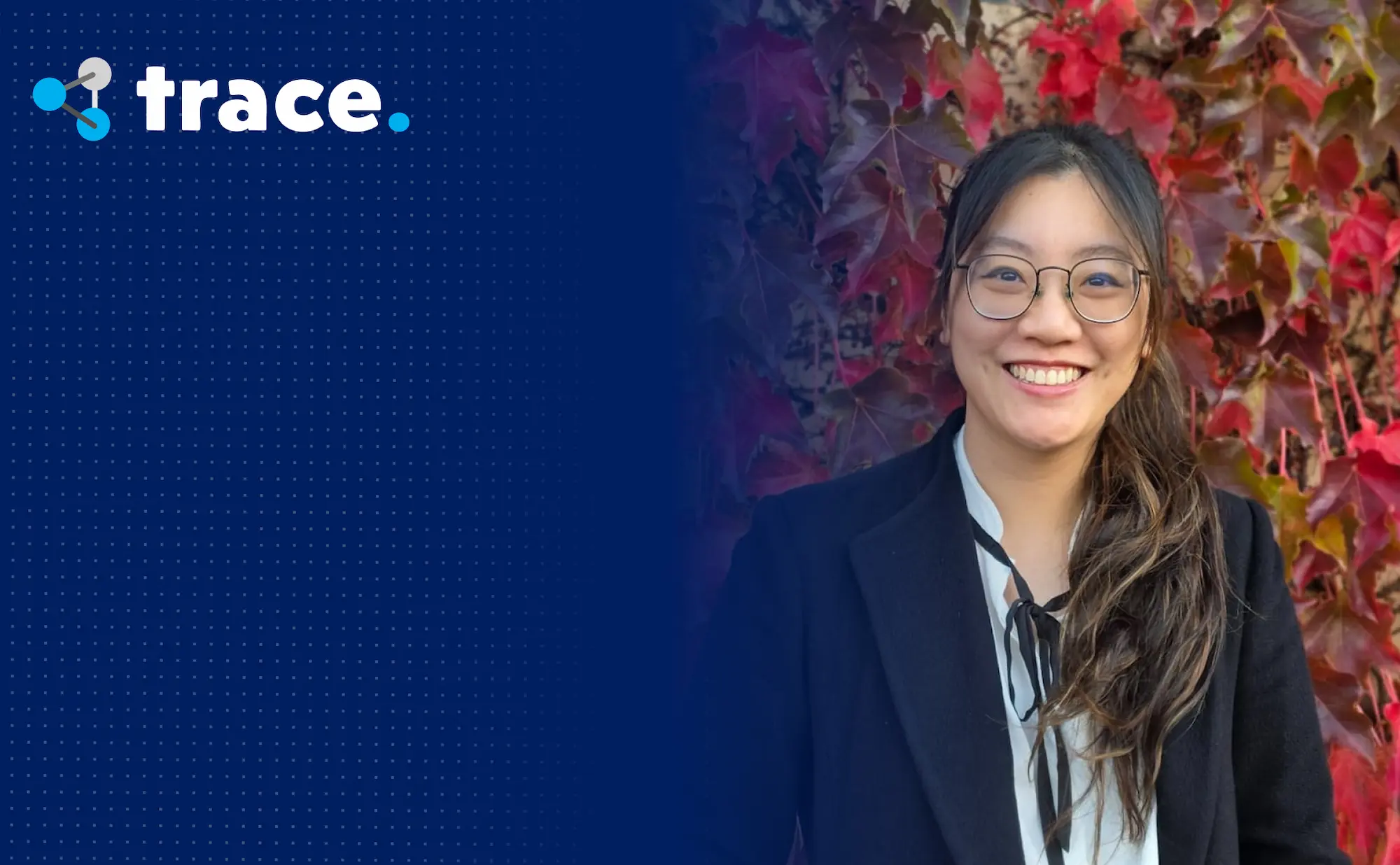

Nai Yan joined Trace as a Manager in April 2026, bringing close to a decade of consulting experience from Deloitte, where she spent several years in Operations Transformation working across defence and government clients based in Canberra. She holds a Bachelor of Laws and Bachelor of Commerce from Deakin University and a Graduate Diploma in Legal Practice from ANU.

We sat down with Nai Yan to talk about her path from law into consulting, how government departments think about value differently to commercial clients, and why she thinks resilience is the piece too many supply chains still treat as optional.
You’re qualified in law and commerce, then went into consulting rather than practising. What pulled you across, and what does legal training give you that a conventional supply chain path might not?
NY: I got into consulting by pure accident! After missing out on graduate programs for most of the major law firms, I was told about a consulting graduate opportunity in Canberra. I didn’t know what consulting was, or what I was signing up for, but I gave it a shot, and the next thing I knew, I was in Canberra working as a graduate consultant!
I think my tertiary education gave me a broad range of skills. Commerce captured the numbers and spreadsheets side of things, while law captured the language and problem solving aspects.
Where I think legal training specialises is how it trains you to build an argument. When assessing a legal case in front of you, you don’t just identify what’s applicable and relevant.You need to identify a position, and build an argument for it. You have to ask yourself “why is this the way to go?” And in building that argument, you have to be prepared for any and all counterarguments—thinking through “how can someone pick apart my rationale?”
For consulting, it means that you’re thinking through how your report or presentation can survive scrutiny from a client or a sceptical stakeholder, or how to best convince them that your recommendation is right for them.
So whilst I might not understand all the nuances of a warehouse like a traditional supply chain practitioner, my education gave me a specific way of approaching problems and making a case that I think serves me more than even I realise.
Defence and government supply chains carry a level of scrutiny most commercial work never sees. When the stakes are national capability or public money, how does that change the way you approach a problem?
NY: I think the key difference is the measure of success. For most commercial businesses, the ultimate goal is profit, either by increasing revenue or decreasing costs. In contrast, government departments, including Defence, focus on capability, or how it will serve the people. It’s not that cost isn’t a factor, it absolutely is when the money used is taxpayer money, but it’s the purpose for which they’re doing it that is the measure of success.
When it comes to money, government departments usually consider whether something is Value for Money (VfM): does it provide sufficient value for the money that is being spent? If something costs a lot of money, but will likewise bring a lot of value and benefit, then it is considered VfM and is likely to go ahead. It’s not the size of the project necessarily, it’s more about what is worth spending on.
It means that when you are faced with a problem, you’re not necessarily immediately thinking “how do I make this more cost efficient?” but more likely “what is the value that this will bring?” because you need to determine if it's VfM to determine if it will go ahead. It means that when you are considering factors and success, you’re not only looking at monetary or financial impacts, you’re looking at the broader value and benefits of the project.
You've spent time inside regulatory and compliance-heavy environments, most people treat that complexity as a hurdle. What does working within it actually teach you?
NY: Some people definitely view regulation and compliance as a burden and a barrier to progress, and yes, sometimes it does seem that way. It can definitely make things take longer or cost more to do, but that doesn’t necessarily mean it's a bad thing, especially if you’re not working in a commercial environment where the ultimate goal is profit.
Another way to view it is that regulation and compliance provide guardrails and guidelines on what is required. This way, you can create a fit-for-purpose product, because you are clear on what is needed to make it compliant.
Another perspective is that by putting in the effort at the start to ensure things are compliant or meet regulation, you’re saving yourself the headache later if it isn’t.You’re avoiding the time, effort, and cost of any consequences of non-compliance, potential rework or even replacement.
If you can change the perspective that regulation and compliance is there to make your life hard, and instead utilise it to help you, it can be something to leverage and propel you and your project forward.
Resilience and efficiency often pull in opposite directions, a lean operation is cheaper but more fragile. How do you help a client decide where that line sits for them?
NY: It generally comes down to what the client wants and needs—and what they want and what they need can be different.
Sometimes they want the nice shiny resilience option, but given their strategic priorities, financial budget or timeline pressures, they might have to opt for a leaner operation as that is what they can reasonably implement to meet the need. Of course the opposite can also be true. A less expensive option might be attractive, but the scenario might mean that a more resilient option is more feasible given the operational or system requirements.
These are just examples, and as with any decision making, I believe that clients need the information to make an informed choice. If they can clearly see the benefits, but also the costs—both financial and non-financial—as well as the timelines, alignment to strategy and so on, generally one of the options will emerge as more appropriate, at least at the moment.
By presenting clients with the information, it enables them to make an informed decision that is appropriate for them, at the time, in the scenario. There is no one-size fits all solution, after all.
You spent years at a large firm before moving to a boutique like Trace. What does a boutique let you do for a client that a big firm structure makes harder?
NY: I think both large firms and boutique firms have their pros and cons, and a lot of the time it comes down to what you want at your stage of your career.
For me, in the short time I’ve been at Trace, I’ve loved being on the ground and interacting with clients more—because we’re not a big name, because we're a smaller team, every Trace consultant has to be a part of the meeting, part of the conversation. It means that I can build deeper relationships with clients and understand them better.
It also makes the work feel more meaningful, because I’ve heard directly from the client what isn’t working, or what they hope to improve. It makes every bit of the report writing, data analysis and slide design that little bit more personable, because I can hear the client in my head telling me why the work is important to them.
What's shifting in how supply chains need to be run that you don't think enough organisations have caught up to yet?
NY: I think the work Emma Woodberry is doing in building sustainability and resilience is an emerging, but critical, piece of the puzzle that supply chains don’t emphasise enough yet.
Most supply chains focus on the cost, and time, elements and where they are getting value, but making sure it is sustainable and resilient is a secondary priority: something to consider when times are good, but the impacts of not considering this are greatest when times are bad.
A good example is COVID. Prior to the pandemic, so many supply chains had focused on being a global supply chain, mostly for cost effectiveness, that when global trade faltered with lockdowns, many companies were suddenly without key products or parts that they had always relied on. They struggled because they had not built the ability to withstand the change and shock to their supply chains and had no idea how to continue to meet demand with the interruption to their supply.
If sustainability and resilience are considered for supply chains from the get go, or at least reinforced regularly, then the ability for organisations to withstand disruption and change is amplified, and supply chains everywhere will be more adaptable and viable in the long term.